
View image in fullscreen In a Sydney gallery, Philippe Parreno’s art is powered by a desert 17,000km away Philippe Parreno, inside his new exhibition 5 Moons at the Museum of Contemporary Art, Sydney. Photograph: Rémi Chauvin/The Guardian In the Museum of Contemporary Art, the French artist’s first major Australian show is truly unpredictable – influenced by real-time data coming from a Spanish farm
Prefer the Guardian on Google Philippe Parreno, inside his new exhibition 5 Moons at the Museum of Contemporary Art, Sydney. Photograph: Rémi Chauvin/The Guardian I ’m standing in a massive white-cube space, staring at a perplexing assortment of objects. There are several expensive looking lamps; a massive industrial fan; a couple of speakers; marquee-style lights; a glowing assemblage of power adapters. At the back of the gallery, a silvery light slides up and down a pole. The bulbs are flickering erratically, and there’s a low hum of machine noise, overlaid with bird song and distant barking.
As an installation, taken by itself, it’s deceptively underwhelming – a spectacle without a story.
View image in fullscreen ‘Deceptively underwhelming’ … entering Philippe Parreno’s exhibition 5 Moons at the Museum of Contemporary Art, Sydney. Photograph: Rémi Chauvin/The Guardian This will be visitors’ first encounter with the Museum of Contemporary Art’s summer blockbuster exhibition, Philippe Parreno: 5 Moons, named for the five lunar cycles of the show’s duration. It’s the first major Australian exhibition by the acclaimed French contemporary artist, renowned for taking over museums and galleries – including Tate Modern’s Turbine Hall and the Palais de Tokyo in Paris – with discombobulating and delightful kinetic arrangements of objects, screen works, sound and lighting.
Parreno’s medium of choice is the exhibition itself; he creates holistic, unpredictable environments for the visitor to navigate.
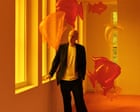
View image in fullscreen Installation photographs of Philippe Parreno’s new exhibition 5 Moons at the Museum of Contemporary Art in Sydney. Photograph: Rémi Chauvin/The Guardian At the MCA, Parreno has created a series of connected environments across the museum’s three levels, featuring works made over his four-decade career.
Upstairs, there’s an orange-carpeted gallery populated by floating, helium-filled, fish-shaped balloons in citrus tones, in which a grand piano plays an enigmatic score. On another floor, a giant luminescent cuttlefish gazes out impassively from a screen, its fins and arms gently undulating, as ambient electronic noise emanates from large swiveling speaker banks.
These spaces feel like haunted houses; machines operated by ghosts or powered by supernatural energy.
View image in fullscreen Inside Parreno’s MCA show 5 Moons. Photograph: Rémi Chauvin/The Guardian In fact, they’re powered by nature: real-time data – including wind speed, humidity and temperature – captured on sensors on an abandoned almond farm in the Tabernas desert in south-eastern Spain, a region best known internationally as the backdrop to spaghetti westerns such as The Good, the Bad and the Ugly and Once Upon a Time in the West.
Data from the farm has been reconfigured into an algorithm that influences the sound, air flow and lighting 17,000km away in Sydney . The land is improvising a score, and the museum is playing it.
View image in fullscreen An 11-hour film of footage of Parreno’s almond farm in Spain. Photograph: Rémi Chauvin/The Guardian In a dar…