
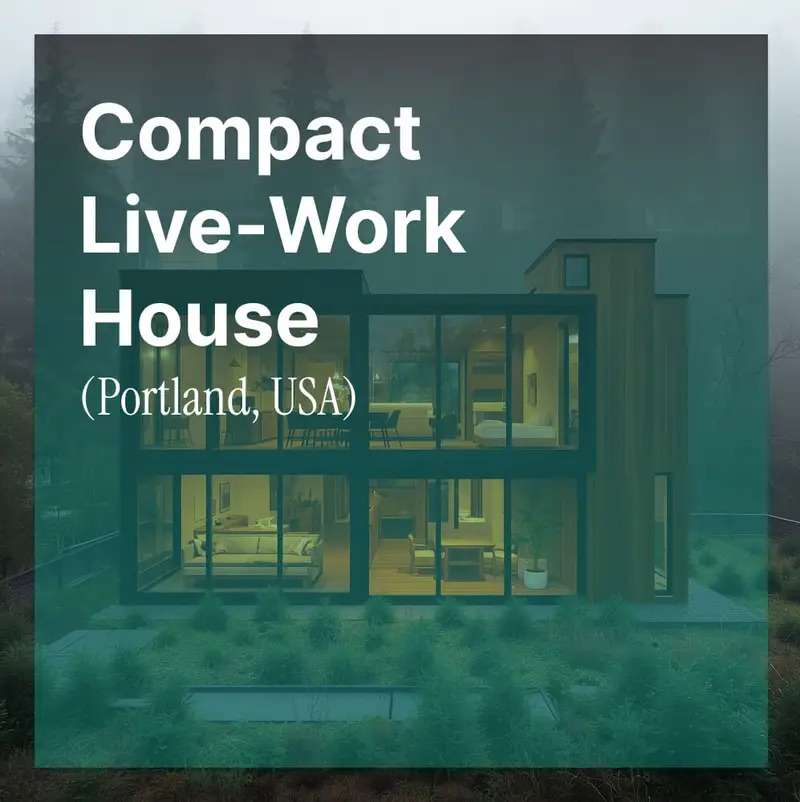
June 16, 2026 June 16, 2026 Home » competitions » Compact Live-Work House — Portland Architecture Competition, USA 2026 Overview of the competition The Compact Live-Work House competition is organized by Archi Briefer, an architectural competition and membership platform launched in early 2026. The competition invites architects, designers, and students worldwide to design a small housing unit that integrates living and working within a single roof on a virtual urban or suburban plot in Portland, Oregon. The competition started on June 1, 2026, with final submissions due by August 25, 2026, and results announced on September 10, 2026. The construction budget is $150,000.
The brief responds to the growing normalization of remote work, freelancing, and home-based businesses in contemporary urban life, taking Portland's creative culture and its sustainability and neighborhood-scale urban initiatives as a contextual framework for a new type of integrated living work housing.
As remote work, freelancing, and home businesses become more prevalent, the boundaries between residential and professional space continue to evolve. The competition explores how architecture can support this shift through thoughtfully designed, flexible, and efficient spatial design within an integrated footprint. The aim is to design a compact house that facilitates both residential and professional activities together, with a nuanced balance between privacy, focus, relaxation, and social interaction while maximizing usability and spatial efficiency.
Site A virtual urban or suburban plot within Portland, Oregon. Participants can choose an appropriate context to support their design concept. Site analysis must consider climate, seasonal changes, sun orientation, neighborhood character, accessibility and mobility, and sustainability opportunities.
Designs must address integrated living and working functions, an integrated floor plan, flexible and adaptable interior spaces, a focus on natural light and ventilation, sustainable design, passive design strategies, and a practical and executable construction approach within a budget of $150,000. A brief cost breakdown covering materials, construction, utilities, and maintenance is encouraged.
Open internationally to professionals and students. No restrictions on nationality or professional stage. Individual and group entries are accepted. Submissions consist of one A1 board (PDF, minimum 150 DPI, maximum size 20 MB) illustrating the concept, design strategy, floor plans, spatial organization, and user experience. Submissions are made via archibriefer.com/submit. A STUDENT code for students reduces fees by up to 33% with a valid student ID.
The names of the jury members and the composition of the evaluation body are not publicly listed on the competition page.
A valid student ID is required for student rates. An alternative membership option: $16.66 per month grants access to 12 competitions annually, AI tools, and publication and certification opportunities.
The Compact Live-Work House competition is the second from the Archi Briefer platform reviewed by ArchUp after the Coastal Shelter competition. The platform shares the same structural profile across both competitions: a modern platform launched in early 2026, low entry fees ($29 early), a single A1 submission format, no cash prizes, no publicly named jury, and no documented winner archive from previous cycles. The brief for this competition is of substantive relevance: the integrated living and working house type poses a genuine contemporary design challenge, and Portland's specific urban character and sustainability culture along with its neighborhood scale provide a worthy contextual backdrop for substantive design implications. The seven criteria are clearly expressed and cover the key aspects of integrated residential design in terms of spatial efficiency, living-working integration, environmental responsiveness, and buildability. The budget constraint of $150,000 is specific and compels realistic design thinking. The early registration fee of $29 (with $19 for students) is among the lowest in any active architecture competition today, making this competition exceptionally accessible to students and practitioners at the start of their careers. The lack of cash prizes and undisclosed jury composition, alongside the platform's novelty without a verifiable track record, remain the same constraints noted in the Coastal Shelter review. The early deadline of June 30, 2026, has passed, making the current fees $49 regular or $39 for students until July 20, 2026.
Presented...