
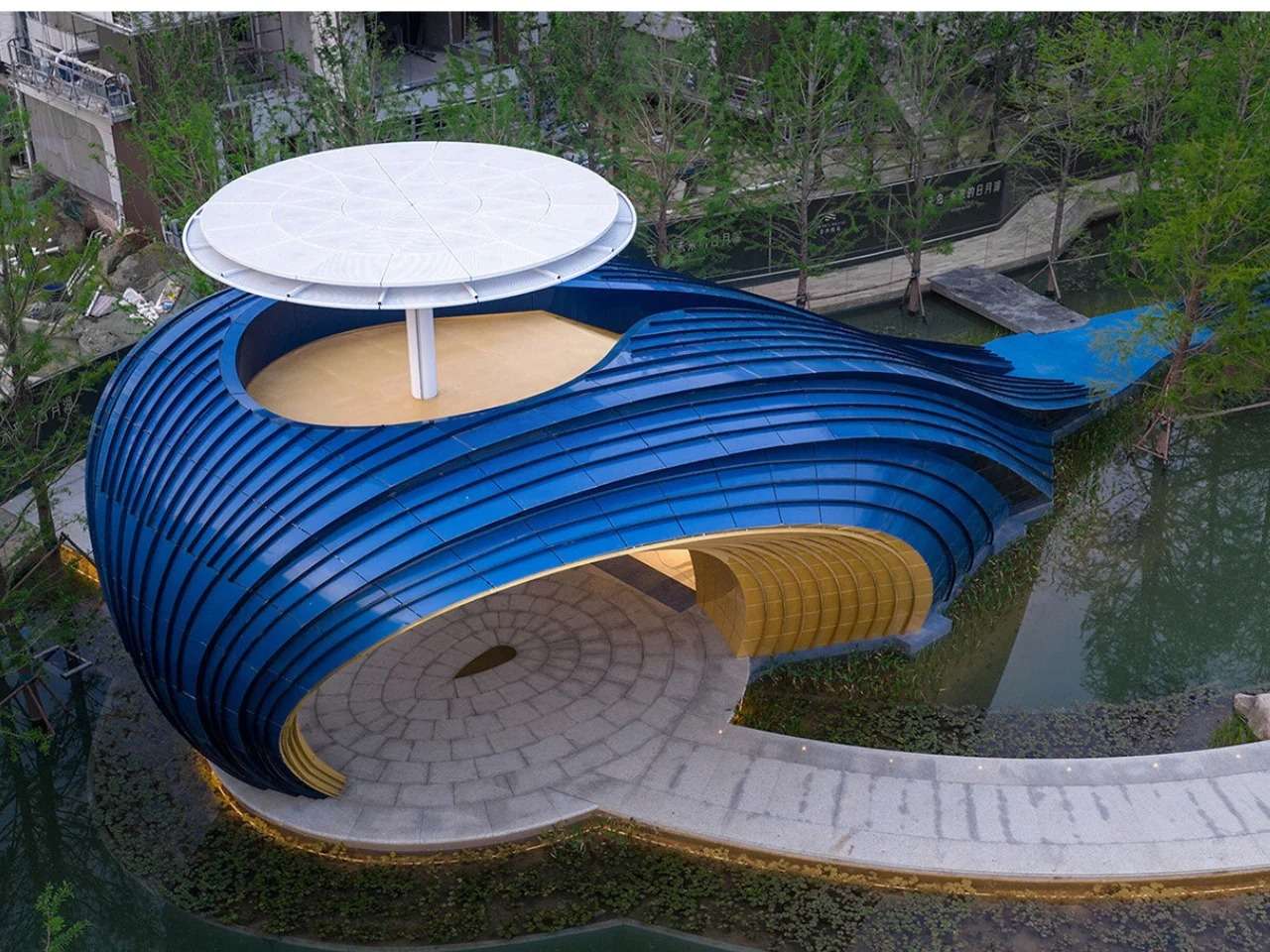
June 16, 2026 June 16, 2026 Home » Projects » Whale Gate redefines the residential gateway within an urban archipelago. The mass form and the shock of spatial crossing move the structural form of the project's entrance outside the traditional frameworks of residential structures. The design replaces familiar horizontal elements with a boldly woven mass shaped like a cobalt blue whale in a dynamic leaping state. This sculptural formation does not merely act as a visual barrier, but redefines the concept of a "gateway" by creating a deliberate spatial shock that breaks the monotony of the external environment. The deconstruction of this mass reveals a desire to transform the daily crossing from a mechanical act into an intense scenographic visual experience, relying on the element of surprise and the massive scale to generate an immediate feeling of complete separation from the city and entry into an environment derived from the idea of the archipelago and floating islands.
The kinetic path of the user upon entry transforms into a scenographic journey that touches on the psychological and physical side; the residential buildings are structurally distributed to appear as if they float above green spaces and water surfaces that mimic the movement of the specific sea. The shadows provided by the massive sculptural mass intersect with movement paths and the changing sun path, granting the space a fluctuating vitality throughout the day, fulfilling the design's desire to isolate the resident from the external noise. The language of the design here does not suffice with visual description but pushes the user of the space to experience the moment of entry and crossing as a transitional threshold separating two realities, where materials and surface textures integrate with air movement to perceive the space as a carefully isolated independent world.
The design idea is embodied in freezing a fleeting kinetic moment and a volumetric penetration of a virtual surface, where dynamism transforms into a solid structural entity covered with double-curved aluminum panels. This complex geometric formation, based on panel contrast and non-conformity, gives the exterior surface a living undulation that interacts with natural light and the sun's path, enhancing the visual suggestion of continuous movement. The critical reading of the mass relies on deconstructing this cobalt blue exterior shell and how the perforated panels on top are employed to generate physical contrast that mimics the scattering of light and water spray, moving the facade from merely a solid membrane to an interactive scenographic element with the surrounding environment.
The human crossing experience within the structure is grounded in a sharp spatial paradox that divides the visual journey into two distinct chapters; it starts from the blue surrounding mass outside and ends at the penetration of the vertical opening representing the point of entry. This kinetic transition through the golden vertical opening acts as an internal threshold separating the materials, generating an immediate psychological and physical effect that transports the user from the public urban space to the private residential space. Here, the design abandons intermediate solutions and ambiguity, imposing a decisive visual language that precisely determines the course of movement and sighting points, making the experience of entry and crossing a conscious and impactful act that reshapes the relationship between humans, architectural scale, and surrounding materials.
The critical reading of this structure transcends the superficial idea of visual strangeness to reveal a strict volumetric commitment that rejects intermediate solutions or floating vital abstraction; design adopts symbolism as a standalone architectural function. Here, the building is deconstructed as a tool to reinforce the concept of "returning home", where the sculptural mass becomes a material acknowledgment of the spatial and psychological rift between the city and the residential field. This architectural stance reshapes the concept of the “architectural landmark” in residential environments, moving it from the idea of bulk and abstract size to a space of clear design conviction that employs form to serve the direct human experience at the moment of crossing.
Behind the external scenographic appearance lies an extraordinary tectonic complexity (linking building and art), where the structure rests on a precise structural system consisting of six layers that include nearly 4000 separate elements made of custom-manufactured steel and aluminum. This structural system has been developed to accurately withstand the twists and curves of the dynamic shape, making the massive structural weight appear in a state of buoyancy and temporary stability that mimics the mid...