
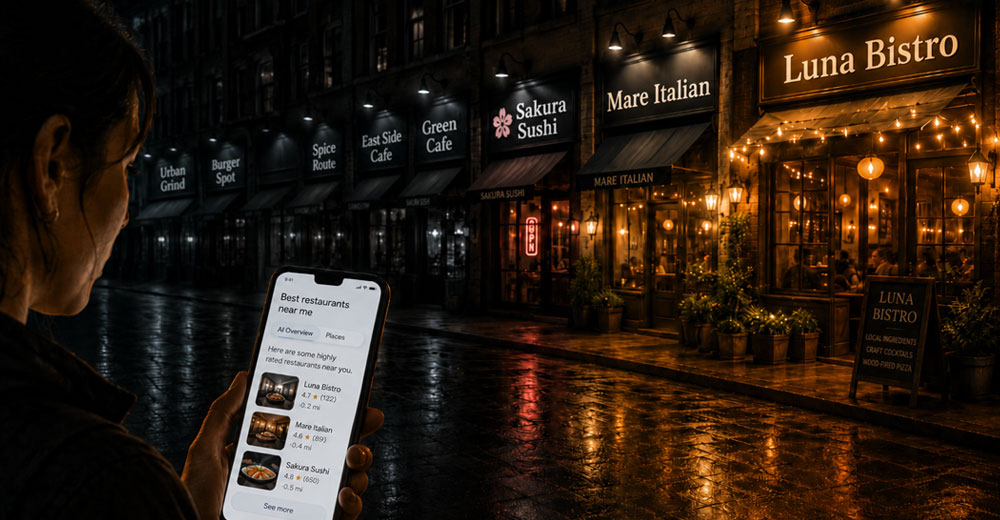
Looking for a nearby eatery to silence your growling stomach? Where you go could vary widely, depending on your search choices.
New research from SEO and AI search platform Local Falcon found a significant gap between searches conducted with AI search and Google Maps for restaurants.
The study examined 10,000 restaurants across all 50 states and Washington, D.C., to test whether they appeared in Google Maps results and in AI-generated restaurant recommendations.
The company found that nearly three in four restaurants (74.9%) were invisible in Google's AI recommendations, never surfacing at a single nearby search when a diner asked the AI where to eat.
"For a restaurant, that means getting shut out of AI Overviews completely, right as those overviews have become the way most people search because Google has promoted AI Overviews to the very top of the page," observed Local Falcon CEO David Hunter.
"A restaurant is almost four times more likely to be invisible on Google's AI surface than on Google Maps," he told TechNewsWorld.
Meanwhile, for consumers, it means a much shorter menu of options, he added. "The top 10% of restaurants take 74.5% of all AI visibility, against 54% on Google Maps, so you're picking from a short, often repetitive list while most of the places near you never come up," he said.
Josh Stanaland, partner and CTO of Shark AI Solutions , a product development, AI, and client account management company in St. Petersburg, Fla., maintained that the core problem is that Google AI Overviews and other AI search tools do not work the way traditional search does. "Traditional search rewards review volume and backlinks," he told TechNewsWorld. "AI search rewards structured, machine-readable content."
"Most restaurants have invested years into getting Google reviews and building their Maps presence," he explained. "None of that translates directly into AI visibility, because AI systems are looking for something different."
"They're looking for citable content, schema markup, and structured data that tells them what the business is, where it is, and who it serves," he continued. "Most restaurant websites have none of that. So the AI ignores them, regardless of how many reviews they have."
An important caveat to the new research is that there are other opportunities for discovery on the Google search results page, including the "map pack," typically below AI Overviews, and organic listings, added Greg Sterling, co-founder of Near Media , a market research firm in San Francisco.
He acknowledged, though, that AI search can be a problem for consumers. "AI recommendations feel authoritative," he told TechNewsWorld. "When someone asks ChatGPT or Google AI where to eat nearby and gets three suggestions, they assume those are the best options. In reality, they are the three options that happened to have the right technical infrastructure. The best restaurant in the area may not be showing up at all."
"Being easy to find on Google and being recommended by AI have become two different games," noted Raúl Menoyo, founder of Citora , an AI visibility company in Madrid.
"A restaurant can own the Google Maps pack and still disappear the second a diner asks an AI 'where should I eat near me,' because the AI isn't ranking the map — it's writing an answer from the sources it trusts," he told TechNewsWorld.
The 74.9% invisibility figure isn't surprising, declared Chris McCarron, founder of GoGoChimp , an AI conversion-rate-optimization…