
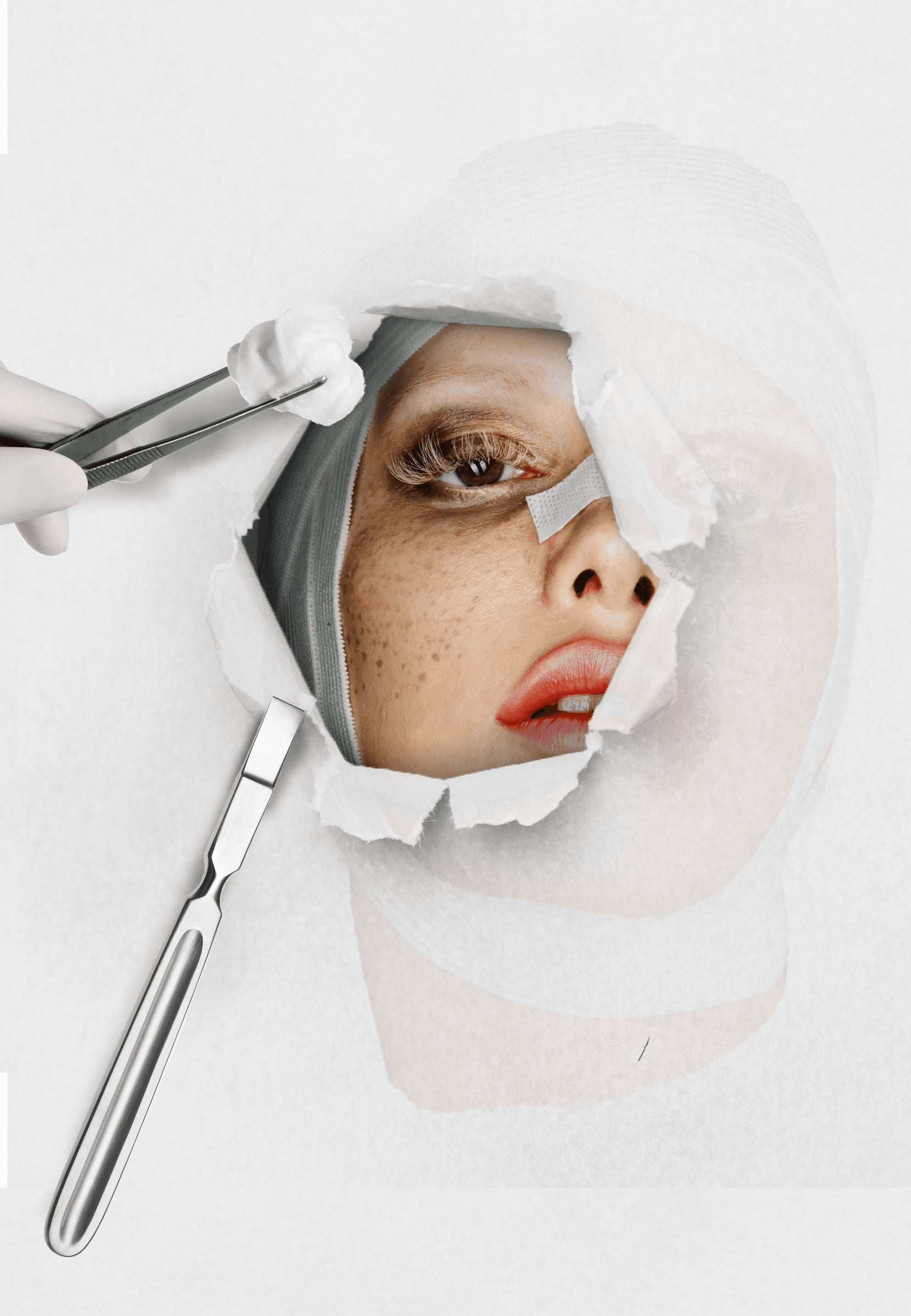
Illustration by Briana Rengifo; Source images: Getty Images Save Story Save this story Save Story Save this story Over the last few years, four friends have asked me to escort them home after a surgical procedure. My designated-adult resume includes two colonoscopies, one blepharoplasty , and one IVF egg retrieval . I take pride in this role. It must mean I’m a responsible, dependable person. Or that I have too much free time.
Regardless, it’s always been a simple favor, typically just requiring me to pick up the friend at the doctor’s office, order an Uber, and make sure they get into their apartment safely. Thanks to Capsule’s delivery service in my hometown of New York City, I’m not even on the hook to do a pharmacy run.
But recently, I volunteered to help one of my closest friends, Robin, recover from a deep-plane face and neck lift , which meant being by her side for an entire week. It also meant flying down to Palm Beach, Florida from New York City (on her dime) since that’s where her chosen physician, facial plastic surgeon Mark R. Murphy, MD , practices.
My nerves are pretty steely, but I was anxious about seeing Robin in the immediate aftermath of this major surgery. Would it be gross? Disturbing? Would she be in agony? I remember the Italian mother of a high school classmate of mine referring to the “sympathy pains” she could feel when one of her kids was sick or hurt. She wasn’t being melodramatic. According to an article in Nature Reviews Psychology , seeing others in pain often recruits the same brain systems as feeling pain ourselves, and can be distressing, especially for highly empathetic people.
Lucky for Robin, my allegiance to her as a friend and my curiosity trumped my fear—and my empathy. I wanted to be there for her, of course, but I also wondered how witnessing her recovery at such close range would impact my own temptation (one way or the other) to eventually go under the knife. On that front, I’ve long been in the “maybe someday” camp—I’m just not there yet. And at 55, I’m eight years older than Robin.
In the days leading up to the surgery, I burrowed into an Instagram rabbit hole of facelift journeys . There are plenty to choose from, but like all things on social media, I couldn’t be sure how much of what I was watching was real. Once the algorithm kicked in, I was served an infinite scroll of videos from women who’d had facelifts all over the world, from Beverly Hills to Istanbul.
I also joined an Instagram Broadcast Channel called The Aesthetic Authority created by actor-DJ-trainer Emily Wagner , who’d had a lineup of procedures—it’s never just a facelift, I discovered—similar to the one Robin had planned. She was chronicling every step of her recovery and what I saw wigged me out a little—specifically, the facial swelling. I wasn’t alone. Emily, who approached the healing process like she was hosting a comedy roast of her own face, told me one of her friends temporarily muted her on social media to avoid seeing the no-holds-barred reveal unfurl.
Nevertheless, I remained committed to my caretaking duties and was shocked by how many surprises were still in store after all of my research. Here are the 10 no one tells you (or certainly didn’t tell me).
Facelift price tags range wildly. Steven Levine, MD , the New York City surgeon who performed perhaps the most famous facelift in history last year (yes, Kris Jenner ’s) is now reportedly commanding $400,000. That number also happens to be the median cost…