
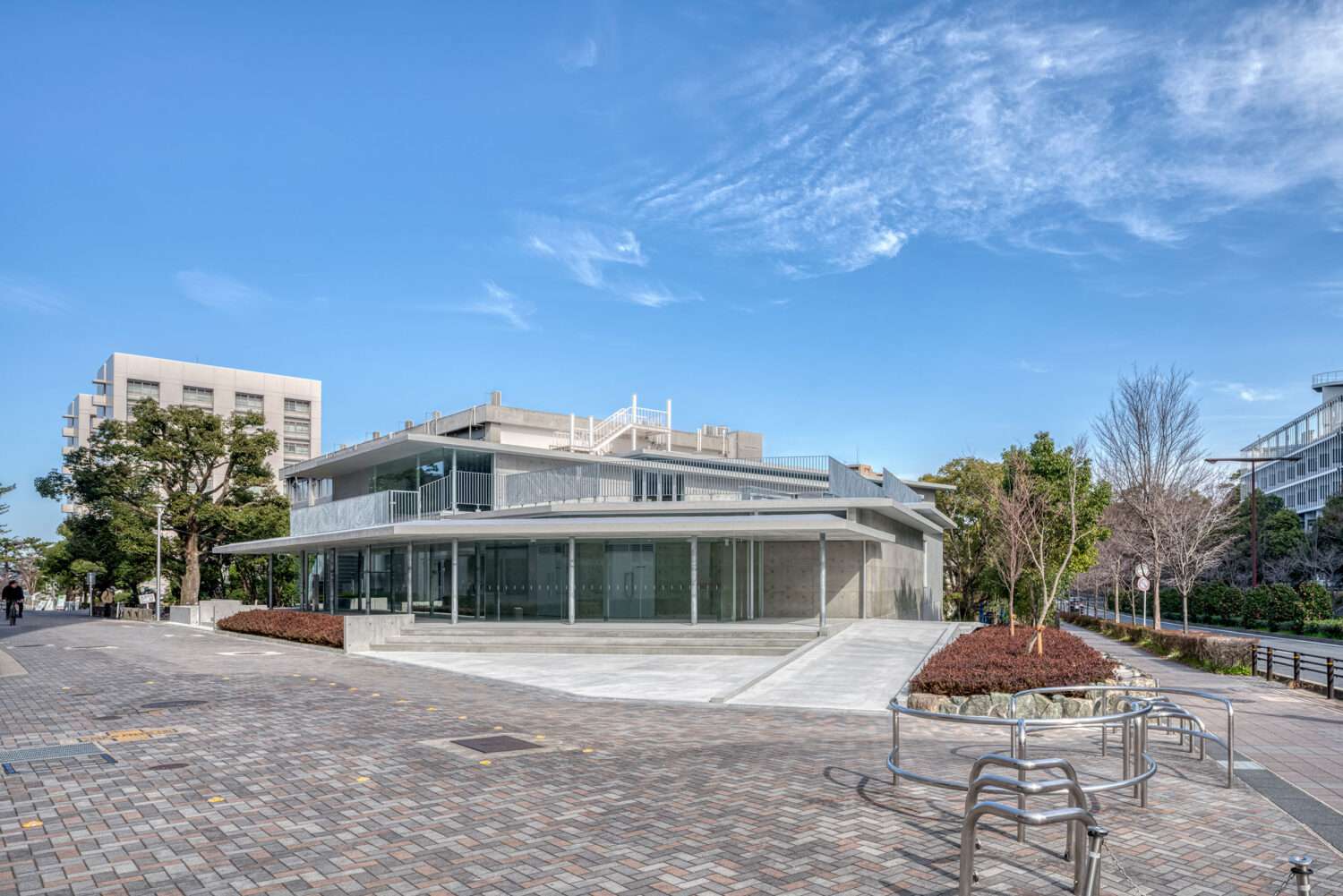
On June 17, 2026, the Mechanical Engineering Building at Nagoya University reorganizes a vital intersection for movement on campus through a low-rise structural intervention. The project transforms a technical research facility into a topographical bridge connecting two major pathways of the university by integrating a public rooftop garden and a transparent envelope. The plan prioritizes urban porosity, functioning as both a university square and a pedestrian corridor.
The site occupies a strategic point at the intersection of Yamati Green Road and Nobel Road, overlooking the entrance to the subway station. The team chose a compact mass design that includes a single basement and two above-ground floors, despite local zoning and master plans for the surrounding high-rise buildings suggesting a taller structure. This decision takes advantage of current changes in the site’s elevation between the north and south, maintaining a low height that protects sightlines within the campus.
The southern façade faces Nobel Road with a large canopy and glass facade, creating a new entrance to the engineering area. This transparency allows visual continuity between the urban streetscape and internal research activities. The design internally provides a direct path for pedestrians through the building, connecting users to the newly constructed Engineering and Innovation Building on the west side.
The team utilized the natural slope of the land to organize specialized programmatic requirements for the university. The lecture hall features tiered seating that follows the natural slope, a strategy that reduced excavation work and improved the acoustic environment. Laboratory spaces are situated at a lower elevation to facilitate the entry of heavy machinery while allowing students on the upper floors to observe experimental work from above.
The site's trapezoidal geometry directly influences the planning of essential gathering spaces. The project creates a central sightline toward the stage by aligning the lecture hall with the site boundaries. High lateral windows puncture the fragmented roof of the building, capturing natural light for the deep floor plates below while breaking up the large mass of the floor slabs.
“I hope this building serves as a link between the two streets and becomes a multilevel square for interaction.”
The rooftop garden acts as a key social catalyst in the architecture. External stairs directly connect street level to this elevated terrace, reducing the perceived vertical distance between the public realm and the internal academic environment. The tiered sections of the roof function as platforms for university events, effectively transforming the building envelope into usable social infrastructure.
The project demonstrates an advanced understanding of campus porosity by rejecting the conventional isolated laboratory typology. The intervention acts as a topographical node, linking diverse levels together through a series of available roof surfaces and internal passageways. The design maintains a ground level for movement and social exchange by embedding heavy industrial functions and the tiered lecture hall within the slope. The material contrast between the solid base resembling stone construction and the lightweight glass upper mass enhances this hierarchy between technical stability and public transparency. This dual strategy ensures the building functions as a vibrant node within the university pedestrian network, while accommodating the rigorous technical requirements of the Mechanical Engineering Facility.
Project Team: Kazuki Moroi Office, Akinori Yoshimura, Katsutoshi Sasaki, Tobata Architectural Office, and Facilities Planning Department at Nagoya University. Location: Furou-cho, Chikusa-ku, Nagoya City, Aichi Prefecture, Japan.
Project Notes: The team completed construction in March 2020 after a design period that spanned from 2017 to 2018. The National Tokai University organization served as the client, while Matsui Construction Company carried out the general contracting, and Terado Tatsumi Workshop provided the structural design.