
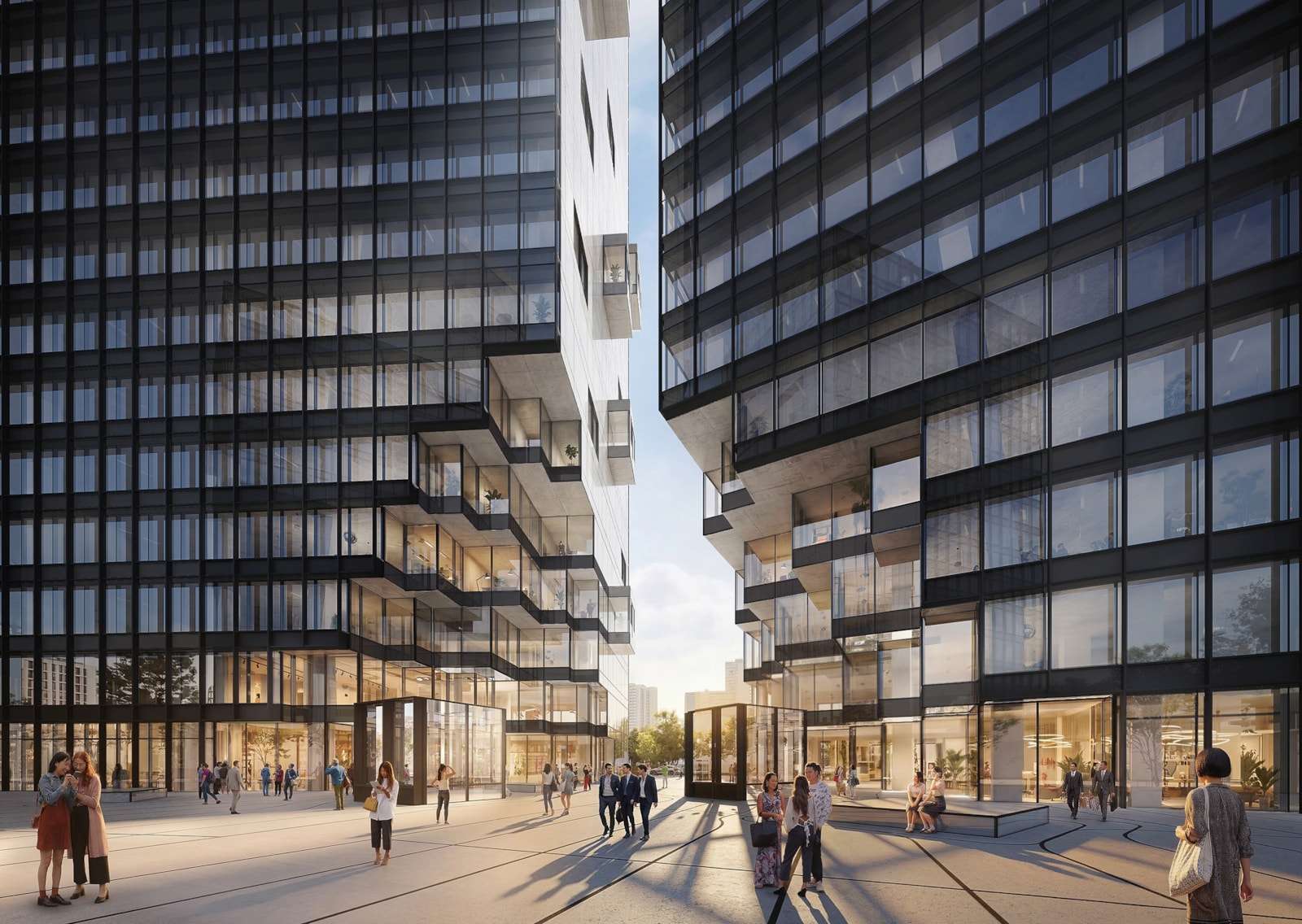
On June 17, 2026, a new office project in the Nangang district of Taipei redefines the eastern entrance of the city through a strategic mass intervention that prioritizes public movement. The project replaces the traditional monolithic mass with two integrated towers that frame a major urban axis and respond to the site at a key transport interchange. This formal separation establishes a clear pedestrian threshold between the regional rail network and the surrounding area.
The project is located directly in front of the Kunyang Station, occupying a site where regional and high-speed rail lines converge. The design team recognized that the building's standard footprint would hinder the heavy pedestrian traffic generated by the transport hub. Therefore, the plan splits the required mass into two distinct elements, angling the towers to create a public square and spacious reception areas that facilitate natural movement towards the city.
The intervention interprets the building mass as a single vertical slice subjected to a physical separation. This conceptual division produces an internally prominent textured facade, where balconies project as "fragments" from one of the towers, leaving opposing recessed cavities in the other mass. This spatial dialogue underscores the gap between the structures, transforming the void into a functional urban corridor rather than just a narrow alley.
The design enhances the separation movement through a contrasting materials strategy for the building envelope. A glass curtain wall with protruding fins delineates the outer skin of the towers, providing a refined texture to the urban street scene. In contrast, the internal facades feature a more subtle and uniform cladding that draws attention to the "break" in the mass. The team extends the facade grid lines to the plaza paving, using a rippled floor grid to visually connect the two structures.
At the base, the project addresses seismic flexibility through a specific structural solution. Slanted columns along the inner edges support cave-like protrusions at the entrances of reception halls, enabling column-free interior spaces while meeting Taiwan's stringent engineering requirements. These cut-out angles expand usable public space on the ground floor, providing shaded areas for visitors of retail outlets and cafes.
"By splitting the required building mass, we create a gateway that directly responds to the urban flows around the station. It is a craftsmanly act of opening; the towers move away from each other to frame the neighborhood and invite the city's movement to flow through the building instead of inhibiting it."
The internal program prioritizes community and tenant interaction through a gradated amenities strategy. The ground floor features high-capacity reception halls and commercial retail spaces, while the third level includes shared services such as video conference suites and lounges. Throughout the site, the team positioned small elements resembling wings that function as seating or kiosks, designed to resemble tectonic shards falling from the main building masses.
To address environmental performance, the project incorporates several sustainability features into its infrastructure. Rainwater harvesting systems support irrigation for the rooftop garden and ground-level plantings. Detention tanks within the gravel foundations and at the roof level mitigate urban flood risks during heavy rainfall. Moreover, photovoltaic panels on the roof edges generate energy for the building's public movement areas.
The project achieves an advanced reading of urban movement by treating the void as a primary programmatic element. Rather than resisting the site's density, the design employs a tectonic "pull" that reorganizes the hierarchy of local movement. The transition from the austere outer curtain wall to the intimate and fragmented internal facades provides a sensory cue for pedestrians entering the station's vicinity. This spatial sequence—from the expansive urban grid to the compressed "valley" between the towers to Hsien Hsien Park—demonstrates a profound understanding of how architectural masses direct civic energy. The structural solution of the slanted columns reinforces this logic, providing the necessary seismic stability without compromising the transparency of the public threshold.