
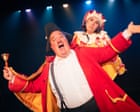
Political intent … James Peake and Morven Blackadder in Cry/Laugh. Photograph: Tommy Ga-Ken Wan View image in fullscreen Political intent … James Peake and Morven Blackadder in Cry/Laugh. Photograph: Tommy Ga-Ken Wan Theatre Review Cry/Laugh review – did you hear the one about the town crier and the jester? Òran Mór, Glasgow Nay Dhanak’s clownish tale follows an odd couple struggling to live up to their roles passing news from royal power to the public
Mark Fisher Thu 18 Jun 2026 07.00 CEST Share Prefer the Guardian on Google W e are in a medieval world of portentous comets, fiery dragons and punitive taxes. For the average peasant, it is tough going, but even in this hierarchical society, two of them have uncommon access to power. One is the town crier, the mediator of news between monarch and serf. The other is the jester, employed by the court to tell it like it is. If anyone can quell a peasants’ revolt, it is these two.
Playwright Nay Dhanak is fascinated by this imbalance of power, reflected, they suggest, in today’s mismatch between tech overlords and everyone else. Cry/Laugh, their professional debut, is a speculation about two such privileged outsiders losing their jobs. Can no news really be good news?
View image in fullscreen Light-footed … Morven Blackadder in Cry/Laugh. Photograph: Tommy Ga-Ken Wan On the one hand, a bloviating James Peake plays a town crier disheartened to be the bearer of so much bad news. He might believe he is important, but the king thinks nothing of sacking him. On the other, a light-footed Morven Blackadder plays a jester redeployed on an impossible mission to find a second sun to outshine an eclipse. She does it in good spirits, but she no longer has the king’s ear.
In this lunchtime production for A Play, a Pie and a Pint, directed by Ben Standish and the Guardian’s Brian Logan, the actors work hard – often too hard – to draw out the play’s clownish joviality, as they go on a fairytale quest to find new roles.
Dhanak has something to say about power and accountability, but exactly what it is gets squeezed out by the writer’s greater interest in narrative structure and a self-referential commentary about the mechanics of a joke. For all the actors’ efforts, Cry/Laugh is neither funny enough to carry the meandering story and its absurdist twists, nor focused enough to articulate its political intent.