
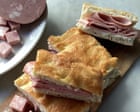
Rachel Roddy’s focaccia sandwiches with mortadella and parmesan cream. Photograph: Rachel Roddy/The Guardian. View image in fullscreen Rachel Roddy’s focaccia sandwiches with mortadella and parmesan cream. Photograph: Rachel Roddy/The Guardian. A kitchen in Rome Food Rachel Roddy’s recipe for focaccia sandwiches with mortadella and parmesan cream A family favourite transforms TV dinners into a summery event
Rachel Roddy Thu 18 Jun 2026 07.00 CEST Share Prefer the Guardian on Google I t’s the time of year when the TV, balanced on the Ikea unit with castors, its feet supported by wooden splints, is wheeled between the kitchen doors so it faces out on to the terrace (flat roof). In the absence of a barbecue or outside shower, the TV is our seasonal shift; an inside object moved outside and, in the process, made (slightly) more exciting. As a result, TV dinners are also altered, as well as given another layer of soundtrack – birds shouting, people chatting in the bar below, the held-down horn of the articulated lorry that can’t reach the supermarket because a car is double parked – to the one coming out of the TV speakers. We also have a table outside, but that changes the nature of a TV dinner too much: the table is moved aside for wooden chairs, tea towels and plates on laps, with focaccia sandwiches with mortadella and parmesan cream for the meat eaters, and parmesan cream, tomato and a handful of green leaves for those who don’t.
Mortadella is considered an insaccati parzialmente cotti , or partly cooked sausage. Its origin is debated, with some suggesting it derives from the object it was pounded in, il mortaio (the mortar); others say the name can be linked back, as is so often the case, to the Romans, and a sausage flavoured with myrtle berries called farcimen murtatum . The dates around when it was first made are also debated, because of a mention of something called mortadella in 12th-century cookbooks, though that was likely made of veal or donkey. The 1600s are a better place to start, when a nobleman and agronomist called Vincenzo Tanara described meat: two-thirds lean from the pork shoulder and leg, cut into large cubes, then transformed through “sharp pounding”, stuffed and cooked at a moderate temperature. Alongside instructions for production, there were strict edicts regulating the labour-intensive processes involved in making luxury products for those who could afford them.
This would change with industrialisation in the 1900s and beyond; machines and the means of processing changed production, demand, expectations and exportation, which saw changes in the quality of the meat and other ingredients, not least the additives required for it to travel and stay Peppa Pig pink. In fact, those permitted additives are tripe, flour, rinds, emulsified ice, egg white, sugar, dried milk, polyphosphates or synthetic flavourings, all of which are noted on the packaging. There are, of course, plenty of producers who have other ideas.
Artigianquality , for example, which is a small producer in the centre of Bologna, uses high-quality cuts of pork from 100% Italian pigs, predominantly from the Bologna region and raised in semi-wild conditions. Half the mix is shoulder, a quarter minced ham and trimmings, and both are pounded to a paste, before neck fat (known as lardelli ) is mixed in. Next comes the seasoning: mace, cardamom, nutmeg, black and white pepper, garlic and whole sea salt flakes. This mixture is then extruded into casings a…