
Share Save Add as preferred on Google Priti Gupta Technology Reporter, Mumbai AFP via Getty Images Global warming has caused Himalayan glaciers to retreat At an altitude of almost 4,000m (13,000ft) and receiving almost no rainfall, the Himalayan village of Sakti is a hostile place to be a farmer.
"Ladakh has a brutal, single-cultivation season," says Gelak Gutme, who has been growing wheat, peas and potatoes there for most of his 65 years.
"It is a desert with an extreme climate," he says.
Conditions have become worse in his lifetime. Global warming means that the smaller, low altitude glaciers they relied on to water their crops have disappeared.
"Now there is scarcity of water. Last year I lost everything - my entire field got dried due of lack of water," Gutme says.
"For generations, small glaciers sitting right above the valleys acted like frozen water towers, holding onto water all winter and releasing it right when spring farming began," explains Lobzang Fardod, who is a member of a local water management committee in Ladakh.
"Now that those lower glaciers have completely vanished into a desert of dry rock, there is nothing left at the top to melt," he says.
The mountain summer is short, so farmers have to plant their crops by May, otherwise the crops will not be ready before the winter hits again.
A reliable source of water in early spring is crucial for them.
To secure that vital resource, in the early 2010s some Ladakh villages attempted to create their own reservoirs of ice.
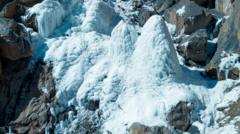
The system involved piping water from higher up in the mountains during the winter and spraying it into the air, where it would freeze, and over time form large towers of ice, called ice stupas.
They successfully supplied melt water in the spring, but were a "nightmare" to manage under harsh winter conditions, says Fardod.
If temperatures dropped quickly below minus 20C, or sometimes minus 30C, the water in the pipes was liable to freeze, cracking the pipes and ruining the whole system.
To guard against that, during the winter teams of four or five farmers would camp high-up, near the water source, rushing to any potential blockages with boiling water, often during the night when temperature drops were most likely.
But enduring those freezing, winter nights high in the mountains could be phased out.
"Because traditional water systems are failing, Leh-Ladakh has become a hub for innovative, grassroots hydraulic engineering," says Murtaza Ali, executive engineer in the Irrigation and Flood Control Division, at the Ladakh Autonomous Hill Development Council.
Leh is the capital of Ladakh, a disputed region in Indian-administered Kashmir that is sandwiched between China to the east and Pakistan to the west.
As well as the potential for cracked pipes, the ice stupa system was not very efficient, says Ali.
Because water flowed constantly, on warmer days fresh water would melt the ice that had already formed.
But over the last couple of years that method has undergone a tech upgrade.
In partnership with private company Acres of Ice, a new system has been developed which precisely controls ice production.
Called an Automated Ice Reservoir (AIR), the process also involves piping water down from higher up in the mountains.
The water arrives at the valley floor under pressure and shoots out of a vertical nozzle like a "massive fountain", says Dr Suryanarayanan Balasubramanian, the founder of Acres of Ice.
That flow is computer controlled from a...