
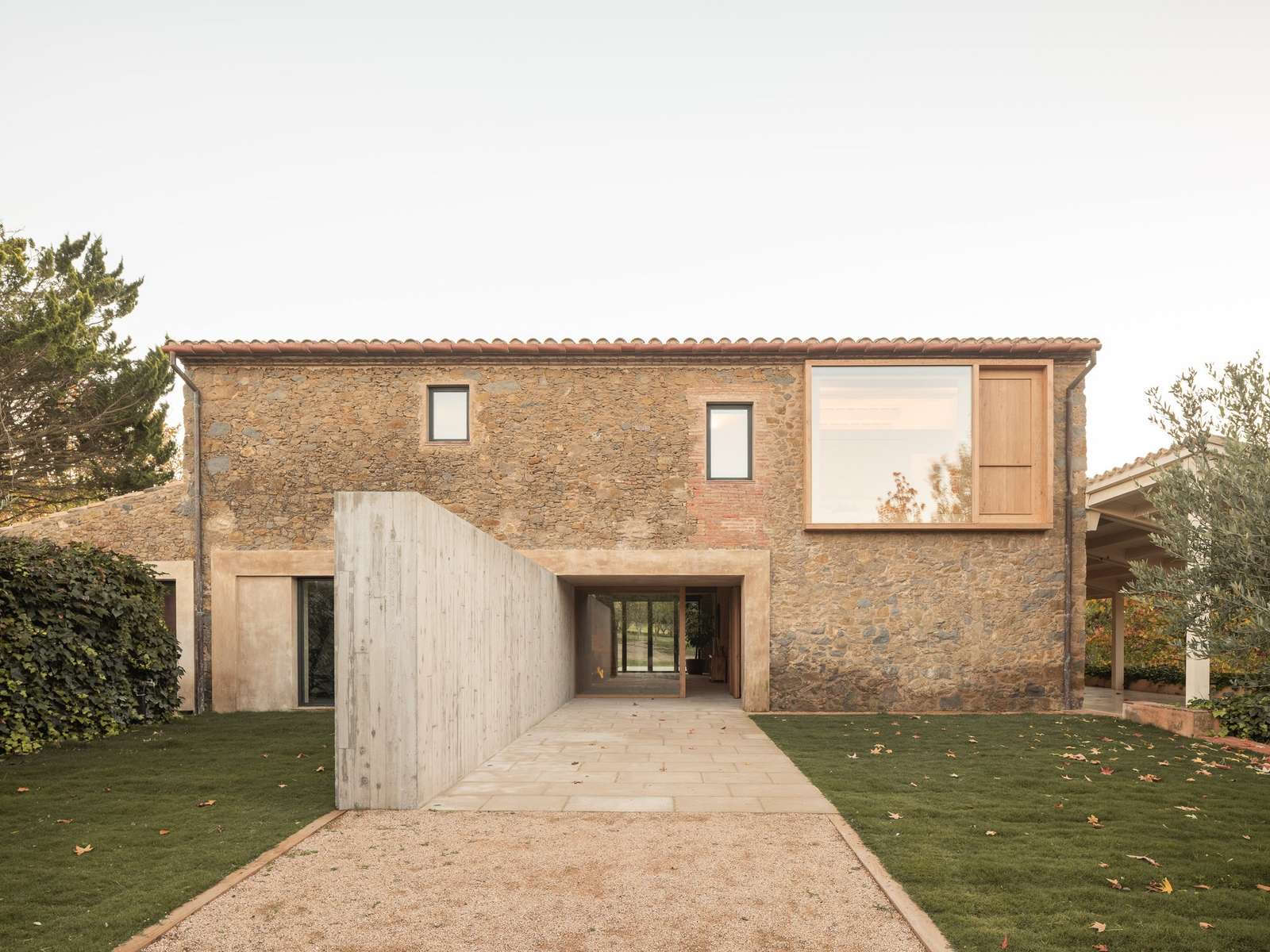
June 18, 2026 June 18, 2026 Home » Buildings » Project House 2302 Reshapes the Interior Space and Interaction Between Inside and Outside. The spatial segmentation and transformation of the central nucleus reshape the interior space of the traditional farm through a dismantling strategy that relies on transforming the solid central mass into a semi-external kinetic nucleus. This structural overlap eliminates the previous fragmentation imposed by the traditional farm, turning it into a linking element directly connecting the entrance area to the southern garden. The interior walls in this space transform into visual facades redefining the boundaries between inside and outside, while the old staircase with its concrete railing stands out as a sculptural element defining vertical and horizontal movement levels, guiding the user towards a sheltered studio on the upper floor.
The human experience inside the building is shaped through rich spatial sequences relying on visual flow and natural light movement. The central space acquires an almost external environmental quality, as shadows intersect with concrete masses and innovative architectural materials. This composition contributes to creating an interactive kinetic experience where the user tests the variation of levels and is psychologically and materially influenced by the contemporary design language that builds a continuous dialogue with the architectural heritage of the farm and its natural surroundings through integrating plants and directing pathways of movement and light.
The scenography of transition in the side balcony of the kitchen is realized through a rhythmic exchange between solid and glass strips, giving the dining and barbecue area a direct visual extension towards the southern garden. This material alternation breaks the sharpness of the solid boundaries, replacing them with a permeable membrane that connects the user's movement with the surrounding natural extent, allowing natural light infiltration to enhance the quality of functional space.
The design language is integrated through a material combination of stone, concrete, and wood in the central nucleus, giving the space visual weight and a distinctive structural character. Psychological tranquility within the space is formed through the side openings with calm colors and natural wood elements, contributing to directing the path of light and shadows. This human experience culminates through the southern glass facade, which harmonizes the internal space with the surrounding external environment without compromising the heritage identity and original essence of the farm.
The project characterizes traditional rural architecture not as a stagnant artifact, but as a flexible spatial framework capable of accommodating contemporary functional transformations. By emptying the residential nucleus and converting it into a semi-external cavity, the intervention exploits raw building materials to insert the historical mass into a volumetric dialogue with modern and flowing movement pathways, thus redefining heritage as an active structural element.
In contrast, this highly customized typological treatment entails a romantic vision that overlooks the reality of regional simulation. While the design celebrates the artisanal friction between stone and concrete, the text ignores how high restoration costs confine this architecture to elite pockets; producing an exclusive and specially designed refuge as a replicable rural thesis, overlooking the economic reality of standard adaptive reuse.