
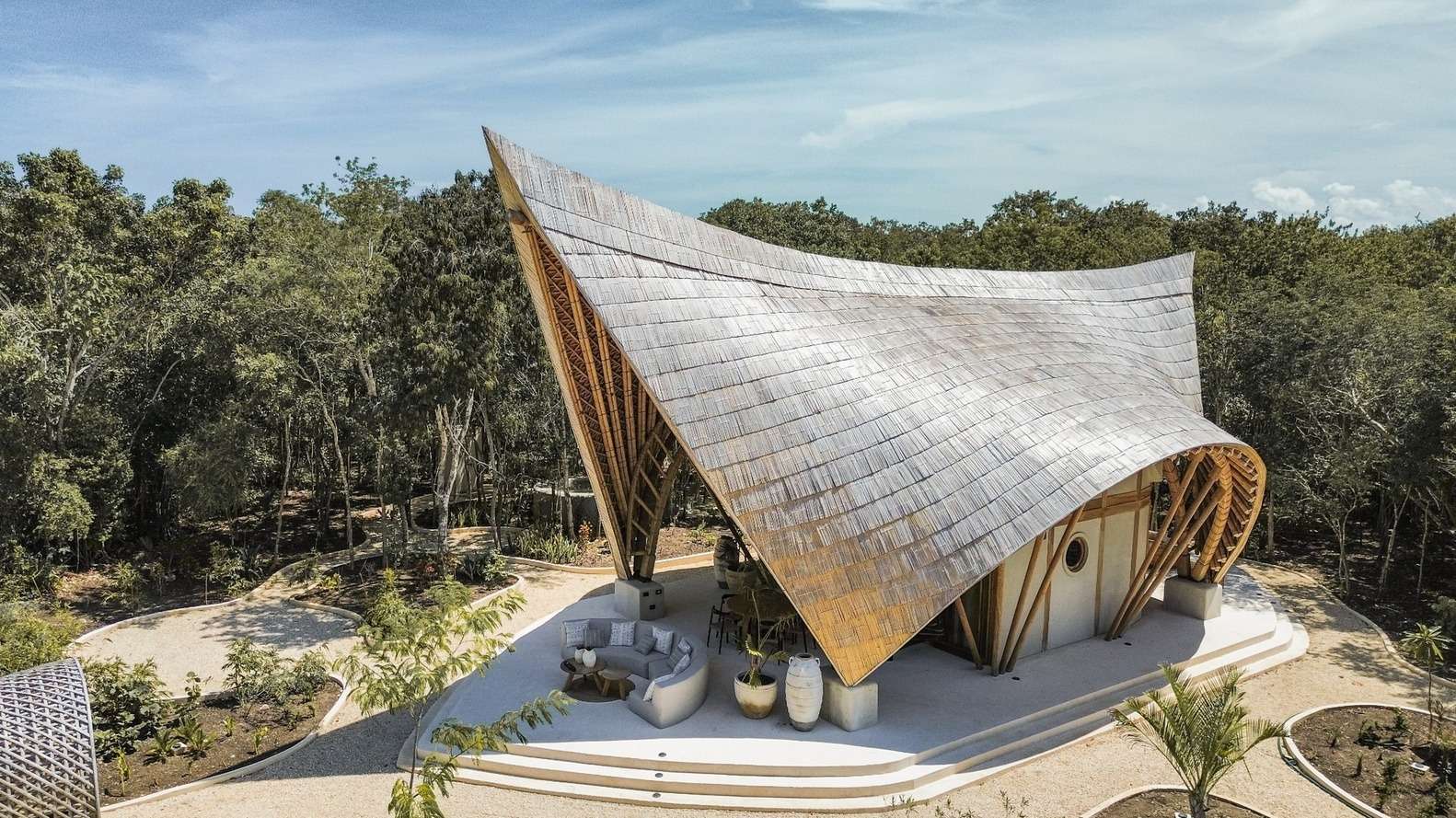
June 18, 2026 June 18, 2026 Home » Projects » CORA Villa as an Architectural Design Exploring the Integration of Housing and the Tropical Environment in Tulum The decomposition of the sculptural mass and the dialogue of materials with the jungle transcends the structural framework of CORA Villa, redefining the traditional concept of a building and transforming it into a spatial capturing tool for elements of the Mayan jungle. The mass imposes its visual presence through a massive sculptural roof made of bamboo, which not only serves as a protective element but as a semi-permeable cover that intertwines with the organic lines of the surrounding plants. This massing reflects a clear desire to dismantle the solid boundaries between interior and exterior, where natural light, the tropical climate, and the sounds of the surrounding jungle become essential components in shaping the architectural space, rather than being treated as external effects.
The human experience of the building begins from the first moment of crossing towards the natural space, where the user’s movement is directed through vibrant paths that are directly influenced by the movement of the sun and the flow of air. The employment of bamboo and local materials results in a continuous interplay between shadows and masses, adding psychological and material depth to the space that changes throughout the day. This harmony transforms daily movement within the project into a conscious sensory experience, where the resident experiences a choreography of light and shadow and climatic changes as an integral part of the living architectural design language.
The structural proposal is based on a clear structural hypothesis which consists of adapting to the existing natural landscape rather than attempting to forcefully reshape it. This thought is manifested in the formulation of light, ventilated, and shaded architectural spaces, primarily aimed at reducing the physical impact on the site's natural topography and maximizing the use of its inherent environmental conditions. Through this approach, the design system has abandoned heavy building systems in favor of renewable materials and low environmental impact execution mechanisms, turning the building into a flexible structure that efficiently interacts with its tropical surroundings without imposing unfair visual or physical dominance.
The continuous bamboo roof becomes the central and experimental organizing element of daily life within the project, where its architecture transcends pure structural requirements to become a tool for organizing the architectural space under a wide and shaded canopy. This massing allows for the complete opening of social areas to the outside, creating a vibrant scenographic experience based on cross-ventilation and the flow of changing natural light. The human inside this space experiences the ongoing movement of air and the interplay of shadows, establishing a continuous sensory relationship with the surrounding tropical landscape and stimulating intimate psychological and material interactions with the daily architectural transformations.
The main design objective of the project is to evoke the sensory experience of Tulum's environment within the residential space and to dismantle the idea of physical isolation. Instead of protecting the interior space and separating it from its surroundings, the architectural treatment reveals an active and continuous integration of natural elements into the details of daily life. The user inside the space experiences the natural light transformations and the presence of vegetation as a dynamic visual background, while the breezes and sounds of the jungle become a sonic and material extension that crosses the spatial pathways, making living within the building a dynamic experience that changes with the timing of the day.
The language of the materials used translates the commitment to responsible architecture rooted in its environmental context, where the villa was primarily constructed from structural bamboo and wood. This conscious material employment significantly reduced reliance on steel and concrete, giving surfaces a warm natural texture that psychologically and materially impacts the space user. This structural composition provides a contemporary reading of tropical housing, not seeking luxury through volumetric enclosure, but through crafting a spatial experience that stimulates human awareness of their direct and harmonious relationship with the natural environment and habitat.
CORA Villa establishes a spatial model wherein the solid mass retreats in favor of environmental fluidity, treating the Mayan jungle as an active structural element rather than just a visual backdrop. By adopting a continuous and lightweight bamboo roof, the design consciously dismantles the traditional residential envelope, reintroducing local building materials as an effective technological mechanism to achieve low ecological climatic integration...