
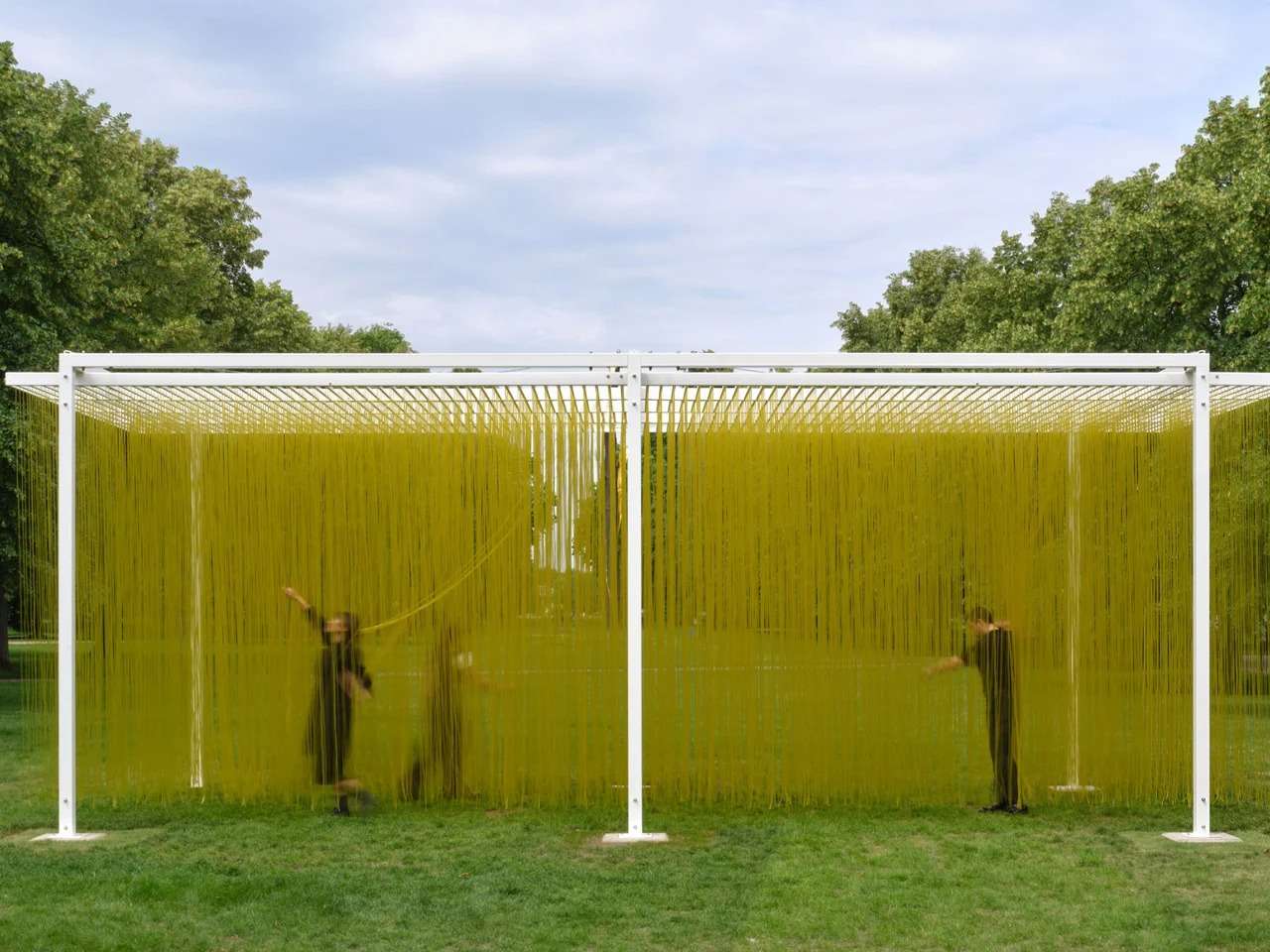
On June 19, 2026, Home » Design » The “Penetrable BBL John” sculpture redefines mass and interactive space. Mass disassembly and the fading of spatial boundaries move the “Penetrable BBL John” sculpture within a formal context that rejects the binary of “viewer and artwork,” offering an alternative based on dismantling solid volume and transforming it into a spatial phenomenon. From the outside, the white steel frame imposes a strict geometry that embraces thousands of hanging tubes made of dense yellow PVC. This initial visual contradiction builds a color mass that appears solid and rigid at first glance, yet this presence does not aim to isolate space, but rather to redefine it; the four thousand tubes do not form a continuous wall but operate as a permeable field that invites and refracts light, transforming mass from a static visual entity into a dynamic structure that is penetrable.
The approach to the sculpture turns into a live scenographic experience that reshapes the movement of the human body within the architectural space. At the moment of entry, the visual illusion of solid mass dissipates, as the user experiences a physical crossing that collapses the boundary between the body and material. The flexible tubes brush against the passerby’s arms, shoulders, and face, generating a vital interaction where the movement of air intertwines with the flexibility of the falling tubes, allowing the human to transition from an external observer to a driving and complementary element of the space itself. This material and psychological exchange fulfills Soto’s obsession with dissolving boundaries, making the artwork an extended experience within the user’s consciousness and movement, rather than merely an object displayed in space.
The placing of the “Penetrable BBL John” sculpture in the open space of the Serpentine galleries in London represents a radical shift in the study of spatial phenomena and its relationship to the surrounding architectural structure; the work transitions from the concept of a solid “thing” to the concept of an open interactive “relationship.” The yellow tubes reshape the external space by transforming color from a fixed visible surface into a dynamic and surrounding atmosphere influenced by the sun’s path and the direction of natural light. The structure here is no longer just a mass added to the public space but has become a medium that readjusts the movement of the human body and directs pedestrian trajectories, turning passing crowds from passive observers into active participants in the daily scenographic scene.
The vitality of the work is achieved through its absolute rejection of visual stagnation, replacing it with a live critical reading based on the physical sensation and psychological impact of the material. The experience relies on the movement of air and the intersection of shadows generated by the swaying PVC tubes, preventing the sculpture from becoming a superficial display object designed for photo capture. The architectural design of the work imposes a direct sensory test; the color field sways with the movement of passersby and winds, causing the reflected light to change and the boundary between the human body and the entire artistic system to dissolve. This vital interaction stimulates the user’s awareness of place, redefining the concept of “public art” as an extended space of tangible material experiences.
The text diagnoses a radical shift in the concept of architecture, reframing Soto’s kinetic installation as an interactive space rather than a solid mass. By employing flexible building materials like PVC tubes to dissolve structural boundaries, the project succeeds in substituting negative viewing with a tangible sensory experience, transforming the public space into an envelope where the body intertwines with light and air.
However, this phenomenological interpretation carries a romantic view that overlooks institutional real estate investment dynamics. The projection of interactive art onto urban spaces often operates as a tactical mechanism for developers to create visual identity, where this open interaction is exploited to generate cultural capital. Accordingly, the dismantling of the celebrated architectural barrier risks becoming a precisely managed product, reducing urban spontaneity to a pre-scripted entertainment event.