
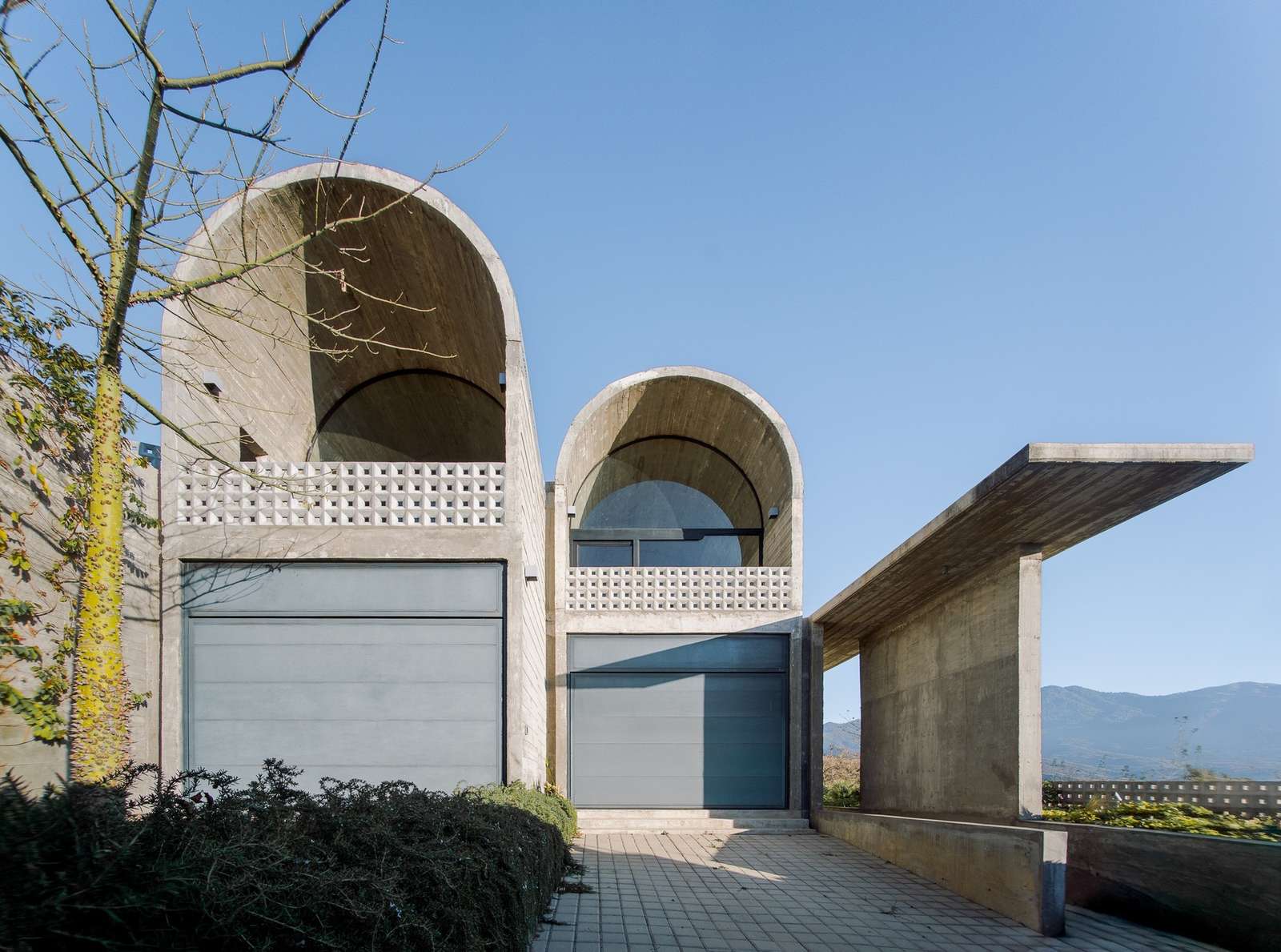
June 19, 2026 June 19, 2026 Home » Architectural Research » Casa Cielo Project Reinterprets Cylindrical Volumes and the Inner Courtyard Conversation of volumes and voids: A reading in the architectural structure establishes the project on a strict construction system relying on three cylindrical vaults, a structural orientation that reinterprets colonial and local models in a contemporary style. The dimension of the vaults confined in the depth of a single room imposes a clear kinetic dynamic; the walls turn into permeable partitions allowing for reciprocal visibility between both sides, eliminating the sense of traditional closure. This spatial distribution makes the inner courtyard the central nucleus around which pathways are distributed, achieving a visual balance linking the main living spaces on the upper floor directly with the surrounding environment, while guest rooms and the workshop in the lower level are separated to affirm the privacy of function and mass. This approach reflects many of the trends proposed in contemporary design and regional character architectural projects.
The cylindrical vaults transform into a scenographic tool that captures natural light and distributes it accurately within both internal and external spaces alike. Users within these formations experience a continuous interleaving of building volumes and open spaces, where the ceiling curves help guide air movement and adjust shadow angles as the sun's path changes throughout the day. This material interaction with building materials and shadows bestows the space with a dynamic dimension linking the experience of passage within the house with the immediate sensation of the surrounding climate, enhancing environmental efficiency through continuous ventilation and direct visual connection to nature. This tendency is also related to topics presented within architectural research concerned with passive environmental performance.
Life functions are distributed across the three vaults according to a careful gradient starting from the public to the private; the first vault welcomes the entry movement and includes the kitchen and service spaces, while the second vault represents a transitional area with an inner courtyard separating the social space of the dining room from the private space of the master bedroom. The third vault reframes the relationship with the horizon through a slight structural bend oriented towards the Sierra Norte mountain range, creating a narrow spatial strip that connects the inner nucleus with the outer natural environment. This visual orientation enhances the extension of a covered balcony at the northeast corner behind the living room, transforming the kinetic pathway within the house into a continuous exploratory experience between closure and expansiveness, resonating with numerous concepts of contemporary buildings redefining the relationship between the inside and outside.
The visual identity of the building is formed from a studied material contrast; the cast-in-place concrete has been left with its natural roughness without finishes, making the curved surfaces of the vaults a lively canvas receiving paths of light and shadow, endowing the space with a profound sense rooted in time. This structural roughness integrates with the soft plaster finishes of the internal partitions, the warmth of locally sourced hardwoods used in the cabinets, and the slender lines of the steel and glass windows. This material interaction extends beyond the visual, reaching into passive environmental performance through natural heating and cooling, supported by the integration of handcrafted elements and furnishings that deepen the user's connection to the space and provide it with scenographic dimensions merging contemporaneity and local traditions, topics that are prominent in interior design discussions and material data sheets studies.
This project embodies a clear tectonic transformation where traditional regional patterns are adapted to create a highly localized residential fortress. By employing raw building materials alongside historical spatial models such as the cloister courtyard, the architects seek to achieve complete environmental independence. This structural formation isolates the residence from the pressures and rapid changes of the contemporary market, favoring tectonic durability and direct passive climatic control over rapid urban integration choices. This approach can be read within a broader context of architectural news discussing the future of sustainability and urban development.
However, this excessive material isolation reveals a blind romantic spot that...