
Science The Midnight Sun Peaks This Weekend — What It Is And Where To See It By Jamie Carter ,
Forbes contributors publish independent expert analyses and insights. An award-winning reporter writing about stargazing and the night sky. Follow Author Jun 20, 2026, 02:00am EDT --:-- / --:-- This voice experience is generated by AI. Learn more . This voice experience is generated by AI. Learn more . Summary This weekend, the June solstice on June 21, 2026, marks the Northern Hemisphere's longest day and the astronomical start of summer. North of the Arctic Circle, this brings the spectacular "midnight sun," where the sun remains above the horizon at local midnight, casting a soft, golden light. This phenomenon is due to Earth's 23.4-degree tilt, causing the Arctic to be angled towards the sun, making it appear to circle the sky without setting. The effect intensifies further north, lasting for days or even months. This unique light changes daily routines, offering 24-hour wildlife viewing opportunities as animals are highly active. Destinations like Norway, Svalbard, and Alaska are prime spots to witness this surreal, awe-inspiring experience, which continues beyond the solstice before days gradually shorten.
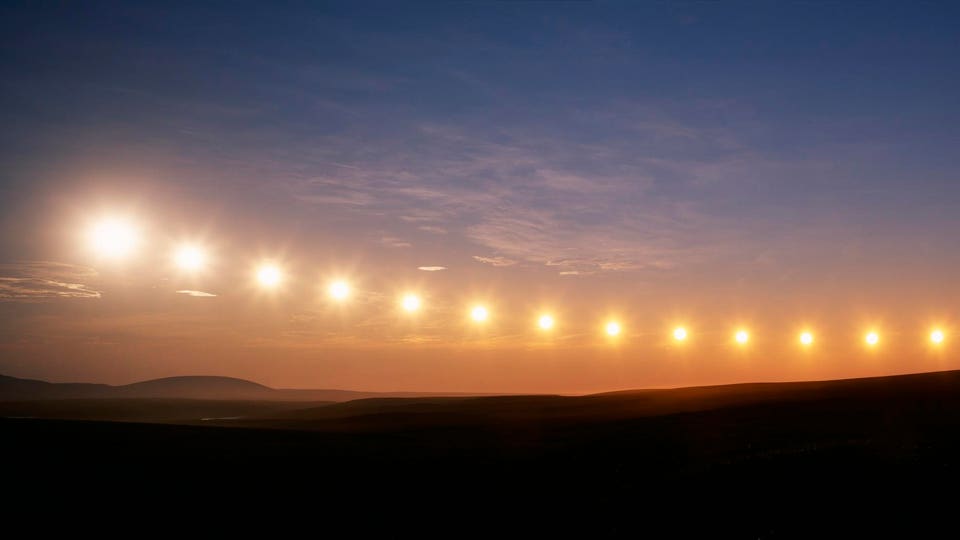
Multiple exposure of midnight sun passing due north on a summer night 175 miles north of Arctic Circle. | Location: Toolik Lake, Alaska, USA. getty This weekend, the sun will reach its highest point in the Northern Hemisphere sky, with sunrise being celebrated at Stonehenge , but in the Arctic, it will not set. The June solstice occurs on Sunday, June 21, 2026, at 08:24 UTC, marking the astronomical start of summer in the Northern Hemisphere. For most people, that means the longest day of the year. But north of the Arctic Circle, it brings something even stranger and more spectacular — a midnight sun.
A midnight sun is exactly what it sounds like. It’s the sight of the sun still above the horizon at local midnight, bathing landscapes in a soft, golden light when darkness should have fallen. Instead of rising in the east and setting in the west, the sun appears to skim around the horizon in a shallow circle, dipping low but never disappearing.
“At the Arctic Circle on the summer solstice is where you have this moment of the midnight sun, where the sun doesn’t actually ever set,” said Solan Jensen, a ranger and guide for Quark Expeditions ’ Arctic cruises, in an interview. “Then you have this vast amount of the planet above the Arctic Circle — Svalbard included — and because you’re so much farther north, even before the solstice and well into the late summer, you have this experience of the sun never setting.”
North of the Arctic Circle, the midnight sun shines from summer solstice. getty Why Does The Midnight Sun Happen? The sun, of course, is doing nothing out of the ordinary. It’s an optical illusion caused by Earth’s tilt. Earth rotates at an angle of about 23.4 degrees as it orbits the sun. Around the June solstice, the Northern Hemisphere is tilted as far toward the sun as it gets all year. That gives the north its longest days, while the Southern Hemisphere (which is titled away from the sun) experiences its shortest days.
The farther north you go, the more extreme the effect becomes. At the Arctic Circle, the sun can stay above the horizon for a full 24 hours around the solstice. Go farther north — to northern Norway, Svalbard, northern Greenland, northern Canada or Alaska — and the midnight sun can last for days,…