
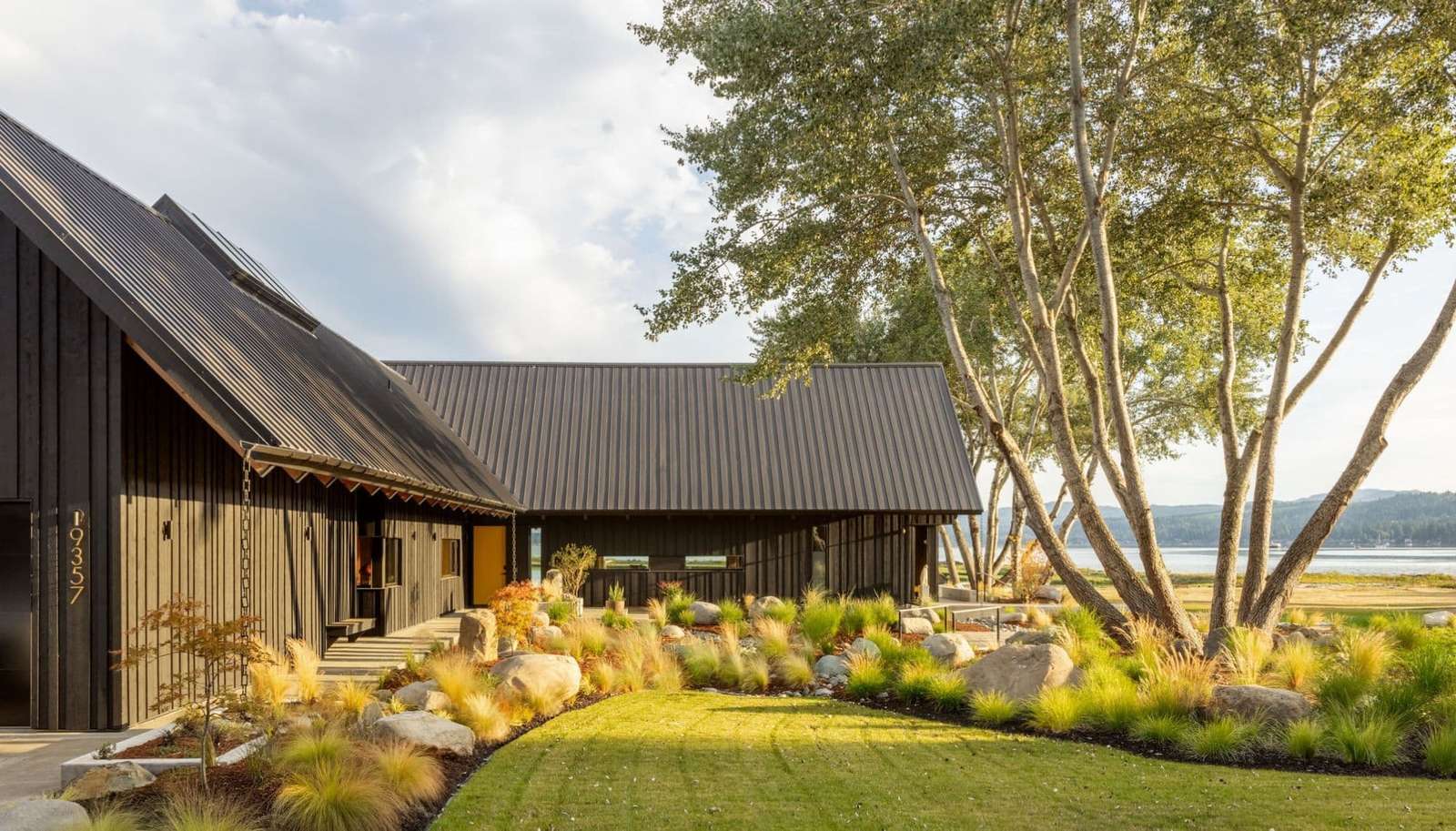
June 21, 2026 June 21, 2026 Home » Projects » The Mass Formation and Spatial Dialogue Project Restructures Residential Space According to Environmental Response. The mass formation and spatial dialogue is formed by two intersecting volumes with gabled roofs mimicking the organization of traditional Scandinavian farms, generating a layout in the shape of a T that imposes a specific kinetic and visual direction. This spatial intersection allows for precise functional separation; the east-west wing extends as a shared living space that attracts direct water views while the north-south wing recedes to include private zones. The architecture here acts as a center for a renewed residential scene that transcends the concept of an independent building, entering into a continuous spatial dialogue with the adjacent guesthouse after its renovation, creating an interconnected system that supports accommodation for multiple generations within the site while delineating clear boundaries for privacy and gathering.
The design language dictates the formulation of a human experience beginning from the moment of entry through the northern reception courtyard, culminating in a visual opening towards the external terrace facing south towards the bay. The physical impact of the building integrates with its coastal environment by combining high-performance strategies and passive house principles, where triple-glazed windows and continuous thermal insulation play a role in managing light and heat flow, in parallel with a heat recovery ventilation system and a photovoltaic solar energy system. These technical elements contribute to formulating a thermally balanced indoor environment that dynamically interacts with the movement of the sun's path and beach air, thus enhancing long-term spatial use and supporting a single-level living pattern in line with aging-friendly interior design principles.
The architecture responds to two opposing environmental conditions by crafting two distinct presences for the building; on the north facade, the architectural strategy employs farming and natural barriers as scenographic elements to mitigate the impact of the urban surroundings and generate a protected access path characterized by calm and containment. Conversely, the south facade adopts a completely open approach towards the coastal face, where glass living spaces and the extended terrace foster a direct visual and physical relationship with the bay, creating a clear kinetic and psychological contrast for the space user between the moment of entry and the passage towards the water.
The spatial logic is based on the intersection of two volumes with gabled roofs inspired by Swedish coastal farm complexes, wherein this intersection serves as the main entry point and experimental movement axis within the home. From this point, human movement is directed through thoughtfully designed pathways that transition between lower, more contained areas and elevated ones with vaulted ceilings, generating a kinetic gradient that balances privacy and openness. Each wing terminates in a double-height space that enhances the sense of spaciousness, achieving a visual differentiation and defined spatial separation between family zones and guest areas.
The orientation of the volumes dictates the nature of the living experience within the home, as the east-west wing extends as a dynamic open space encompassing the living areas, kitchen, and dining space, directing its movement and view entirely towards the coastal horizon and the external terrace. In contrast, the north-south wing separates to provide a quiet and contained kinetic experience, placing the main wing in the southernmost isolated end, while the guest rooms occupy the remaining part with a shared bathroom. To enhance spatial efficiency without compromising the clarity of organization of the single-level main floor, the design employs a lofted space above the entrance hall as a flexible area for work and storage.
The project’s visual structure relies on a balanced and solid material palette combining wood, concrete, glass, and alder plywood, invoking the architectural identity associated with the Pacific Northwest and Alaska. These materials play a scenographic role in defining the nature of spatial transition, illustrating the shifts in texture and surface nature that transitions the movement between lower and elevated spaces. Far from decorative solutions, the design focuses on formulating proportions, volumes, and texture, leveraging the expansive glass facades that blend the marine horizon and make the transitions of light and shadow a key element that grants the...