
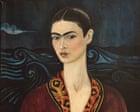
Nobody could portray her like she portrayed herself … Self-Portrait (With Velvet Dress), 1926. Photograph: Private Collection View image in fullscreen Nobody could portray her like she portrayed herself … Self-Portrait (With Velvet Dress), 1926. Photograph: Private Collection Frida Kahlo Review Frida: The Making of an Icon review – forget her iconic status, just show us more of her art Tate Modern, London Frida Kahlo took self-portraiture to new levels of interior revelation and her work takes you deep into her mystery. So why is this show padded out with responses by lesser artists?
Jonathan Jones Mon 22 Jun 2026 11.54 CEST Last modified on Mon 22 Jun 2026 14.20 CEST Share Prefer the Guardian on Google C harisma is something you can’t fake and Frida Kahlo had it before she became an artist, let alone a modern hero. In photographs, the teenaged Frida appears both in a silk dress staring boldly from beneath her already colliding black eyebrows, and posing as a man in suit and tie. In a home movie her husband, the Marxist mural painter Diego Rivera, woos her and they cuddle. Those were the good times. Rivera is so fat and ugly next to his wife, you’d think he would have appreciated his luck more.
Every image of Kahlo is interesting but nobody could portray her like she portrayed herself. She took self-portraiture to new levels of interior revelation, psychological and physical. Inspired partly by the surrealists and partly by Catholic traditions of depicting pain, Kahlo took herself apart and put herself back together in images of suffering, survival and triumph. In her 1937 painting The Heart, she stands neat and calm while a sword pierces her chest and her disembodied arms reappear in two floating, otherwise empty outfits. The most complete of the Fridas has a brace on her left foot which could be a Freudian symbol except it’s a factual reference to the physical challenges she suffered all her life after she was severely injured in a bus crash when she was 18.
View image in fullscreen She was inspired partly by the surrealists and partly by Catholic traditions of depicting pain … Memory (The Heart), 1937. Photograph: Private Collection Her most shocking works depict the accident directly. In a 1926 drawing Kahlo sketches flattened bodies strewn around streetcar wreckage, while in the foreground she lies bandaged in hospital. In another work she restages the accident with a toy cart and doll. These memories have a primal quality as if this devastating event was the end of childhood innocence. One of the surgical corsets she wore is in a glass case nearby. On it she has painted a red hammer and sickle, where the cast is moulded to her breasts: below, over her abdomen, is a picture of a foetus squatting in the womb.
Magic, myth, doubles and dreams: Kahlo takes you inside, into her mystery. She even lets her hair down, literally, in a 1947 self-portrait that shows her dark locks hanging loose like a river. The effect is disarming. You look in the mirror with Frida as she gazes into her own deep dark eyes.
View image in fullscreen Letting her hair down … Kahlo’s Self-Portrait with Loose Hair, 1946. Photograph: Private collection Tate’s blockbuster show about this rightly beloved artist asks how and why she became an “icon”. But I’ve never seen an exhibition about how Picasso got famous or the cultural invention of Rembrandt. We know they are great artists and how they were historically recognised is for scholars. Here, those assumptions…