
BBC News, Arabic Go to content Main Watch Listen Main Sections News Economy Health and Science Culture and Arts World Cup 2026 Investigations News Economy Health and Science Culture and Arts World Cup 2026 Investigations What do we know about Qatar's Barzan facility that witnessed an explosion killing and injuring dozens? Image source, AFP via Getty Images
At least 13 Pakistani and Indian workers were killed, and 66 others of various nationalities were injured in an explosion at the Barzan gas facility in the Ras Laffan industrial city in Qatar.
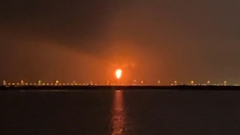
The Interior Ministry announced that the main liquefied natural gas processing site in Doha experienced a "technical accident" in the Ras Laffan industrial area on Sunday night, causing the city's sky to turn orange due to the explosion.
Qatar's Energy Minister Saad Sherida Al-Kaabi stated that the explosion would not affect the country's exports, adding: "This was an accidental incident and not a sabotage or hostile act."
Al-Kaabi confirmed that the government is working to determine the cause of the explosion that occurred at the local Barzan gas supply facility, assuring that there are no environmental hazards.
However, the energy minister stated that it would be difficult to determine when operations would resume.
Al-Kaabi said: "We completely halted the operation of the station since December 2025 due to urgent maintenance requirements, and it was restarted for the first time just two days ago."
Ras Laffan port is the largest artificial port in the world and includes the largest liquefied natural gas export facility in the world. It was targeted in Iranian strikes earlier this year.
The facility is located in Ras Laffan industrial city, which is the main center for QatarEnergy for liquefied natural gas production and export, with a total production capacity of 77 million tons per year across 14 production lines.
It deserves in-depth attention to explain the key events and topics, to help you understand the most important variables around you and their impact on your life.
Previously, the Barzan facility was able to provide 1.4 billion standard cubic feet of sales gas per day to local power generation and water desalination plants, along with local industries.
The facility can also produce ethane, condensates, liquefied petroleum gas, and sulfur for local and export markets.
During the U.S.-Israeli war with Iran, Ras Laffan port sustained significant damage from retaliatory strikes, forcing the company to evacuate about 10,000 workers from offshore drilling rigs and onshore processing plants.
Qatar had halted production on March 2, resulting in the shutdown of one-fifth of the world's liquefied natural gas production. Shipments have recently begun to resume operations.
QatarEnergy, the government energy company in Qatar, has stated that the required repair works for the facility will lead to a reduction in production of 12.8 million tons of liquefied natural gas over three to five years.
ExxonMobil owns 7% of the Barzan station's shares, while the state-owned Qatari company owns the remaining 93%, according to the website of the American oil and gas giant.
Qatar shares the massive North Dome/South Pars gas field with Iran and is among the top producers of liquefied natural gas in the world alongside the United States, Australia, and Russia.
An investigation into the cause of the incident has begun, and Al-Kaabi confirmed that all victims of the explosion were from India and Pakistan.
The explosion that occurred on Sunday caused windows to shake and was felt by residents in central Doha, causing panic among residents more than 70 kilometers (43 miles) away from Ras Laffan.
Restarting liquefied natural gas operations is a very complex process due to the deliberate slow cooling process to avoid thermal shock. LNG units cannot be restarted simultaneously but must be operated sequentially.
Cooling is the most important step in the liquefaction process that transforms gas into a liquid by cooling it to about minus 162 degrees Celsius.