
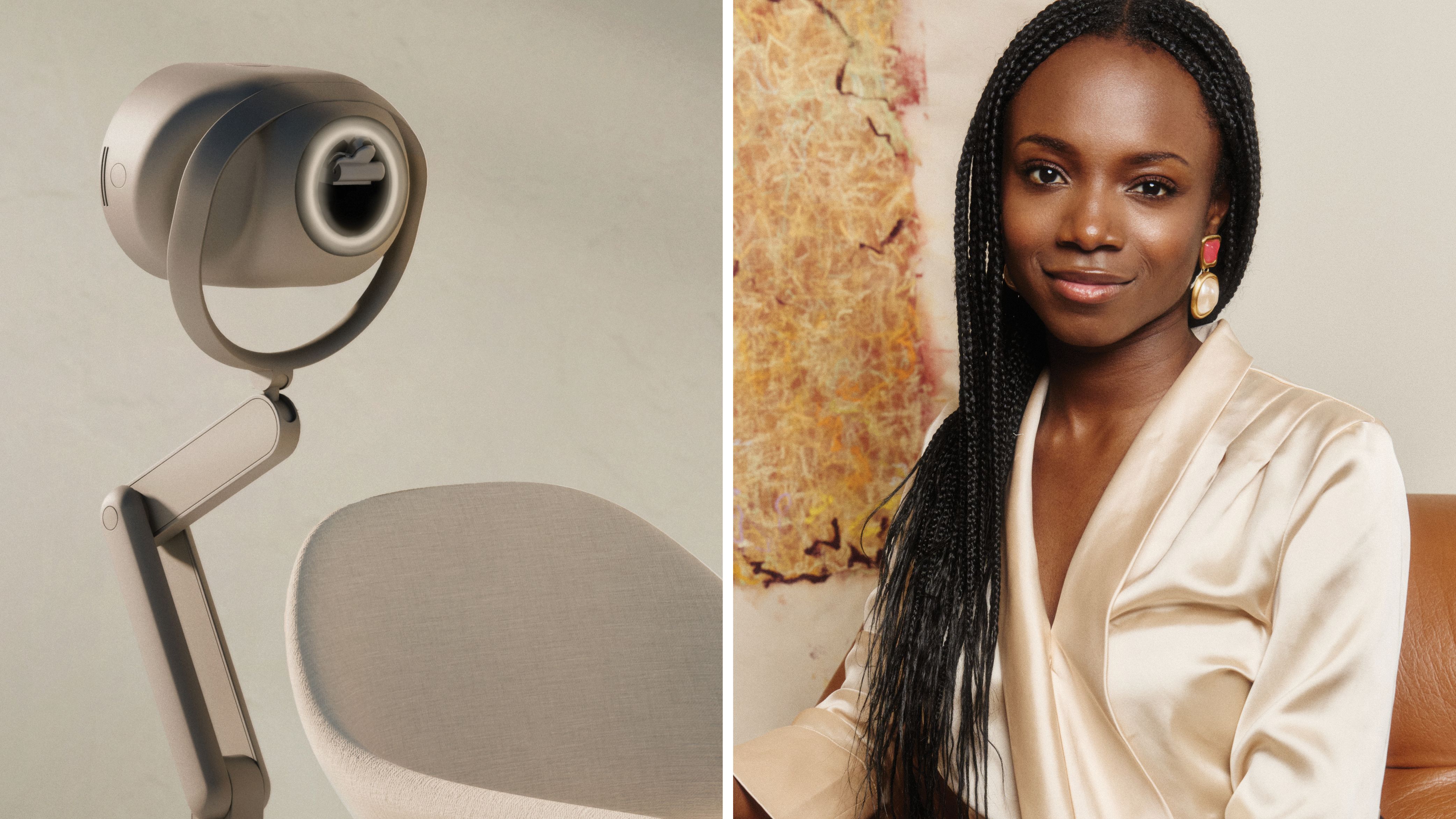
Courtesy of brand Save Story Save this story Save Story Save this story It takes most people years to land on a signature look. Yinka Ogunbiyi solidified box braids as hers when she was just five years old. That’s pretty early to settle on a beauty uniform, yes, but as a young Black girl—and a Nigerian at that—getting braids felt like a natural part of life. Ogunbiyi enjoyed her regular visits to the salon: She’d settle into the braider’s chair with some snacks and a good show to make the time pass quickly.
But the 2020 lockdown forced Ogunbiyi (then an engineering student at Harvard) to attempt doing her own braids. No longer a passive participant in her styling sessions, she realized that the process is “really hard and mechanically repetitive,” she says. “It took me four days to do small, waist-length, knotless box braids .”
By the second day of braiding, a light bulb went off in her engineer's brain. Reflecting on how long the process was taking, she wondered, Where's the machine to make this faster? Ogunbiyi saw similarities between the process of braiding and sewing—a meticulous and repetitive action that could be automated—and began to envision a solution. This experience led to the invention of HaloBraid: a device that assists stylists by finishing the braids they’ve started.
Excitement about the device spread online after a clip of Ogunbiyi winning the Harvard Pitch Competition went viral in 2025. The win secured Ogunbiyi’s brand, Halo, $75,000 in funding, and its inaugural product, HaloBraid, will be launching in September 2026.
Courtesy of Brand The “braiding robot,” as the internet has dubbed it, is more accurately described as a braider’s assistant that’s attached to the salon chair. “Each braid is started by hand,” says Ogunbiyi. “The stylist does just a small portion of the braid, then they transfer [the braid] to the HaloBraid device.” How much of the braid makes up that “small portion” varies, but the stylist needs to at least finish adding in all the braiding hair, since the robot can't feed in extensions.
Because there is so much variation in styles, the brand isn't making any time-specific claims about how fast the robot works. However, Ogunbiyi says, “HaloBraid can complete each braid up to five times faster than a stylist.” Ogunbiyi gives one example: With traditional box braid styles that can take six to eight hours, a stylist working with HaloBraid could theoretically bring that down to about two and a half to three hours.
The device is limited in what it can do, though. If you’re a fan of intricate cornrow styles, the HaloBraid can’t help you there since it can’t braid close to the scalp. The robot can only handle mid-lengths to the ends of the hair, plaiting a classic three-strand braid. “It's not as complex as a human hand, and it can't do everything a human hand can,” says Ogunbiyi. She adds that the team is already brainstorming ways to enhance the device to support more advanced styles.
The journey to developing the final version of HaloBraid took over three years and 600 prototypes—a process that began by examining toys that braid dolls’ hair and machines that create three-strand cords. “We've looked at every pattern on a braiding machine and looked at the different problems there to solve,” says Ogunbiyi. For example, the team needed to figure out “how to get hair into this device as quickly as possible and easily for the user.” Most of the toy braiders use a lit…