
June 24, 2026 June 24, 2026 Home » buildings » Multnomah Library Operations Center as a Model for Large-Scale Adaptive Reuse The spatial formation and crossing experience exceed the project’s idea of structural reuse of a former commercial establishment, offering a critical reading in rethinking civic space and the daily user experience. The moment of entry and passage transforms from an old consumer movement pattern to a directed kinetic path governed by operational efficiency and psychological comfort; where the solid mass of the former store has been dismantled and reorganized internally to integrate collection management and logistics in a flexible spatial flow. The user experiences the transition between administrative functions and educational programs through carefully designed kinetic corridors that eliminate the sense of congestion and give workers a clear visual experience that connects different work environments and provides direct access to external amenities, enhancing kinetic responsiveness and attachment to place.
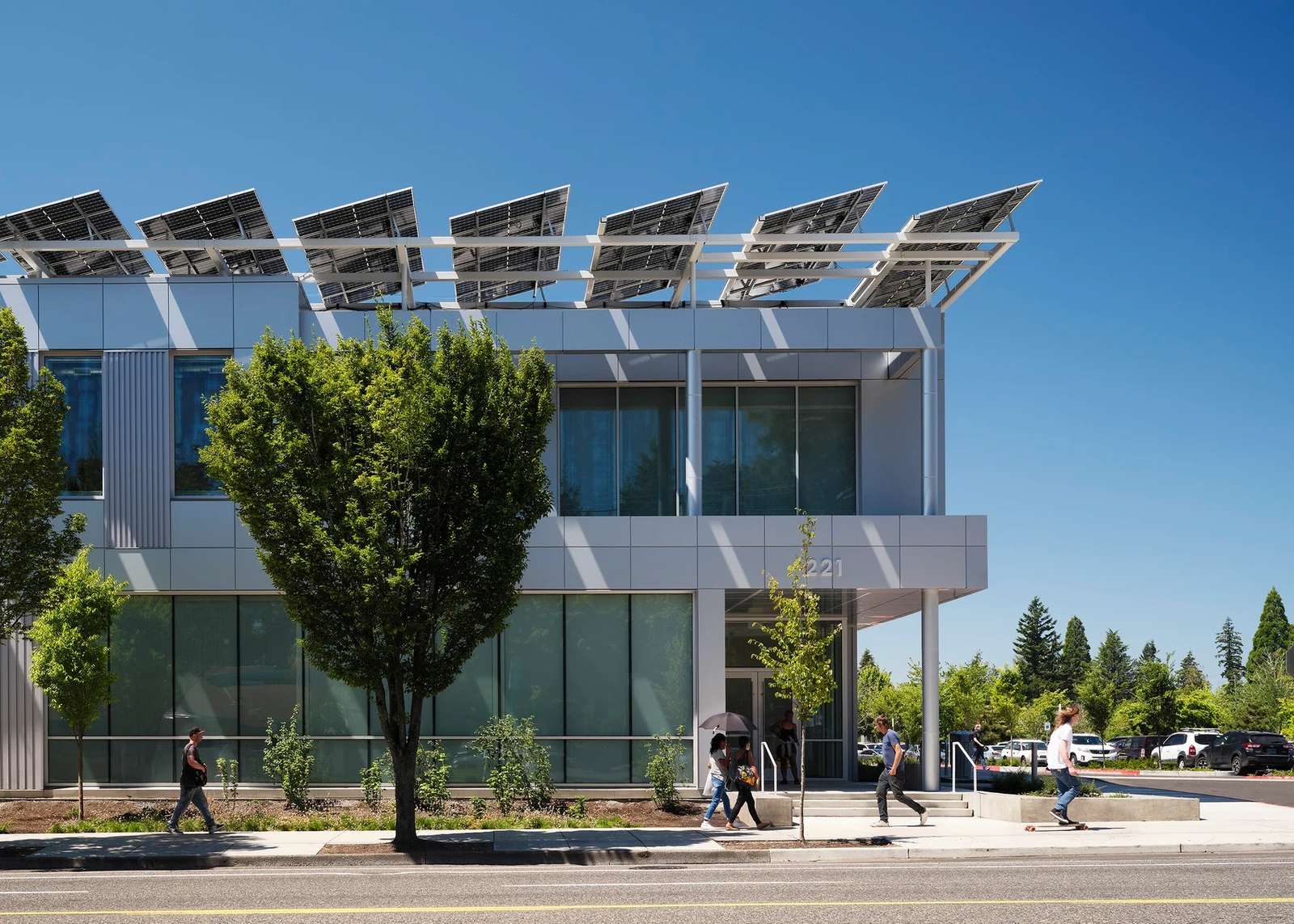
The internal structure of the building is formed through a dynamic interaction between physical masses and natural elements, where the facades have shed their old silence to allow for a continuous flow of abundant natural light penetrating deep into operational spaces. The language of design highlights a vibrant scenography through the interplay of shadows with the natural materials used in the finishes, giving the space a visual warmth that reduces the harshness of the strict administrative character. This thoughtful orientation of the sun’s path not only has a positive psychological and physical impact on employee well-being but also functionally integrates with the overall environmental performance, as the building breathes through advanced air purification systems mimicking natural air movement, while the upper masses covered with photovoltaic cells stand out as an environmental roof protecting the facility and directing its sustainable identity.
The project transitions architecturally from an abandoned consumer pattern historically linked to vehicular movement in East Portland to a new kinetic centrality that redefines the concept of public infrastructure. The architectural depth lies in deconstructing the internal space of the dormant retail store, transforming it from an open horizon oriented towards consumers to a complex logistics facility engineered for managing and moving physical mass. This spatial transformation represents the backbone of the office system; pathways were directed to accommodate the dense daily flow of over half a million indexed materials, requiring precise structural handling to ensure the smooth movement of materials and mechanisms without intersections that hinder operational performance.
The human experience within this facility moves through a design language that transforms the strict logistics work environment into a lively and stimulating spatial experience. Workers experience the moment of entry and passage through a studied spatial sequence that balances the kinetic function of machines and the psychological and physical impact of the place on the human user; the rigidity of the old commercial mass has been broken by opening visual pathways that allow natural light to penetrate deep into sorting and preparation areas. The materials used and the spatial divisions contribute to reducing the noise generated by material movement, creating a specialized and highly efficient working environment that enhances employee well-being and provides them with a sense of connection to the essence of the public service that the building offers to the community.
The design approach of Henningson, Durham & Richard focuses on reorganizing interior spatial relationships by distributing workstations, offices, and meeting rooms peripherally along the building's facades. This thoughtful engineering direction aims to maximize the benefit from natural light flow and provide direct visual connections to the outside, changing the nature of the traditional administrative space experience; conversely, the darkness of the deep masses has been fragmented by inserting skylights that allow natural light to penetrate vertically directly into the central group area, creating a daily crossing experience characterized by visual clarity and psychological and physical comfort for employees during movement and work.
The language of the internal space is formed through a conscious material interaction that balances strict logistical function with absolute human warmth. The selected wooden finishes provide a scenographic effect that reduces the severity of the industrial character of the building, where shadows and reflected light intersect on the wooden surfaces.