
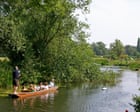
The River Cam at Grantchester Meadows. Photograph: Andrew Holt/Alamy View image in fullscreen The River Cam at Grantchester Meadows. Photograph: Andrew Holt/Alamy Car-free UK Cambridge holidays Art trails, swimming spots and punt safaris, all easily accessible from Cambridge’s new train station With Cambridge South about to welcome its first passengers, it’s an ideal time to explore some of the university city’s lesser-known treasures on foot or by public transport
Prefer the Guardian on Google The Guardian’s journalism is independent. We will earn a commission if you buy something through an affiliate link. Learn more .
F lat fields of poppies and ox-eye daisies stretch out to a wide horizon. There are butterflies, vetches, salad burnet. Skylarks sing overhead and a cuckoo calls from the trees near the river. Legend has it that the poet Lord Byron swam here as a Cambridge undergraduate and, 20 years later, Charles Darwin surveyed its beetles. Heading through flowering meadows towards a nature reserve known as Byron’s Pool , I’ve walked a mile from the new £250m Cambridge South station.
The Guardian’s journalism is independent. We will earn a commission if you buy something through an affiliate link. Learn more .
Opening to passengers on 28 June, Cambridge South will be the first Great British Railways -branded station. The towering Biomedical Campus next door is Europe’s biggest medical research facility, with about 40,000 visitors a day. The station itself, with its 1,000 cycle-parking spaces, living roof and solar panels, feels like a model for sustainable transport.
View image in fullscreen The new Cambridge South station, with its living roof. Photograph: Bav Media Like other scenic medieval cities, Cambridge itself suffers from congestion. Its cobbled alleys are crowded with tourists, its roads gridlocked with cars. But you can reach some wild and peaceful corners without adding to the traffic. There are layers of human and natural history, a newly devised art trail , bat safaris by punt and a peaceful botanic garden near the busy central station.
Cambridge has been my nearest city for the last 15 years. With lots of buses and now three stations, it’s easy to get around without a car. I’ve spent countless days exploring, and published guides to the long-distance Harcamlow Way , a 140-mile (227km) figure-of-eight walking route that loops between Cambridge and Harlow. The best rural bus routes include the busway from Cambridge North station (opened in 2017) to Fen Drayton lakes and bus 1 to Fulbourn for orchid-rich fens and chalk-flowered Saxon Fleam Dyke .
Heading through Grantchester Meadows, I have a dip in the reedy River Cam, keeping my head above the willow-shaded water Walking and cycle paths head out in all directions from the new station at Cambridge South, and I am following one of these to Trumpington, stopping for bao buns and peach oolong tea at the Dao cafe . In the village church , I find one of England’s oldest brass monuments. Sir Roger de Trumpington, who died in 1289, is lying in prayer and full chain mail, with a little lion-clawed dog biting his broadsword. Just south of the church, archaeologists unearthed the grave of a young Anglo-Saxon woman , with a delicate gold-and-garnet cross on her chest.
Heading north through Grantchester Meadows, I have a dip in the reedy River Cam , keeping my head above the willow-shaded water. Sun glints off ripples as I swim past waterlilies, moorhens and straggling blue...