
Science The ‘Blaze Star’ Could Explode Tonight — Here’s Where To Look By Jamie Carter ,
Forbes contributors publish independent expert analyses and insights. An award-winning reporter writing about stargazing and the night sky. Follow Author Jun 25, 2026, 01:00am EDT Topline If predictions come true, June 25 could see a dim star in the night sky suddenly brighten in a once-every-80-years event. The star, called T Coronae Borealis (T CrB) and nicknamed the “Blaze Star,” is a recurrent nova located about 3,000 light-years from the solar system in Corona Borealis, a crescent-shaped constellation now visible. Here’s exactly how to find it in the night sky.
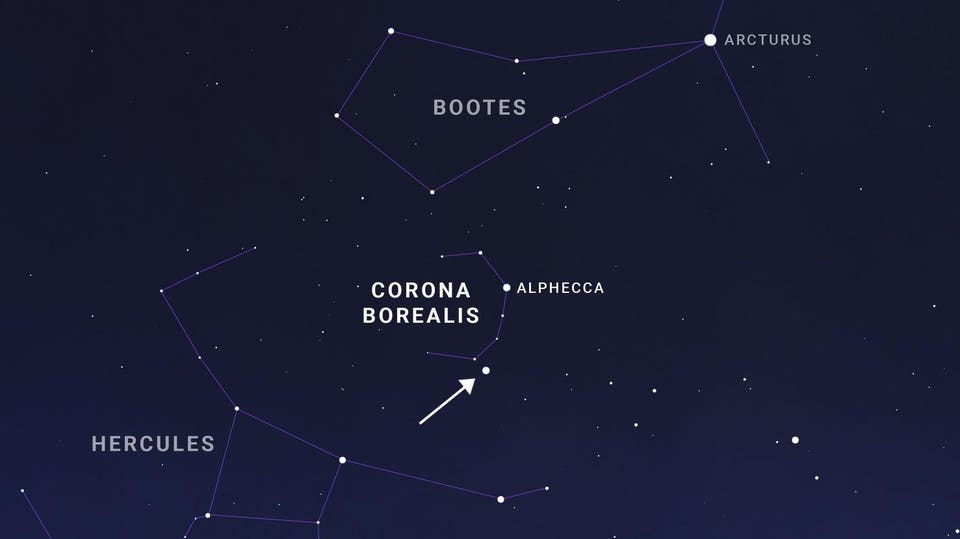
Sky chart showing constellation Corona Borealis with the location where nova "T CrB" is predicted to appear. The view depicts the constellation with the nova occurring, indicated by an arrow. NASA/JPL-Caltech Key Facts T CrB will become visible just outside the arc of seven stars that comprise the small, but beautiful constellation Corona Borealis, which can be found between the bright stars Vega and Arcturus (see below).
According to a paper published in Research Notes of the American Astronomical Society in October 2024, the star is most likely to go nova on June 25, 2026.
A nova — Latin for new star — exploding is one of the night sky’s rarest spectacles. T CrB erupts roughly every 80 years, with previous outbursts recorded in 1866 and 1946.
During the once-in-a-lifetime event, TCrB will likely brighten from its usual 10th magnitude to around magnitude +2 or +3, making it visible to the naked eye for a few days or weeks.
Given its distance of 3,000 light-years from the solar system, what is about to happen actually occurred 3,000 years ago, and the light is about to reach Earth.
T CrB will become visible just outside the arc of seven stars that comprise the small constellation Corona Borealis. getty How To Find The ‘blaze Star’ The nova will appear within the boundaries of Corona Borealis, a distinctive crescent-shaped constellation located between the constellations Boötes and Hercules. A simple way to locate it is to find the Big Dipper and follow its handle to Arcturus, one of the brightest stars in the sky. Then locate Vega, the brightest star in the Summer Triangle asterism, rising in the eastern sky. Corona Borealis lies roughly halfway between these two prominent stars. Within Corona Borealis, T CrB will appear close to Epsilon Coronae Borealis, just outside the constellation’s arc of seven stars. If there is no outburst in June, the next most likely date is Feb. 8, 2027, according to the paper’s authors. That would be bad news since Corona Borealis is in the daytime sky at that time of year.
The prospect of a "Blaze Star" appearing in the night sky has generated considerable excitement, but the event is likely to be subtler than many expect. When T Coronae Borealis erupts, astronomers estimate it will brighten to around magnitude +2 or +3, making it similar in brightness to stars such as Polaris (the North Star) and Mizar in the Big Dipper.
That will be bright enough to see with the naked eye, particularly in dark locations, but it will not rival the brightness of the brightest stars or planets. The real attraction is the transformation itself. A star that is normally invisible without a telescope could suddenly appear where no obvious star existed before.
A red giant star and white dwarf orbit each other in this animation of a nova similar to T Coronae Borealis. T NA…