
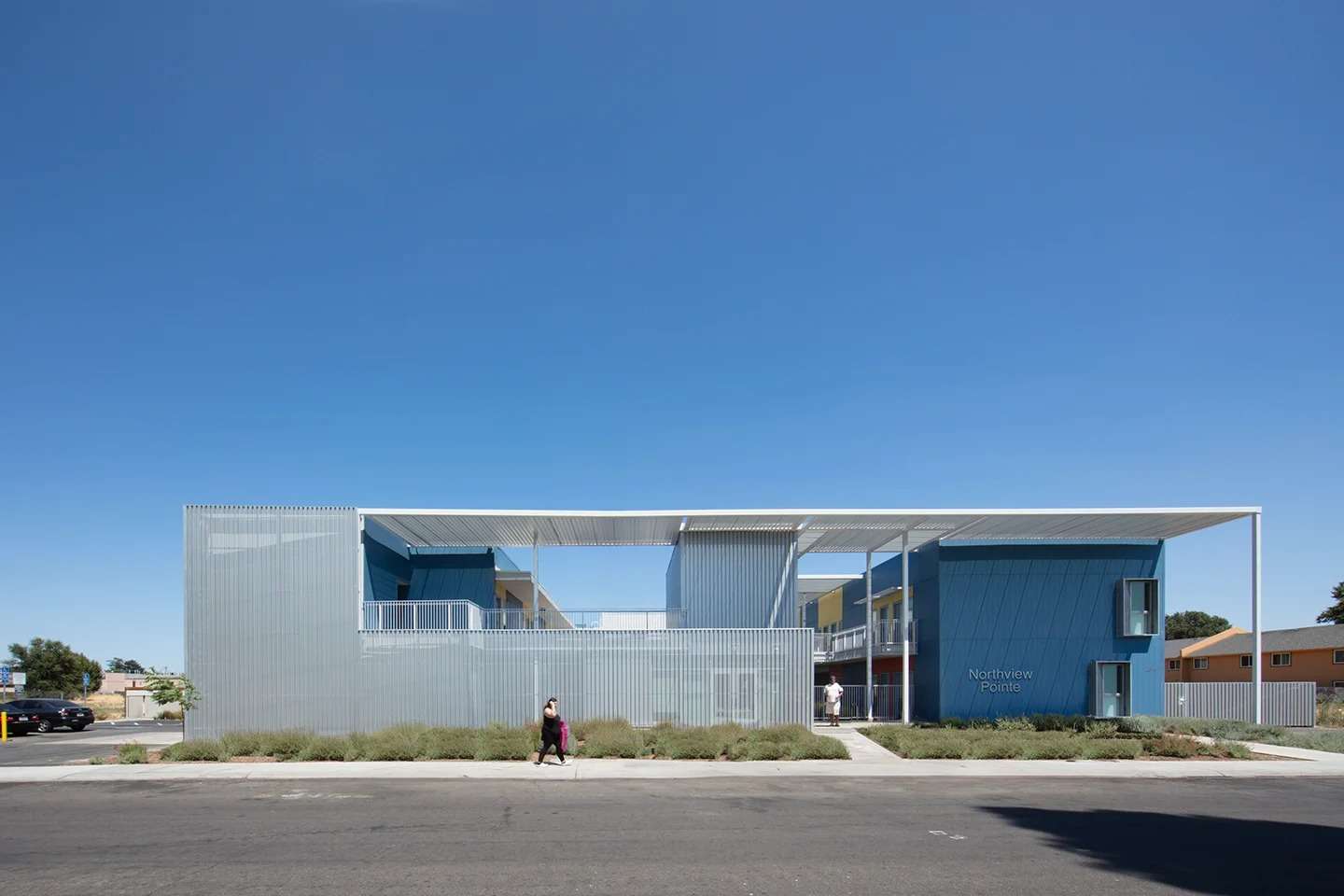
June 25, 2026 June 25, 2026 Home » Projects » Northview Apartments Project Balances Residential Privacy and Spatial Openness The organization of mass and spatial openness is based on breaking down the solid mass into a set of low-rise residential buildings composed of two floors, which alleviates the visual presence of the mass and enhances the human scale within the site. Unlike traditional models of closed residential complexes, the buildings are organized around courtyards and shared outdoor spaces, which form the primary organizational element of the overall plan. This formation contributes to achieving a balance between visual openness and residential privacy, as the units are linked by a network of passages and paths that organize movement and provide seamless transitions between public, semi-private, and private spaces.
The distribution of the blocks at the edges of the site, extending over an area of 1.23 acres, reflects a planning trend aimed at liberating the center of the project in favor of a park and shared social courtyard. Instead of treating open spaces as leftover areas between buildings, the design gives them a central role in organizing daily activities and visual relationships within the complex. This distribution also allows for accommodating 67 residential units within a total building area of 31,100 square feet, while maintaining a sense of spaciousness and openness in the heart of the project.
The central courtyard serves as the connecting element between various parts of the project, as the facades, corridors, and pedestrian paths open onto it within an urban system that enhances ease of movement and visual clarity. Windows and corridors overlooking shared spaces play an important role in supporting the concept of natural surveillance of external spaces (Eyes on the Street), which increases the vitality of these areas and their usability without relying on barriers or traditional security solutions.
The openings and passages penetrating the residential blocks enhance the permeability of movement within the site, linking parking lots, green spaces, and community facilities through a clear and direct transportation network. This organization helps reduce the feeling of enclosure and creates a connected spatial sequence that links different components of the project within a cohesive urban experience.
The architectural formation integrates with passive environmental design strategies by organizing the blocks and courtyards in a way that improves cross-ventilation and takes advantage of natural airflow. The buildings were not designed as closed elements that obstruct airflow; rather, they were arranged in a way that allows air to flow through carefully studied spaces and corridors, contributing to improving thermal comfort and reducing reliance on mechanical systems.
This environmental approach supports the use of drought-resistant plants and reduces impervious surfaces, contributing to lowering resource consumption and improving stormwater management and runoff. These strategies gain special importance due to the project's location near the junction of the American and Sacramento Rivers, where landscape coordination and water management solutions relate to broader environmental sustainability goals and the protection of surrounding natural habitats.
The community hall occupies a central position within the overall plan, serving as a connecting link between internal spaces and the surrounding outdoor areas. The design features large sliding glass doors that allow the hall to open directly onto adjacent courtyards, granting it a high degree of flexibility and accommodating a variety of activities of different sizes. This connectivity between the interior and exterior expands the scope of daily use of shared facilities and enhances the presence of open spaces as an essential part of social life within the complex.
This idea integrates with the central open space covered by a networked canopy extending two stories high, serving both an environmental and functional role. In addition to providing protection from direct sunlight and improving thermal comfort, the canopy allows filtered natural light to pass through, adding visual variety to the space and giving the gathering area a distinctive architectural identity that supports its use throughout the day.
The project reflects a close connection to the natural characteristics of its location near the junction of the American and Sacramento Rivers within the San Francisco Bay watershed. This connection has been translated into a set of...