
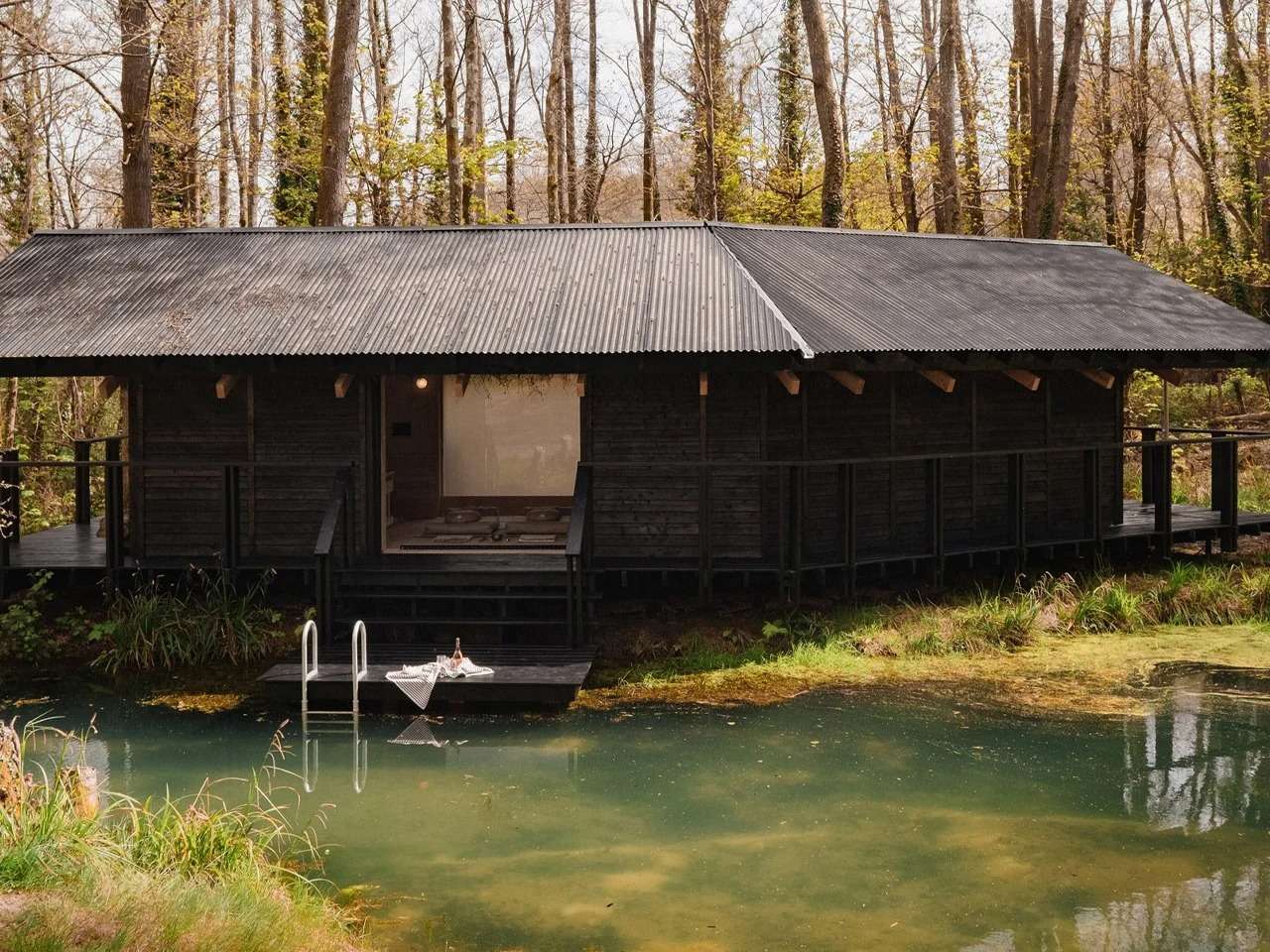
June 26, 2026 June 26, 2026 Home » Projects » Yogi’s Cabin Project Employs Architectural Abstraction to Enhance Connection to Site. The spatial integration and disassembly of the mass transcends the design concept of the structural framework as a separate entity from its surroundings, becoming an organic extension of the natural landscape. The building draws its volumetric composition from the traditional lines of rural barns, but reinterprets them in a contemporary architectural language that reduces its visual presence within the site. The cabin is positioned alongside the natural pond, while the facades and materials used enhance its connection to the surrounding scenery and seasonal changes. This configuration contributes to softening the mass's rigidity and transforming its boundaries into transitional elements that connect the interior and exterior, supporting the continuity of spatial experience.
The movement within the building is organized around the yoga studio, which serves as the main axis of the functional program. The gradation between the natural environment and the interior space enhances a sense of serene transition from the external scene to a more concentrated and contemplative space. Natural light plays a pivotal role in shaping the spatial experience; it filters through openings and facades to generate changing interactions with the wooden surfaces throughout the day. This relationship between light and material contributes to creating a tranquil environment that aligns with the nature of the contemplative activities hosted by the building.
The interior space organizes a horizontal axis extending from east to west, enhancing the building's relation to the natural light movement throughout the day. The wide sliding openings frame views extending towards trees and the pond, making natural elements part of the daily visual experience. This orientation establishes a continuous relationship between the interior space and the external environment, where the quality of light and visible scenes change according to the time and seasons, granting the building a quiet dynamism without the need for complex formal interventions.
The external composition combines the Japanese concept of “Inaga” with the English agricultural barn style, by creating a protected transitional area between the interior and exterior formed through the surrounding terrace and deep eaves. The use of locally sourced larch wood from the farm lands reinforces this connection to the place, especially after being treated using the traditional “Yakusugi” technique. This treatment gives the surfaces a distinctive material character and a dark color that helps the mass visually blend with the surrounding environment while highlighting the properties of the natural material and its role in shaping the project's identity.
The interior environment relies on a minimalist approach that focuses on the quality of space rather than the multiplicity of visual elements. Continuous wooden surfaces, a limited palette of materials, and movable sliding screens establish a flexible space that can be reshaped according to different usage requirements. In this context, essential functional elements such as the bedroom, kitchen, bathroom, and outdoor bathtub recede into the architectural background, while the spatial experience takes precedence as the most present element within the project.
The project presents a model based on architectural reductionism as a means to cultivate a balanced spatial experience. Instead of relying on formal complexity or visual element density, the design focuses on regulating the relationships between mass, light, material, and nature. Through this economy of architectural means, the building successfully directs attention towards the surrounding landscape and highlights its daily transformations, providing a space that emphasizes calmness, contemplation, and the quality of sensory experience within a simple and precise architectural framework.
The project proposes a contemporary architectural approach that subjects the built mass to the experience of place rather than making it the focal point of visual interest. Through reduced composition, material continuity, and deliberate sequencing of spaces, the cabin becomes a tool for framing light and nature rather than an architectural object in itself. Its reliance on local timbers, transitional boundaries, and tranquil spaces reflects a growing trend within design and architecture towards prioritizing sensory experience over formal display.
However, this discourse may carry a degree of idealism; as the notion of complete integration with nature conceals the reality that the building remains a material intervention consuming the...