
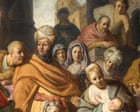
Let The Little Children Come Unto Me, previously not confirmed to be a Rembrandt, had also been edited to clothe the naked child in the foreground. Photograph: Sotheby's View image in fullscreen Let The Little Children Come Unto Me, previously not confirmed to be a Rembrandt, had also been edited to clothe the naked child in the foreground. Photograph: Sotheby's Rembrandt Rembrandt painting was altered to erase turban from man’s head, restorers find Exclusive: Unknown hand covered up artist’s depiction of diverse crowd during influx of refugees to Leiden in 1620s
Prefer the Guardian on Google Layers of overpaint have been removed from a 17th-century painting, confirming that it was painted by Rembrandt and revealing that a turban on one of the figures had been replaced with a traditional Dutch soft cap.
A later anonymous hand had amended or sanitised Rembrandt’s original, apparently misunderstanding that its biblical theme – “Let the Little Children Come Unto Me” – is about tolerance, with Christ blessing children as well as adults. In the gospel of Saint Luke, Jesus rebukes his disciples for turning away parents who brought their children to him: “Suffer [allow] little children, and forbid them not, to come unto me: for of such is the kingdom of heaven.”
Rembrandt depicted a crowd of diverse figures. As well as the man in the turban, Jewish and Christian faiths are also represented.
View image in fullscreen In the painted-over version (left), the turban was replaced with a traditional Dutch soft cap and the child clothed, among other changes. Composite: Sotheby’s The artist seems to have been inspired by the multicultural, religiously diverse streets of 17th-century Holland. When he painted it, religious rivalry was rife and large numbers of refugees were coming to Holland, many settling in Rembrandt’s birthplace, Leiden, to the dismay of most of the city’s population.
The art historian Andrew Graham-Dixon said the painting tallied with Rembrandt’s close connection with the Remonstrants, a group that argued for religious tolerance and acceptance.
“In 1627, when Rembrandt started this painting, Leiden was undergoing an extraordinary humanitarian crisis. The thirty years’ war was at its height, and … hundreds of thousands of people were flooding into the Dutch republic as refugees. In 1626, 1,500 weavers alone arrived there, with their wives and children … so there’s a massive crush of people. It’s estimated that Leiden took something like 10,000 refugees in that one year,” Graham-Dixon said.
“Now, when Rembrandt is painting this, he’s painting this crowded scene of Christ welcoming children, welcoming families. This was very controversial at the time. There were people in Leiden who didn’t want to welcome them. But what we can tell from this painting is that Rembrandt is on the side of humanitarian relief … “So, this is more than just a painting, I think it’s a statement of Rembrandt’s moral position.”
The painting, which measures 106cm by 80.5cm, was discovered in 2014 in a German auction, which had catalogued it as an anonymous “Netherlandish 17th-century painting”.
Now, having been attributed to Rembrandt, it will be auctioned by Sotheby’s in London on 1 July with an estimate of £8m to £12m, reflecting that it is among the most significant early works by Rembrandt remaining in private hands.
Alex Bell, the chair emeritus of Sotheby’s UK, told the Guardian: “It was made into a more traditional, conventional treatme…