
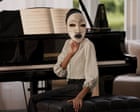
Romy Woods in Strung. Photograph: Blumhouse/Ilze Kitshoff View image in fullscreen Romy Woods in Strung. Photograph: Blumhouse/Ilze Kitshoff Thrillers Review Strung review – far-fetched thriller awkwardly mixes Blumhouse and Tyler Perry There are flashes of low-rent fun to be had here but a busy script makes it feel like a limited series inelegantly cut down to movie length
Andrew Lawrence Fri 26 Jun 2026 09.00 CEST Last modified on Fri 26 Jun 2026 09.02 CEST Share Prefer the Guardian on Google S trung is a cautionary tale about following your gut. Directed by Malcolm D Lee – the under-heralded virtuoso behind Girls Trip, Barbershop and other fine franchises – the Peacock suspense thriller stars Chloe Bailey as Laila, a classical violinist with her sights set on a seat in the city philharmonic. A substitute music teaching gig leaves that dream feeling farther away than ever until Laila meets Lynn Whitfield’s Audra – who not only offers more stable and lucrative work as a private music tutor for her granddaughter, but also an inside track to the philharmonic.
Read more Of course, Laila is too bright-eyed, too bubbly and too overwhelmed by the opulence she’s suddenly crossed into to see that it’s all too good to be true. Audra’s daughter, Imani (DC Titans’ Anna Diop), is icy and unmoved by this childcare lifeline, even as she’s well into her third trimester. The prized pupil, Zuri (Romy Woods), is a modern problem child: hyper-allergic, emotionally withdrawn and forever hiding behind a Dahomey warrior mask. The pupil’s antisocial behavior, and its eerie echoes of another young Black girl who looms large in Laila’s imagination (her sister, we later learn), is supposed to set Zuri up for the classic killer kid role. But Lee abandons that tension fairly quickly, and instead traces the girl’s quirks back to the murder of her rapper father. It isn’t until Imani’s husband, Marcus (Emily in Paris’s Lucien Laviscount), re-enters the picture – he and Laila hooked up before she was hired to tutor his stepchild in another coincidence, more inconvenient this time – that Strung really starts to get wooly.
Given how insistent Strung’s screenwriter Alan McElroy is on returning to the theme of instinct, you wish the film itself had as much courage in its own conviction. Suspense thrillers are supposed to be taut and pacy, an anxiety factory running at maximum efficiency. But Strung is full of detours, each more tedious than the last: the ancillary character development, the romantic entanglements, the flashbacks to her sister – which somehow still don’t land even after Audra spells out the connection. The fixation on Zuri’s physical and mental state becomes so acute you half expect it to lead to a deeper meditation on the early childhood development needs of Black children who have been unduly exposed to trauma. Instead, the film drags on – for about two hours in total – and the central tension flickers until the whole thing feels less like a purpose-built feature than a limited series hastily stitched into one, with Lee ham-handedly propping the door open for a sequel.
Still, it can’t be said that Strung isn’t slickly put together. The art department and visual effects team really draw out the sterility of this wealthy world, more gilded cage than anything truly aspirational – all while looking, as is so often the case with US-focused productions that shoot in South Africa, like nowhere in particular. You can practically see the steam radiating off…