
There’s this thing in acting where, when you first encounter a new part, in order to build out the character and figure out exactly who they are the actor needs to take big, sometimes outlandish swings. They need to scream and cry and laugh and feel their feelings as deeply as possible. Doing so allows them to see where the edges of said character really lie. What’s too much. What’s shockingly not enough. This is usually done in rehearsal, in workshops, and in private work at home. Things are tried and decisions made that may never be seen by the public at large, but inform the performance that ultimately is. Because the thing about good acting is, it’s brave — it goes right to the edge — but, often, it’s hard (if not impossible) to know exactly where that edge is until you’ve gone over it a few times.
This is true, in one form or another, for all art and artists — from actors to painters to poets to fashion designers. Kicking out the corners of a thing is necessary in order to really understand its shape. That’s why painters make preparatory sketches and sculptors make scale models. And maybe, just maybe, it’s why Jonathan Anderson began his tenure at Dior menswear with so many strange and outlandish creations — from the men’s bar jackets to the labial cargo shorts to the sequined flapper tanks. He famously told Bernard Arnault that in order to do his best work at Dior, he needed time to cook. To experiment. To figure out exactly what his Dior would look like. And now, it seems, the true shape of what that is may finally be coming into focus. And it’s pretty compelling.
Loose and louche, the show opened with a trio of sheer, double-breasted suits in pinstripe and plaid — a sort of dreamy take on classic menswear that was pajama-like without feeling like actual sleepwear.
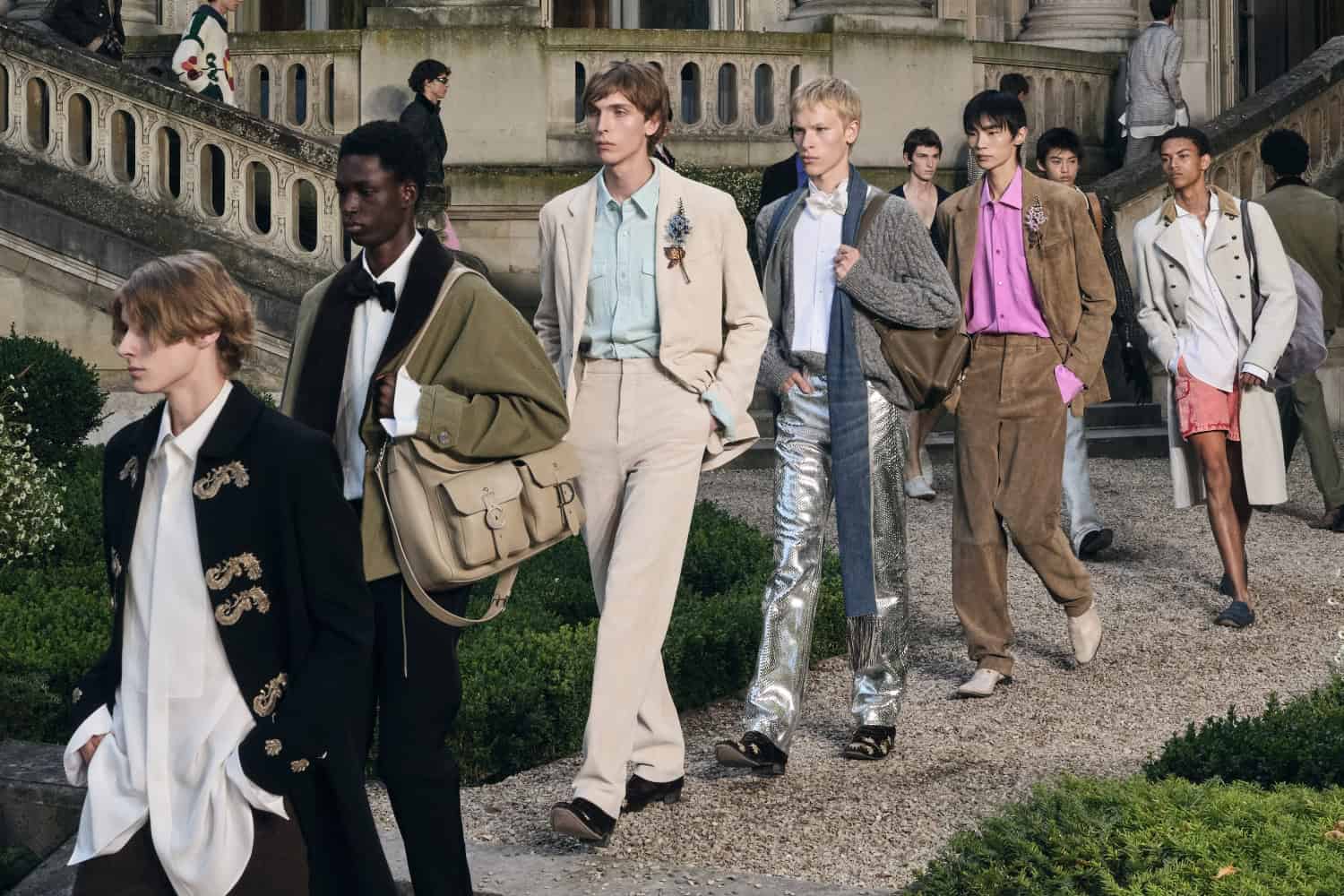
The entire collection, in fact, had this sort of liminal quality — somewhere between waking and sleeping, lounging and living. The coats looked like robes, but not so much that anyone would think you were actually wearing your robe out of the street. The fringe that bordered the cuffs and hems of some of the jackets was reminiscent of throw blankets, while the ripped up jeans felt lived in and well loved — like a favorite childhood blanket, or, indeed, a favorite pair of jeans that you were never able to bring yourself to throw away, even when rips and distressing fell out of fashion.
While other designers push skinny jeans and shrunken silhouettes that feel almost like an assault on the male body, Anderson shows clothes that are loose, that drape, that one imagines would actually feel good on the body and be a pleasure to wear, not just to look at.
And, of course, there are still plenty of sartorial flourishes — the gold and silver lame shorts and trousers, the glittery captain’s coats, and the oversized floral boutonnieres, which seem to be becoming something of a staple in Anderson’s Dior — but it all feels much less forced this time around. Much more grounded in reality. More wearable.
Workwear-inspired pieces like the green twill jacket (or the one in beige) with the brown shearling shawl collar — a Carhartt-esque take on a tuxedo jacket — feel especially successful and desirable. As did one particularly beautiful off whit double breasted coat with brass buttons and a brown suede collar — refined and elegant but brought down to earth just enough that you could wear it with anything.
Sea...