
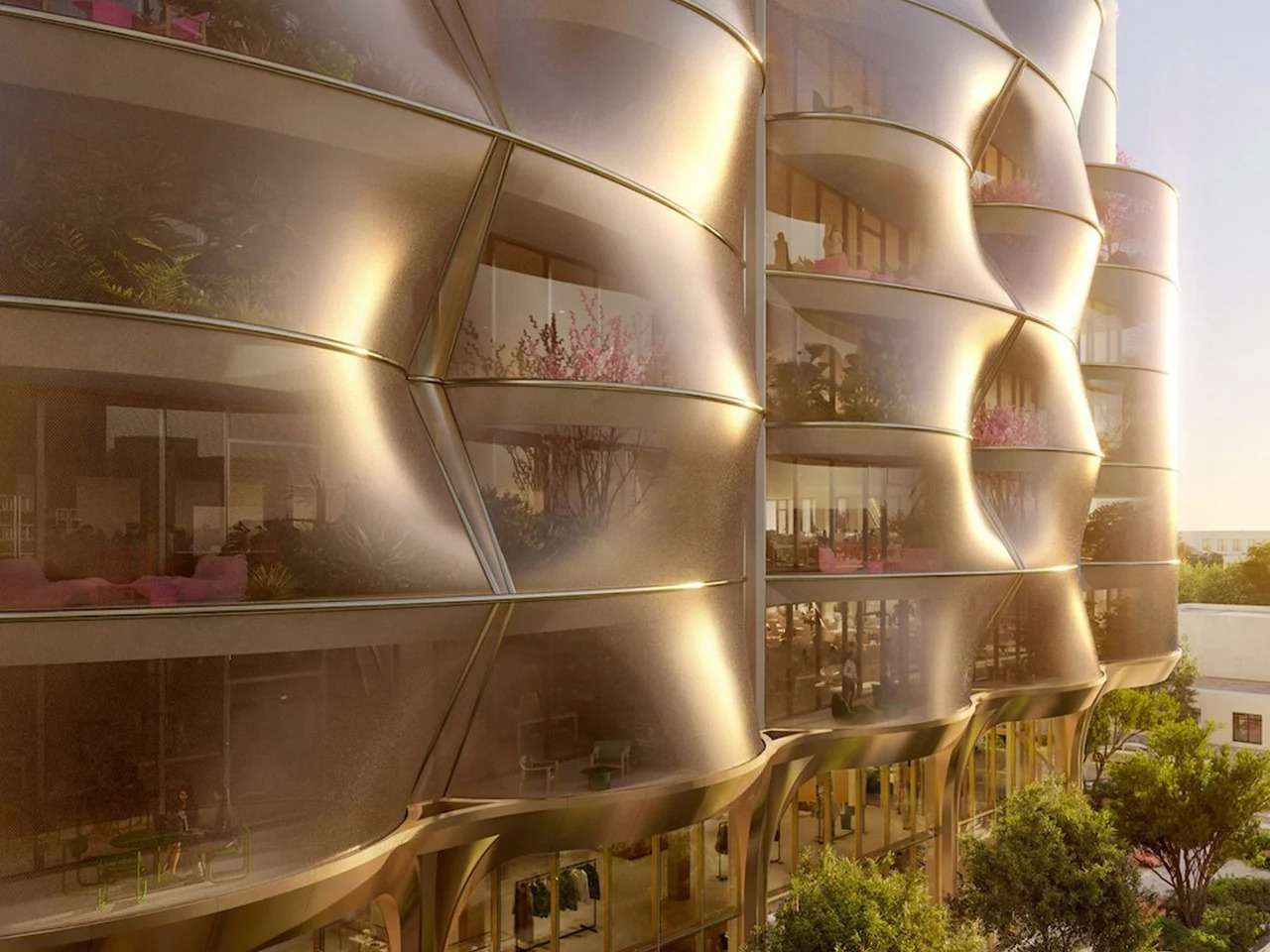
On June 26, 2026, Home » Projects » Swaybird North Tests the Limits of Reveal and Conceal in Architectural Facade Configuration. The dynamics of mass and double façade present the exterior as a transformed structure that does not settle into a single visual state, but acts as a responsive layer to light and the surrounding environment. The stainless steel façade forms a surface grid that interacts with changing sun angles, where the intersection of geometric rhythm with the daily light movement results in a continuous contrast between opacity and reflection. Thus, the covering transforms from a traditional closure element into a dual-performance façade, revealing terraces and interior spaces at certain moments while redirecting light at other times to reduce glare and achieve a higher degree of privacy in front of the internal glass façade, aligning with contemporary design directions.
The kinetic experience begins at the sidewalk level at the base and gradually transitions through a vertical void extending over eight mixed-use floors. The vertical structural grid extending from the ground to the roof organizes the visual movement and directs spatial perception, enhancing the sense of vertical extension. In this sequence, the architectural scene overlaps with the planted terraces and interior spaces, forming a crossing experience that relies on the continuous alternation between the built and nature, without the need for a strict separation between them, a trend present in many contemporary architectural projects.
The programmatic organization is based on a clear vertical separation between uses. The base (first and second floors) accommodates flexible commercial activities, while office floors extend from the third to the eighth with adaptable open floor plates to suit the needs of creative and service sectors. The integration of planted terraces within these levels enhances the quality of the internal environment, providing spaces for ventilation and natural lighting that mitigate the density of the surrounding urban context, supporting a work environment that balances productivity with nature, considerations that also relate to fields of interior design and sustainable building materials.
The mesh façade acts as a visual filter whose effect changes according to the angle of view and the changing light throughout the day. It is not read as a static layer, but as a shifting membrane that reshapes the perception of the architectural mass from moment to moment. This contrast results in a dual visual experience: a rapid reading from the street level reveals gradients of light and movement, while a deeper contemplation from farther distances highlights the internal layers of the building. Between the two cases, the façade oscillates between revealing and concealing, granting the mass a variable visual presence without relying on a fixed formal impression, a theme repeated in many contemporary architectural research.
Swaybird North is presented as a responsive vertical system where the steel mesh covering acts as an intermediary between the movement of the sun and the gradient of internal programs, forming a dual façade that oscillates between opacity and transparency. The vertical distribution is organized over eight floors that integrate planted terraces with mixed uses in a continuous spatial field shaped by light, redefining the relationship between mass and façade within a changing urban context analytically connected to the architectural façade, placing the project in the category of buildings exploring visual performance as part of its architectural identity.
However, critical reading reveals an exaggeration in attributing the mesh covering to an independent environmental role, as it is depicted as a self-sustaining climatic mechanism without sufficient detail on execution costs or long-term performance maintenance. In reality, such systems often tend to favor the representational aspect over operational efficiency, especially in urban projects dependent on symbolic economy more than physical performance. Thus, the architectural meaning becomes a discursive product rather than a realized environmental measure, a discussion present in many architectural news articles and within the archive of specialized content in architectural affairs.