
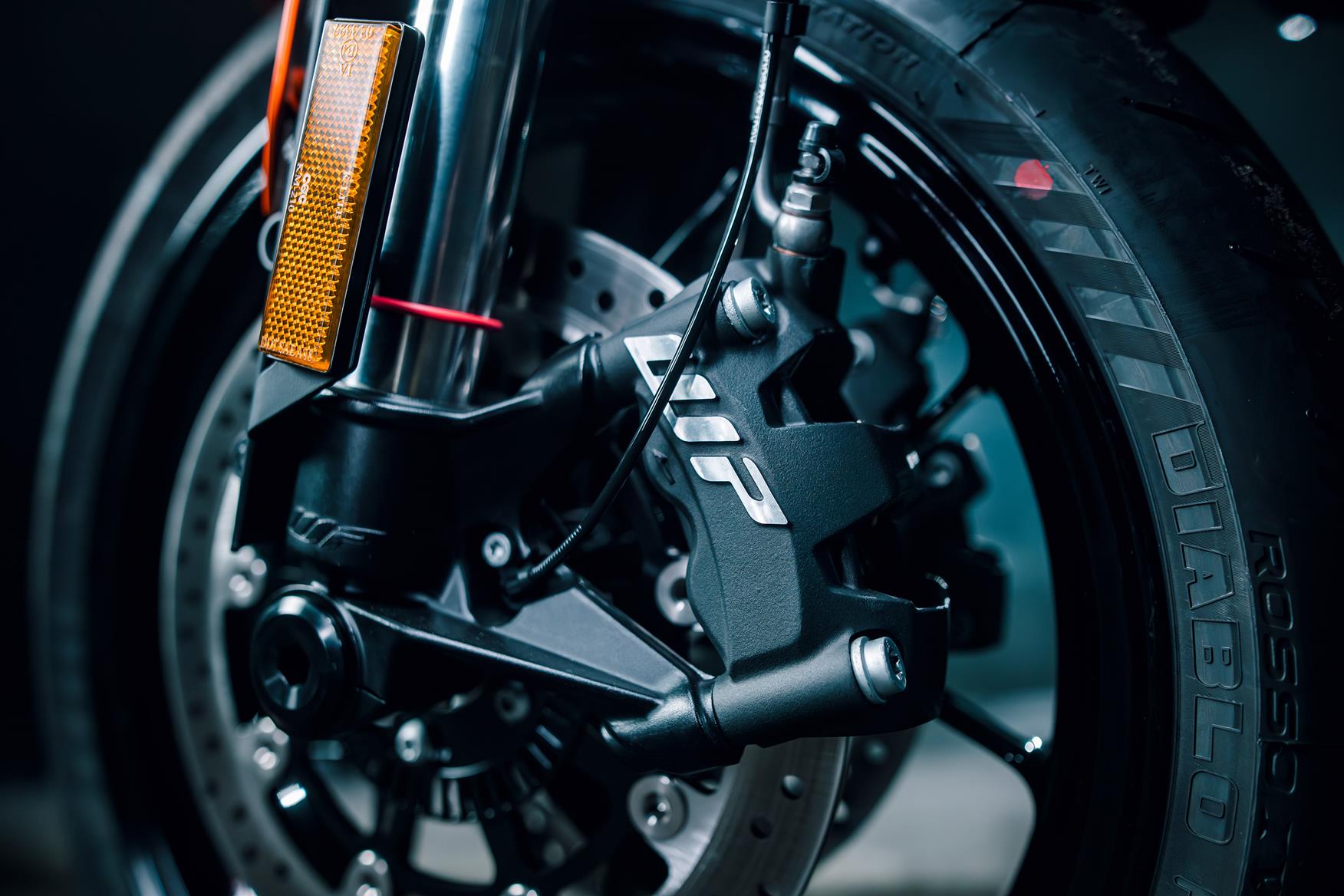
There’s been a shortage of new names on brake calipers in recent years, but KTM are now looking to mix things up with a new range of stoppers produced by their in-house WP operation – allowing them to speed up their development operations.
The suspension specialist brand was bought by KTM’s former parent firm Pierer Mobility (now Bajaj Mobility AG) in the late 1990s and has since served as the internal suspension division for GasGas, Husqvarna and KTM – producing shocks and forks for on-road and off-road bikes, plus KTM’s RC16 MotoGP racer.
But now WP has turned its hand to a new area of chassis tech – brakes. The new stoppers appeared first on the 390 Duke single, then the latest 790 Duke twin which was launched to the world in late June.
“KTM wanted to start making these components, to control the development and set up the components as we want them for our bikes,” Project Leader in the brake development programme, David Bruna, told MCN.
That desire for more control over how its braking systems were developed led to KTM engineers setting up a secret five-year development programme based in Barcelona, Spain.
They headhunted a team of specialists from other brake companies, with more than 20 years of experience in developing brake components, basing them in a new high-tech R&D lab. This new Catalan team has pioneered the design and production of KTM’s own brake caliper and master cylinder designs.
Production will be moved to India, which makes sense after Bajaj took over the Pierer group last year following a period of ‘self‑administration’ that started in late November 2024.
“What we needed to do was build our own manufacturing plant there,” Bruna continued. “This has been done to have control over the whole production chain.
“We do the machining, the assembly, the anodising, the checking… Everything is done in one building, following all the KTM quality requirements.”
The result is a new line of brake products, which KTM are gradually feeding into their model range. First bike to get WP brakes was the Duke 390 at the beginning of the year. It wears a single WP four-piston FCR4 caliper, which weighs less than 740g and is made of a high‑strength alloy.
That’s been followed by the new 790 Duke , which wears a brace of four-piston radial WP calipers plus the firm’s radial master cylinder and in-house braided steel hoses.
So, what are the differences between the two systems? The 790’s front brake lever master cylinder has a larger piston diameter to accommodate the dual front brake disc system, while at the rear a different caliper carrier is required due to the modified swingarm and corresponding wheel configuration.
The 790 also gets more aggressive brake pads to enhance braking performance and response. The results are impressive: testers on the 790 Duke launch (MCN, June 24) reported a strong initial bite from the new brakes, with really progressive power.
WP isn’t making its own discs as yet – for now it’s sticking with Galfer (also based in Barcelona).
While KTM are tight‑lipped on future developments, it seems clear that we’ll be seeing WP brakes on many more Pierer/Bajaj machines soon, with the brand becoming as ubiquitous as its suspension on KTM and Husqvarna bikes.
“We don’t have to stick to off‑the‑shelf components, so we can really dedicate all our ideas and bring everything together for the bike,” Bruna said. “We can develop them specifically for this product and nothing else. This is something you cannot do w...