
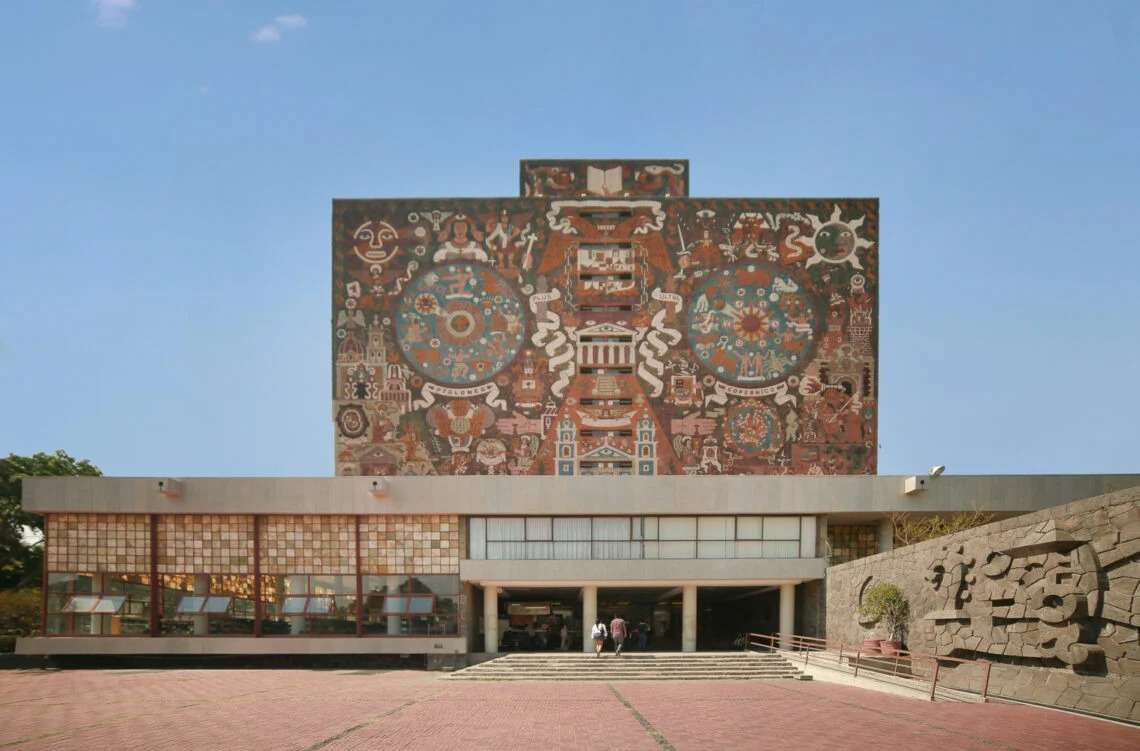
June 28, 2026 June 28, 2026 Home » Architecture » UNAM Central Library: Organizing Movement and Light Between the Open Base and the Archive Tower The human experience and spatial transition impose the library's visual presence through a sharp contrast between two functional and dynamic levels; the journey begins from the open ground floor that relies on transparency and direct connection to the surroundings, where movement flows within an organized educational space reflecting the principles of functional architecture in the distribution of paths and organization of use. This horizontal extension dedicated to reading and interaction gradually retreats with the vertical transition towards the closed archive tower, where the space closes upon itself to protect the knowledge collections, in a clear transition from visual openness to functional isolation linked to conservation requirements and environmental control within a distinctive volcanic topographical context.
The visual dimension of the building is manifested in the mural “Historical Representation of Culture,” which transforms the solid tower into a wide visual surface that interacts with changes in light throughout the day. Here, natural building materials do not function as decorative elements, but as visual mediums that reshape shadows and light on the four façades, producing a multilayered reading of the pre-Hispanic, colonial, and modern Mexico historical periods. This interplay between functional architecture and mural art gives the façades a visually changing character influenced by viewing angles and the movement of the sun, enhancing the presence of the cultural dimension within the academic structure of the building.
The library is situated within the central fabric of the university buildings in Ciudad Universitaria, where user experience transforms into a gradual transition between varying spatial levels. The experience starts from an architectural mass that blends modernity requirements and the symbolic dimension of the academic institution, within an urban plan aimed at promoting Mexican cultural identity through a precise organization of the relationship between function and architectural expression.
The visual dimension of the building is shaped through an architectural treatment developed by Juan O'Gorman with a team of architects, where the solid blocks interact with natural light to produce a changing visual scene. This interaction is highlighted in the integration of the structure with mural art, so that surfaces become narrative façades reflecting cultural transformations in Mexico during the 20th century. This integration of material and configuration produces a spatial experience that connects the user with the context of national identity without the need for additional decorative elements.
The internal organization of the building clearly reflects the principles of functional architecture, as it is built around a precise distribution of activities within the space. The use begins from the open ground floor that allows smooth movement between the reading, reference, and service sections, in an environment that relies on fluidity and direct functional organization. This character gradually changes as one ascends to the upper floors designated for the archive, where the space transforms into a closed structure dedicated to preservation, visually isolated to serve the stability of the library collections. More architectural news similar to this project can be accessed.
The project represents an important transition of architectural modernity to the Mexican context during the mid-20th century, through a precise treatment of the relationship between mass and site. The tower mass acts as an organizing element of light and the surrounding environment, not as a direct technical control system, but through a solid structural mass that achieves environmental protection through density and mass. This configuration results in a clear contrast between functional transparency in the ground base and massive closure in the upper tower, enhancing the visual reading of the mass as an independent architectural element within the site.
The structure of the building emerges from the volcanic terrains of Pedregal de San Ángel, where the entry experience is based on a ground level functioning as an architectural base integrated with the site's nature. Within this level, movement is distributed between lecture halls and reading and reference areas within a clear functional organization grounded in the principles of modern composition based on geometric masses and organized spaces. Cities adopting such architectural proposals can be explored.
This horizontal extension transforms into a counterpart element to the upper tower, where the user gradually transitions from open and transparent spaces to a closed archive mass. This transformation not only presents a difference...