
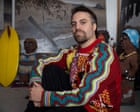
Bain in his Granville studio with a few of his clay Indigenous figures dressed in bikinis, shorts and budgie smugglers. Photograph: Jessica Hromas/Guardian View image in fullscreen Bain in his Granville studio with a few of his clay Indigenous figures dressed in bikinis, shorts and budgie smugglers. Photograph: Jessica Hromas/Guardian Indigenous art ‘The beach was and still is an Aboriginal space’: artist Billy Bain on reclaiming the sand and waves For his upcoming solo exhibition, the Dharug artist has made 11 colourful clay sculptures that represent a counter-image to the bronzed Aussie beachgoer
Sign up for a weekly email featuring our best reads
Prefer the Guardian on Google A s a teenager in the mid 2000s, Billy Bain would ride waves around Sydney’s northern beaches, having travelled the world watching his champion surfer father Rob Bain compete. But even though he was minutes from his home in Avalon, he was often made to feel an unwelcome outsider.
“I’d be told that I’m not from there, so I need to go in [to shore],” he says, seeing these warnings as veiled threats of violence. “Otherwise, you know, ‘something’s gonna happen to you’.”
Read more Now 33, the Dharug artist sees simply being an Aboriginal surfer as a way of reclaiming space. “[The northern beaches are] quite an isolated and predominantly white place,” he says.
“You know, the beach was and still is an Aboriginal space, but in popular culture it has been represented as a very white space. There’s obviously the bronze Aussie, which is your typical tan, athletic white male, but it’s not seen as being a space that Aboriginal people inhabit any more.”
View image in fullscreen Bain holds a soft sculpture of an eel, which will hang in his solo show By the River at AGNSW. Photograph: Jessica Hromas/The Guardian In his studio in Granville in Sydney’s inner west, Bain is preparing for an upcoming solo exhibition at the Art Gallery of New South Wales, By the River . The survey will feature new work, including five landscape paintings of the Dyarubbin/Hawkesbury river – a location that connects the Manly born artist with the country of his ancestors.
“Geographically it was actually very close for us,” says Bain, who has come to see surfing on the northern beaches as a form of cultural return, because the Dyarubbin flows into an estuary at Pittwater. “I see the story of the eel and how it spawns out at sea and then it finds its way back up these river systems to be an interesting metaphor for a return. I see myself as having a similar journey.”
For By the River, Bain has made 11 funny, figurative Indigenous family members (and one dog) dressed in bikinis, shorts and even a pair of budgie smugglers painted in Aboriginal colours: red and black with a yellow tie. These clay sculptures represent this collective reclaiming of the beach as an Indigenous sovereign space, open to everyone.
View image in fullscreen Bain’s figurative clay family members at his studio. Photograph: Diana Panuccio/Art Gallery of New South The figures will be displayed holding aloft a four-metre, long-finned eel – a totem animal and spirit of resilience known in Dharug language as a burra – which Bain has fashioned as a soft sculpture using cloth on a wire and steel frame, adorned by 200 textile elements handwoven by his mother, Kathleen Bain.
Kathleen, a Dharug woman who grew up in Balgowlah, north of Sydney, met Bain’s father when they were teenagers. She would encourage her children to create with a…