
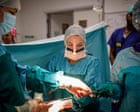
Dr Kathryn Tompsett, consultant obstetrician and gynaecologist and clinical group director assisting during the planned caesarean section in Queen’s hospital maternity ward in Romford on 1 June 2026. Photograph: Alicia Canter/The Guardian View image in fullscreen Dr Kathryn Tompsett, consultant obstetrician and gynaecologist and clinical group director assisting during the planned caesarean section in Queen’s hospital maternity ward in Romford on 1 June 2026. Photograph: Alicia Canter/The Guardian NHS How a Romford maternity ward was able to turn the tide after a ‘requires improvement’ rating Hiring more staff and providing interpreters are just some of the actions taken by Queen’s hospital to tackle core problems
Risk of serious birth injuries is rising for women in England, data suggests
Denis Campbell Health policy editor Sun 28 Jun 2026 21.04 CEST Last modified on Sun 28 Jun 2026 21.53 CEST Share Prefer the Guardian on Google T wo days after giving birth, Juliana Nascimento Barbosa is still ecstatic about becoming a mother. “I’m so happy to have my baby,” she says from her bed in Queen’s hospital in Romford, Essex, smiling broadly.
To her left, her husband, Emerson, sits on a chair. To her right, their newborn son Dominic lies on a neonatal resuscitaire receiving phototherapy, a light treatment to help relieve his jaundice.
He is wearing a tiny nappy and his eyes are covered by a mask to shield them from the machine’s four bars of bright light.
It is helping to purge his tiny body of bilirubin, the pigment in bile that turns skin yellow in people with jaundice, because his liver is not yet strong enough to do that. He cries softly when a nurse takes a few spots of blood in a heel prick test to help staff monitor his condition.
View image in fullscreen Mum Juliana and dad Emerson with baby Dominic, born two days earlier, being treated for jaundice. The maternity ward at Queen’s hospital in Romford, 21 May 2026. Photograph: Alicia Canter/The Guardian Juliana is still in hospital – not just to look after Dominic but because, like so many women, the birth proved complicated.
Her labour was progressing, albeit slowly. But then a CTG (cardiotocograph) trace, to monitor her baby’s heartbeat, showed he had passed meconium – his first stool – while still in utero.
That can be a sign of a baby’s distress, perhaps because they have an infection or are not getting enough oxygen, explains Dr Kathryn Tompsett, the head of maternity and children’s care at Queen’s. “When that happens the priority is to get the baby born ASAP, usually within 30 minutes,” says Tompsett.
Such safety-first medicine is common in childbirth, where two lives could be at risk. A wrong decision can lead to a baby suffering brain damage and cost the NHS £20m in damages.
Things moved fast. By then Juliana had become fully dilated, which helped. Fifteen hours after her labour began, and six after staff ruptured her membranes to speed things up, Dominic was born.
He was delivered vaginally but only after Dr Georgina Lennon-Butler, a resident obstetrician, had used a ventouse suction cap to help get him out and made a cut – called an episiotomy – to create more space for that to happen.
That meant Dominic was classed as an assisted vaginal birth. His care illustrates the medical intervention that maternity teams increasingly use because childbirth has become more complex and more perilous.
View image in fullscreen The nurses on the postnatal ward at Queen’s hospital…