
BBC News, Arabic Go to main content Main Sections News Economy Health Science Culture and Arts World Cup 2026 Investigations News Economy Health Science Culture and Arts World Cup 2026 Investigations The United States and Iran Plan to Cease Strikes and Resume Talks, Lebanon Under Fire Despite Framework Agreement with Israel Image credit, Reuters
An American official said on Sunday that the United States and Iran had agreed to cease the latest wave of hostilities in the Gulf and to resume talks regarding their dispute over the Strait of Hormuz, according to Reuters.
He added, "Technical discussions regarding all terms of the memorandum of understanding are scheduled to resume. Both sides will temporarily cease strikes and allow ships to sail freely," referring to the 14-point memorandum of understanding agreed upon on June 17, under which the strait will be reopened to navigation.
Axios reported, citing a senior U.S. official, that talks will resume on Tuesday in Qatar.
This comes as strikes and mutual accusations between the United States and Iran have continued for the fourth consecutive day, despite both sides agreeing earlier this month to end the war.
Iran targeted U.S. military bases in Kuwait and Bahrain on Sunday, in response to a threat issued by President Donald Trump to "wipe out the Iranian leadership" if it does not comply with the temporary agreement between them.
The U.S. military announced it had again struck Iran after a Panama-flagged tanker was targeted by an Iranian drone in the Strait of Hormuz.
Explosions were heard in the city of Sirik in southeastern Iran, according to Iranian state media, which did not disclose further details.
The Iranian Revolutionary Guard stated that the U.S. strikes had violated the ceasefire, which could lead to "a halt to all diplomatic operations."
A detailed explanation of the main events and topics is warranted to help you understand the significant changes around you and their impact on your life.
An American official confirmed Iranian targeting of U.S. facilities, without details regarding the damage caused by this targeting.
The Iranian Revolutionary Guard Navy indicated that U.S. bases in the region "will face hell in the coming days."
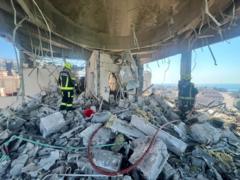
Within hours, sirens sounded for the second time in Bahrain, where authorities reported that an Iranian attack destroyed a residential building in the Muharraq area in the northernmost part of the kingdom, without mentioning any injuries.
Manama urged the United Nations Security Council to hold an emergency session to hold Iran accountable.
The Kuwaiti army stated it intercepted two ballistic missiles without any damage or injuries.
Additionally, Qatar reported that one of its citizens had died from injuries sustained during military operations in the region.
These attacks threaten to undermine efforts to reopen the Strait of Hormuz under the memorandum of understanding signed by the United States and Iran.
They also add pressure on the initial peace agreement, alongside ongoing fighting on the Lebanese front, as well as differences over nuclear inspection operations.
Nonetheless, both Trump and Iran have shown signs over more than two months since the signing of the ceasefire agreement in early April of this year of a desire to keep any fighting "under control."
These mutual skirmishes did not prevent the signing of a memorandum of understanding aimed at reopening the Strait of Hormuz and ending the U.S. blockade imposed on Iranian ports.
Negotiations between Washington and Tehran were expected to resume during the upcoming weekend in Switzerland, were it not for the renewed fighting between the parties, according to the Wall Street Journal, citing informed sources.
Meanwhile, oil prices rose on Monday after the exchange of strikes between the United States and Iran, highlighting the fragility of their temporary agreement to end the war and again slowing oil shipping in the Strait of Hormuz.
Brent crude futures rose by 50 cents, or 0.69 percent, to $72.49 a barrel by 22:04 GMT, while U.S. West Texas Intermediate crude traded at $69.96 per barrel, up 73 cents or 1.05 percent.
The Iranian Revolutionary Guard said...