
Science Northern Lights Forecast: Aurora Possible In 19 States On Monday Night By Jamie Carter ,
Forbes contributors publish independent expert analyses and insights. An award-winning reporter writing about stargazing and the night sky. Follow Author Jun 28, 2026, 11:30pm EDT --:-- / --:-- This voice experience is generated by AI. Learn more . This voice experience is generated by AI. Learn more . Summary The Northern Lights may be visible Monday night into Tuesday morning, June 29-30, in northern U.S. states near the Canadian border. A coronal mass ejection (CME) from the sun on June 26 is forecast to trigger a G1 or G2 geomagnetic storm upon reaching Earth. Montana, North Dakota, Minnesota, Wisconsin, Washington, and Maine are among states with the best viewing potential. However, long daylight hours post-solstice and the full Strawberry Moon may hinder visibility. To view, look north, avoid bright lights, and use long-exposure camera settings, as cameras often capture faint aurora before the human eye. Real-time forecasts are available via NOAA and dedicated apps.
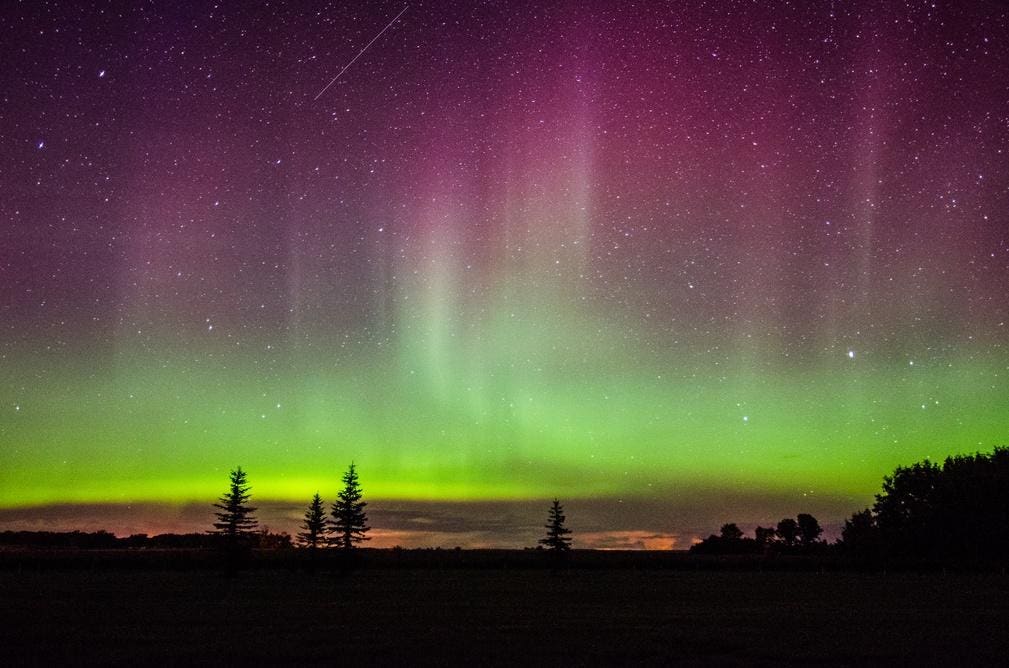
The northern lights may be visible from states along the U.S.-Canadian border overnight on Monday, June 29, into Tuesday, June 30. getty The northern lights may be visible overnight from a few northern states along the U.S.-Canadian border on Monday, June 29, into Tuesday, June 30. A coronal mass ejection — a cloud of charged particles — left the sun late on June 26 in Earth’s direction, with NASA models forecasting its arrival on Earth. It could cause up to a G2-class geomagnetic storm, which could mean aurora being seen on the northern horizon from U.S. states close to the border with Canada — most likely across parts of Montana, North Dakota, Minnesota and northern Wisconsin.
Long daylight hours in the wake of last week’s solstice , coupled with the rising on Monday, June 29, of the full Strawberry Moon in the south, may make aurora harder to see.
A G1 or G2-rated geomagnetic storm is not a major aurora outbreak forecast. However, KP 4 or KP5 conditions can sometimes bring visible northern lights to the far northern tier of the U.S., especially near the Canadian border.
If the skies are clear, aurora watchers should look north, avoid bright lights, and use long-exposure settings on their phones or cameras. Cameras often detect faint aurora before the human eye can see color clearly. Here’s how to photograph the northern lights using a phone .
The nine states with the best chance include the northern parts of Washington, Idaho, Montana, North Dakota, South Dakota, Minnesota, Wisconsin, Michigan and Maine. It’s also possible that aurora will be glimpsed from Oregon, Wyoming, Nebraska, Iowa, Illinois, Indiana, Ohio, New York, Vermont and New Hampshire.
A CME is a cloud of charged particles often created by solar flares. Unlike solar flares, which travel at light speed, CMEs move at up to 1,900 miles (3,000 kilometers) per second and take a few days to travel across the solar system. If they are Earth-directed, they can produce geomagnetic storms and auroras.
According to SpaceWeather.com , this CME could spark a G1-class geomagnetic storm when it reaches Earth. According to a forecast by space weather experts at the National Oceanic and Atmospheric Administration, “Enhanced conditions are expected to return early to mid on 30 Jun due to the CME that left the Sun late on 26 Jun.”
A UK Met Office forecast slightly ups the ante. “CME arrival on day 3 is expected to in…