
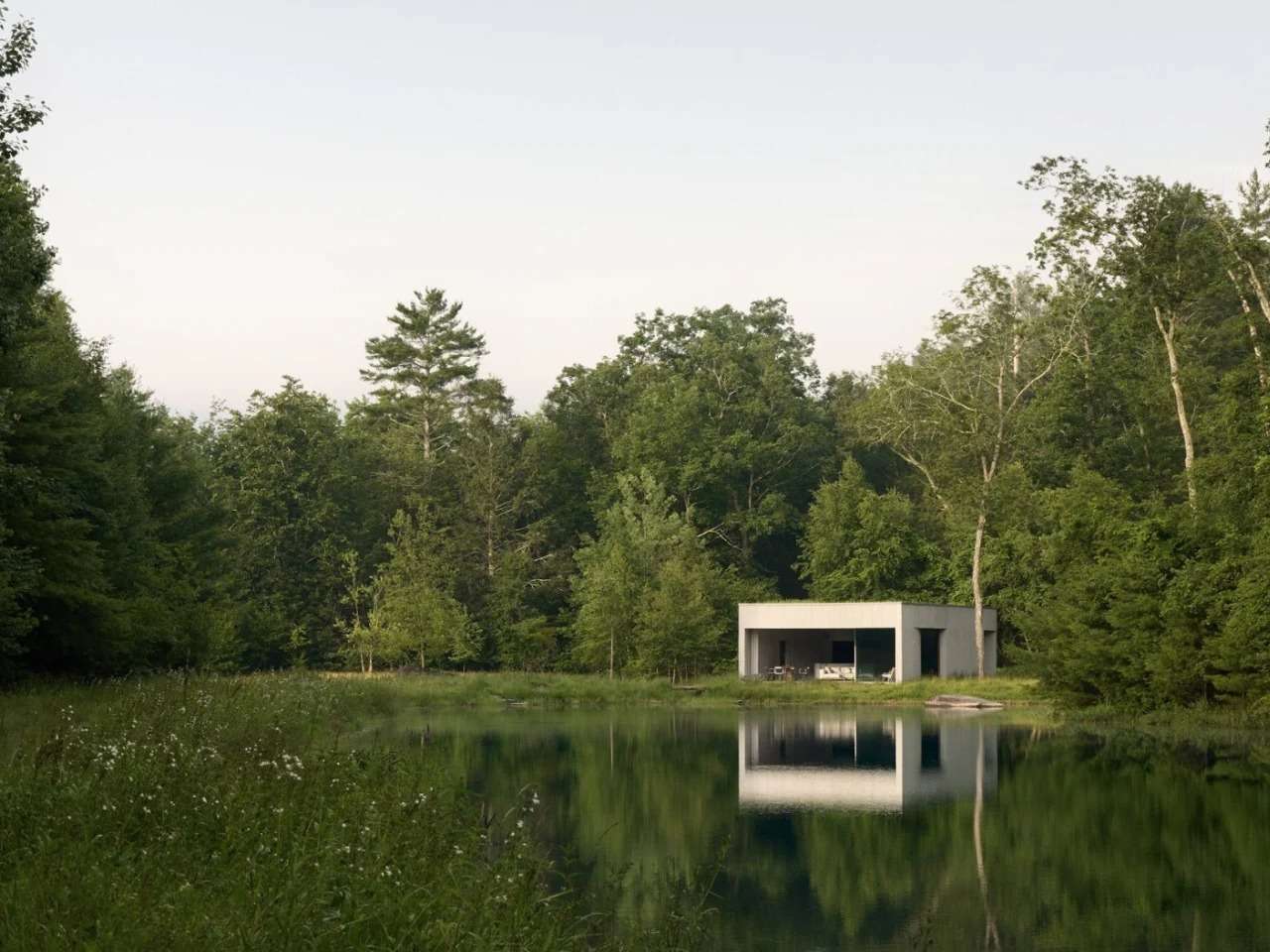
On June 28, 2026, Home » Buildings » Vibe Pavilion Design Integrates Mass and Light in a Changing Spatial Experience. The disassembly of mass and spatial dynamics extends beyond the pavilion's traditional shelter concept to provide an architectural reading of the relationship between mass and the surrounding landscape. The structure is based on two adjacent oval forms responding to the curvature of the nearby pond, enhancing the visual connection between architecture and natural elements. The exterior envelope is composed of a mix of smooth and ribbed stucco, giving the façades a material presence that changes depending on the light and viewing angles. Semi-circular cutouts from the mass contribute to softening the rigidity of the exterior form and directing visual perspectives, revealing the building gradually instead of presenting it as a closed mass that can be fully perceived at first glance.
The visual perception of the building is shaped by the ongoing interaction between light, texture, and mass. As the sun's position changes, the density of shadows produced by the ribbed surface varies, giving the façades a visual transformation throughout the day. At the same time, the nearby pond amplifies this effect through the reflection of light on surrounding surfaces, making nature part of the architectural scene itself. This interaction between material and environmental elements grants the building a changing presence that surpasses conventional geometric stability.
The interior layout relies on a concise functional program that includes two bedrooms, one bathroom, a covered terrace, and an outdoor yard, in an approach focused on spatial efficiency rather than functional complexity. The 1,200 square foot space features furnishing elements made of travertine stone and polished aluminum, enhancing the serene character of the space without competing with the core architectural elements. The interior opens up to the natural scene through an extended floor-to-ceiling glass façade, visually aligning with the pond's surface to expand sightlines and connect the interior space with the surrounding natural landscape and the Catskill Mountains.
The experience of access begins from the internal courtyard, which acts as a transitional space between the exterior and the main space. This movement sequence integrates with the green roof covering the building, reinforcing the continuity of the natural landscape above the architectural mass and limiting its visual presence within the site. This fusion of movement and natural composition contributes to establishing a more balanced relationship between the building and its surroundings, making architecture an extension of the natural landscape rather than a separate element.
The pavilion reflects a design direction based on resource efficiency and a focus on quality execution. This is manifested in the balance between the materials used and the architectural composition, where material elements are employed to highlight the characteristics of mass and space without resorting to excessive formal treatments. The idea of design continuity is also evident in the relationship between the geometric precision of the components and the overall architectural experience, creating a clear harmony between the details and the general scene.
The project is not just an architectural composition for viewing but offers a model for daily use within a serene natural environment. The value of the experience stems from the design's ability to achieve a balance between residential function and spatial quality, while maintaining a cohesive visual presence that changes with the surrounding natural conditions. Thus, the pavilion becomes a comprehensive architectural experience affirming that the success of the project does not rely on the complexity of design solutions but on its ability to unify mass, function, and site within a coherent integrated system.
The pavilion is read as a controlled mediation between engineering and landscape, where the oval masses align with the curvature of the pond to dissolve formal independence within a transforming water reflection. The alternating smooth and ribbed stucco envelope, perforated with semi-circular openings, transforms light into a changing temporal material. Internally, the limited program and glass continuity expand perception towards the Catskill Mountains, redefining architecture as an ecological device rather than a container.
However, the narrative of ecological harmony conceals structural and economic tensions that are not clearly discussed. The oval formation and polished stucco surfaces tend to produce high pictorial viability at the expense of thermal efficiency and maintenance difficulties in a humid lakeside environment. Similarly, green roofs and facades...