
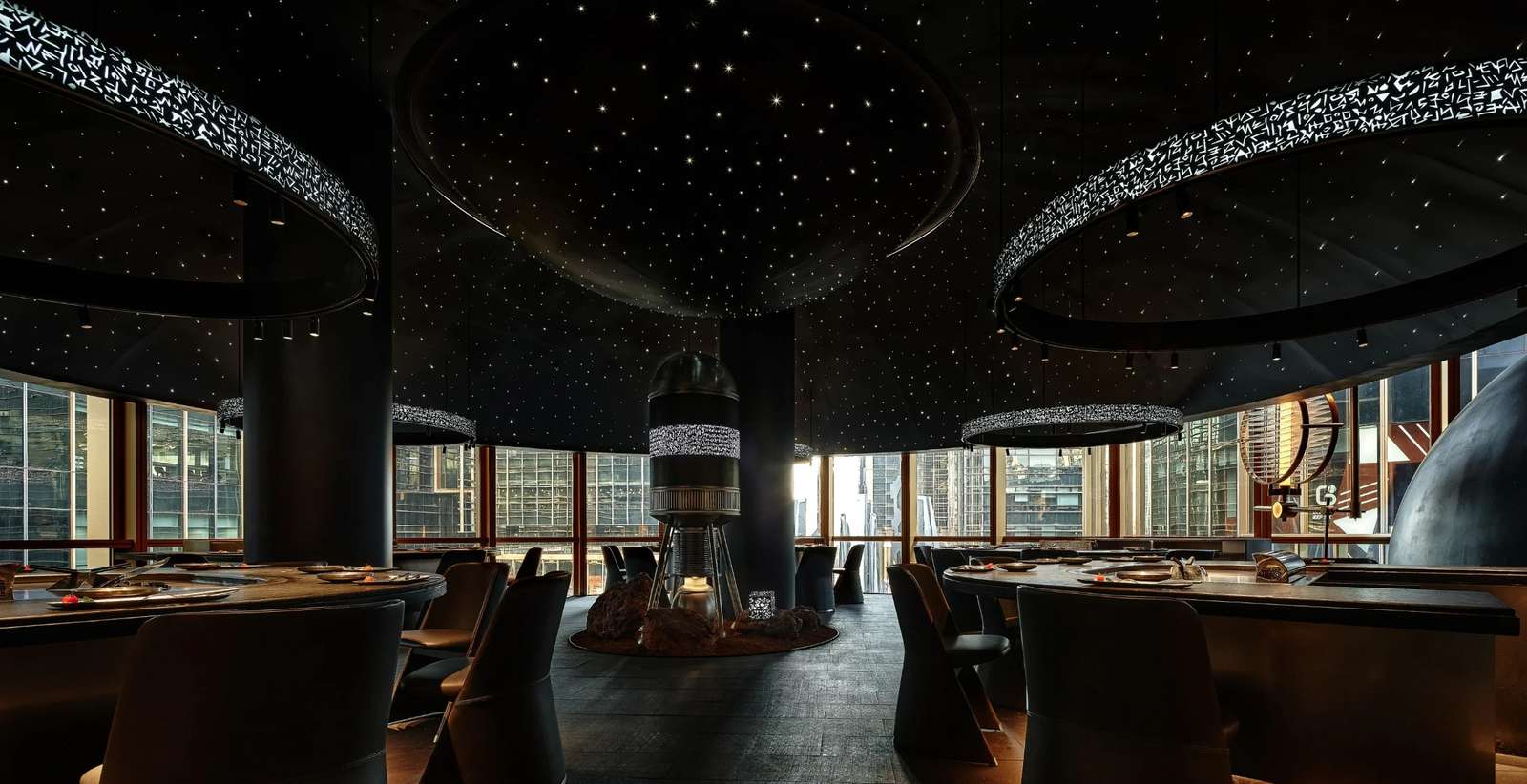
On June 28, 2026, the Teppanyaki restaurant project reinterprets the relationship between mass and space through kinetic interior scenography, establishing the material contrast and the dialectic of scenographic space based on a rough material dialogue inspired by sandstone formations and the gradients of shale. This creates a tactile presence of surfaces that evokes the rituals of geological exploration. This cognitive transformation begins at the moment of transition, where the stainless steel entrance gate imposes a strict character announcing the shift from the public exterior to a more controlled and dense interior.
In the depth, dark metallic spheres are distributed as spatial markers invoking images of celestial bodies, but functionally organize sight lines and redistribute the relationships between social openness and privacy. Over this formation ascends a circular lighting element evoking abstract script rhythms, providing a visual guiding role that enhances the reading of movement within the space, within a lighting system designed to regulate the cognitive rhythm of the user.
The cooking act within the teppanyaki platforms transforms into a scenographic performance structure that redefines the relationship between the user and the interior scene, in contrast to the isolation imposed by closed kitchens in contemporary experiences. At the teppanyaki stations, the thermal act of cooking intersects with the movement of light and shadow, producing a moment of immediate sensory perception that engages the user in the event rather than merely watching it.
The spatial experience varies between two private cabins that provide high levels of considered seclusion, and a main open room that interacts with natural light through wide glass facades allowing the external scene to change and reflect inside the space. This gradient creates a dynamic relationship between architectural time and natural time, resetting the user experience within a highly visually sensitive contemporary environment.
The project is based on a mass metaphor mimicking the concept of the “mother ship,” where integrated soft lighting along with cascading acrylic rings redefines spatial boundaries both horizontally and vertically. This formation enhances the feeling of extension and transforms surfaces into perceptual layers that change with the movement of light.
In the center, a primary spatial unit emerges evoking natural elements like stone and gravel to produce a sense of intended isolation associated with the idea of exploration. Red sandstone is used as a material and color contrast element that cuts with the external commercial environment and integrates with polished steel and audiovisual systems, forming a unified material language that connects the visual identity with the architectural logic of the place.
The social function within the restaurant is distributed across five independent island food platforms, designed to achieve a balance between visual and auditory privacy on one side, and the continuity of the space as a whole that is interrelated on the other. The user transforms from a mere food consumer to a mover within a spatial structure that stimulates exploration and reinterprets the idea of “path” within the experience.
Interactive artworks at transition points support this trend, blending technology and material to reshape the perception of movement and deepen the psychological impact of the place, consolidating an architectural experience based on interaction rather than mere observation.
The article dismantles the relationship between geological material and the interior space through the construction of a sensory scenography that transforms the restaurant into a cognitive system governed by light and movement. Layers of sandstone and shale intertwine with steel and glass to form controlled perceptual transitions, while metallic spheres and lighting serve as organizational knots guiding spatial behavior and integrating the cooking performance within a visual sequential design logic that redefines the experience. Within a high perceptual accuracy spatial context.
However, this scenographic representation exaggerates the assumption of neutrality in the spatial experience within a hospitality commercial environment subject to strict operational constraints. The visual intensification resulting from the composite lighting and acrylic rings may create a maintenance burden and weaken the clarity of daily movement within spaces that rely more on economic efficiency than on visual narrative. Additionally, excessive reliance on spectacle may reproduce a visually beautiful space but with limited performance within architecture.