
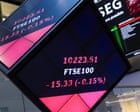
If you have a workplace pension, you may already be investing in trackers without realising it. Photograph: Bloomberg/Getty Images View image in fullscreen If you have a workplace pension, you may already be investing in trackers without realising it. Photograph: Bloomberg/Getty Images Investment funds ‘Buy the haystack’: how tracker funds beat searching for shares Designed to mirror the stock market, they are an easy and cheap way to save. Here’s how to start investing in them
Prefer the Guardian on Google Tracker funds have been around for about half a century, providing investors with access to a range of assets without them having to make difficult and risky decisions.
Built to follow the fortunes of a given financial market index, trackers do not need management teams, which means they generally come with low charges. If you have a workplace pension, you probably already invested in one without realising it. If you want to start investing, you are likely to be directed towards a tracker fund.
Tracker funds are a kind of investment fund. These are pooled investments that use investors’ money to buy into a range of different assets, including shares in companies and government bonds.
There are two main types of fund, passive and actively managed. Trackers are passive funds. They follow the performance of an index – for example, the FTSE 100 or S&P 500. When the shares in the index rise in value, so does the value of your investment; when they fall, it falls, too.
In contrast, with actively managed funds, decisions on buying and selling assets are researched and made by a fund manager and their team, and they will be trying to beat the performance of a chosen benchmark.
According to AJ Bell’s latest Manager versus Machine report , which compares the performance of actively managed funds with that of their tracker counterparts, trackers frequently provide better returns. Only 29% of active fund managers beat the passive alternative of their fund in 2025, and over the past decade fewer than 24% of active managers beat the trackers.
Historically, one reason for that has been their inherent diversification – although this has been called into question recently because of the sheer size of some of the biggest companies listed on the indices.
View image in fullscreen The Vanguard founder, Jack Bogle, says: ‘Don’t look for the needle in the haystack. Just buy the haystack.’ Photograph: SOPA Images/LightRocket/Getty Images Instead of choosing a company and hoping it will grow, a tracker effectively buys a stake in all the companies on an index (or a representative selection of them), and, in theory, the growth of those that do well cancels out the losses of those that do less well.
Jack Bogle, the founder of the investment firm Vanguard and a pioneer of tracker funds, once said: “Don’t look for the needle in the haystack. Just buy the haystack.”
This diversification is one of the main reasons trackers are often suggested as a starting point for new investors. “With a tracker you are not putting your eggs in one basket; they are naturally diversified products,” says Steve Palmer of Royal London Asset Managers.
Typically, tracker funds work on a “market cap” basis. This means that they weight their investments according to the size of the firm. “So if one company represents 5% of an index, 5% of the fund will be invested into that company,” says James Norton, head of retirement and investments at Vanguard.
Tracker funds can be struc…