
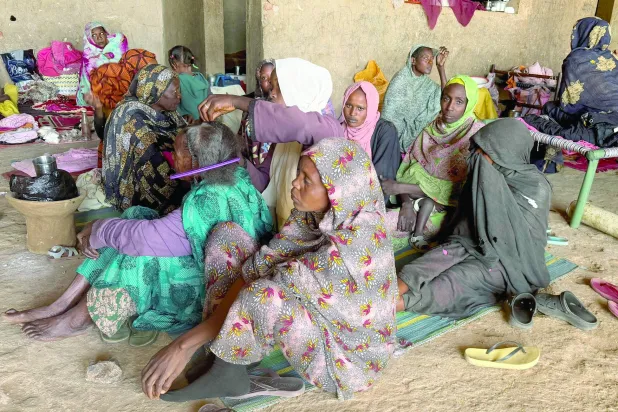
Since drone strikes have caused a halt to electricity, fuel, and water stations in Al-Obeid in northern Kordofan, Muhammad's sections have to take a long and arduous route under the scorching sun every day to fetch muddy water from a distant well.
In recent weeks, the Rapid Support Forces have intensified their airstrikes on Al-Obeid, targeting civilian infrastructure and facilities for electricity, fuel, and the highway leading out of the city, deploying military reinforcements reminiscent of scenes before the attack on Al-Fasher in northern Darfur at the end of last year. United Nations experts noted that this attack bore signs of genocide.
Sections, who lives with her seven children in the Al-Rahmaniya camp on the outskirts of Al-Obeid, tells AFP: "We walk long distances and carry the water on our heads, which is not even safe to drink."
With the water supply being disrupted due to damaged stations, residents have told AFP that they have been relying on wells, water truck deliveries, and some distribution points.
Muhammad, 35, adds: "We have no aid. We need water and food supplies."
Al-Obeid, which originally has a population of half a million and has now taken in roughly 100,000 displaced persons due to violence in surrounding areas, is on a vital route linking the Rapid Support Forces-controlled Darfur region in the west to the army-controlled areas in central and eastern Sudan.
Last week, the United Nations Security Council expressed concern over the "massive military reinforcements by the Rapid Support Forces around the city of Al-Obeid," warning of imminent "collective atrocities."
Nihad Al-Tayeb, a researcher at the Armed Conflict Location and Event Data Project (ACLED), states that military movements of the Rapid Support Forces were observed last month about 60 kilometers east, south, and west of Al-Obeid.
Analysts believe that seizing the city could consolidate the Rapid Support Forces' control over western Sudan and potentially pave the way for movement toward the capital.
Al-Obeid hosts an army infantry division, an airbase, a major oil pipeline, and a large market for gum arabic, a strategic Sudanese commodity.
According to Sudanese affairs researcher Khlood Kheir, control over Al-Obeid relates to "power, land, and money."
Fighting, roadblocks, and restrictions on movement have created significant difficulties in accessing the city and independently verifying information.
Rare footage taken by an AFP reporter at the Al-Rahmaniya camp shows exhausted women walking slowly under the scorching sun, balancing plastic water containers on their heads after waiting for hours around the well to get water.
In the camp, about 200 families are crammed into flimsy shelters made of straw, torn fabrics, and plastic sheets. Children spend their time under the narrow shadows cast by the huts, with some appearing worn out and unable to play, while others walked silently behind their mothers.
In a straw tent, 70-year-old Waseela Muhammad tells AFP: "We have nothing. No water, no food, no bedding."
Over the past few weeks, supplies of humanitarian and food aid reaching the camp have dwindled due to roadblocks and destruction of infrastructure.
One humanitarian volunteer states that "needs exceed supplies," emphasizing that camp residents require healthcare and food.
Across Al-Obeid, the hum of drones is constantly heard, "and no one knows what is happening," according to Adam Hussein, who requested to use a pseudonym for fear of revealing his identity.
He reports that, although a drone crashed near him without causing injury: "Everything in Al-Obeid is in crisis and civilians and infrastructure are continuously targeted."
Khlood Kheir confirms that many residents are effectively "trapped," with water prices doubling and food costs rising by up to 300 percent, along with a significant increase in transport fares.
She adds: "Many have not left because they lack the necessary funds or do not know where to go."
Mohamed Rafat from the International Organization for Migration warned...