
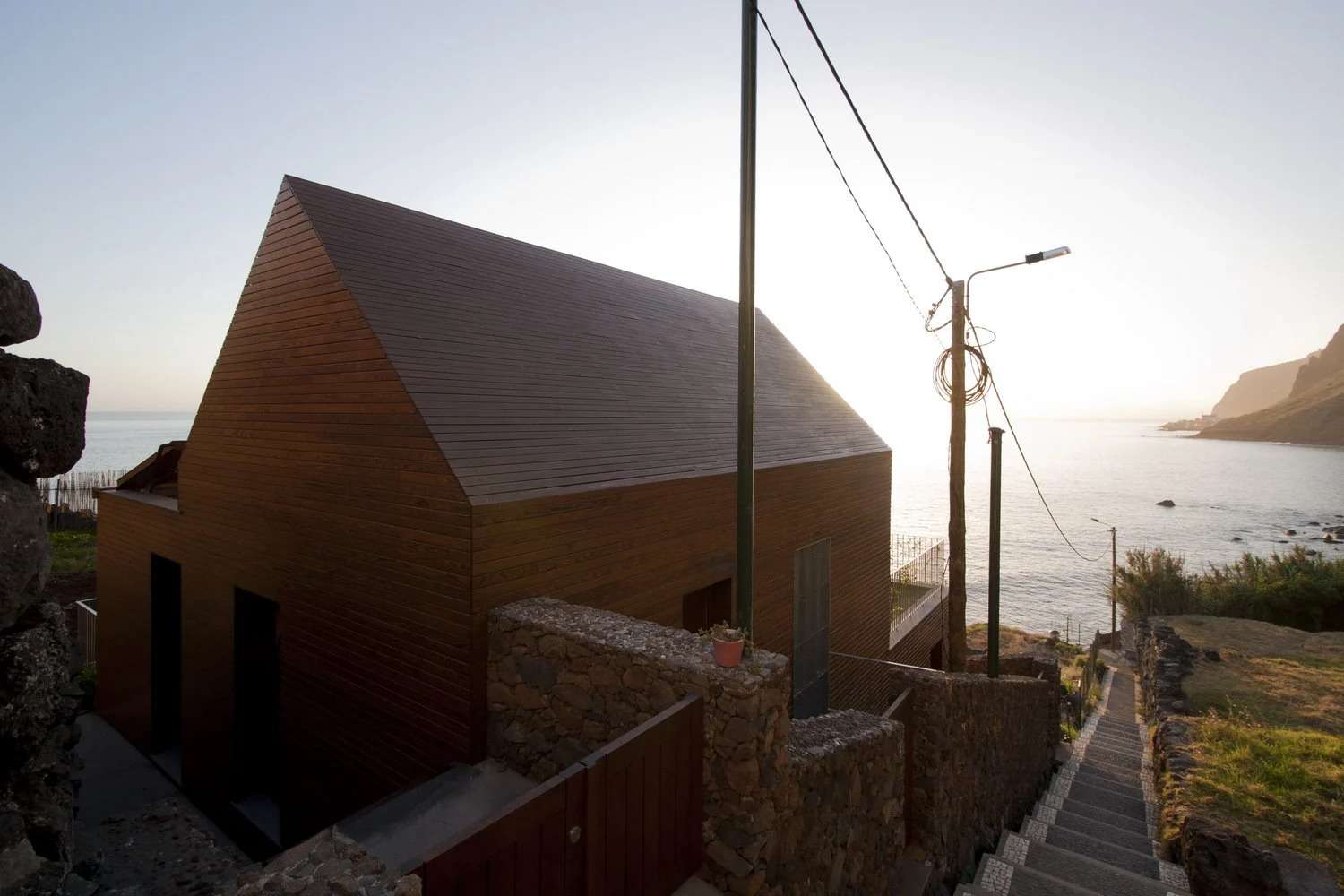
June 29, 2026 June 29, 2026 Home » Projects » Jardim do Mar Homes Project Balances Site Preservation with Contemporary Housing Needs. The massing and response to the topography stem from a narrow L-shaped plot within the coastal slopes of Jardim do Mar village in Madeira Island, with the design investing in existing agricultural terraces to organize the architectural program across two separate levels. The studios have been distributed vertically in accordance with the natural slope of the land, allowing for reduced structural interventions while preserving the direct relationship between architecture and topography. The northwestern orientation has also contributed to defining the locations of the main openings, framing maritime views and bringing natural light into the interior spaces.
The existing basalt wall is one of the key elements of the project, as the architects chose to preserve and integrate it within the new composition rather than remove it. This decision reflects a direct connection to the site's traditional agricultural landscape, where dry stone walls historically spread to form the agricultural terraces. Consequently, the new mass appears as a natural extension of the existing structure rather than a separate element from it, which is an approach seen in many contemporary architectural projects.
The lower apartment offers an experience based on horizontal extension through an open space that combines living, cooking, and dining functions within a single area facing the coastal landscape. In contrast, the upper apartment relies on a vertical organization that takes advantage of a double height space and a gable roof, where an internal staircase leads to a half-floor dedicated to sleeping. This gradient between horizontal and vertical movement allows each unit to possess a unique spatial character despite the limited area, reflecting the principles of interior design tied to spatial efficiency.
In response to space limitations, the staircase, kitchen, storage area, and table have been integrated into a single multifunctional furniture element, allowing for the maximum freeing up of available space for daily use. The living experience extends outside through a lower terrace that includes a small swimming pool made of two overlapping circles and organic gardens containing fruit trees and vegetables, making the natural elements part of the daily landscape associated with housing, which is a trend tied to numerous studies in contemporary architectural research.
The site imposed clear logistical constraints due to its difficult accessibility and the inability to use heavy machinery, necessitating manual transport of building materials over a distance of about 50 meters. These conditions reflected in the execution methodology, which adopted frugal and precise structural solutions that align with the site's sensitivity and limit impact on its existing natural structure. These challenges can be compared to what is discussed in material data sheets concerning the specific execution conditions.
The project reorganizes housing within a narrow plot on a coastal slope in Madeira by transforming the topography into a governing structure for block distribution. It relies on breaking down the program into vertical units that benefit from the existing agricultural terraces and basalt wall, reducing structural intervention, enhancing the continuity of the natural landscape, and redefining the relationship between inside and outside within a contemporary reading of housing density, emphasizing the logic of sharp spatial economy, a topic that intersects with transformations in contemporary cities.
However, this romantic approach to integrating the site with local material overlooks the limits of operational sustainability in contemporary environments, where maintaining stone walls and manual labor turns into a long-term economic burden. Additionally, reliance on integrated furniture solutions and reducing structural mechanics may limit future expansion flexibility, especially in contexts that require building systems more adaptable to updates and digital manufacturing such as construction materials instead of the slow contextual reading, a discussion that is continuously present within architectural news and content archives.