
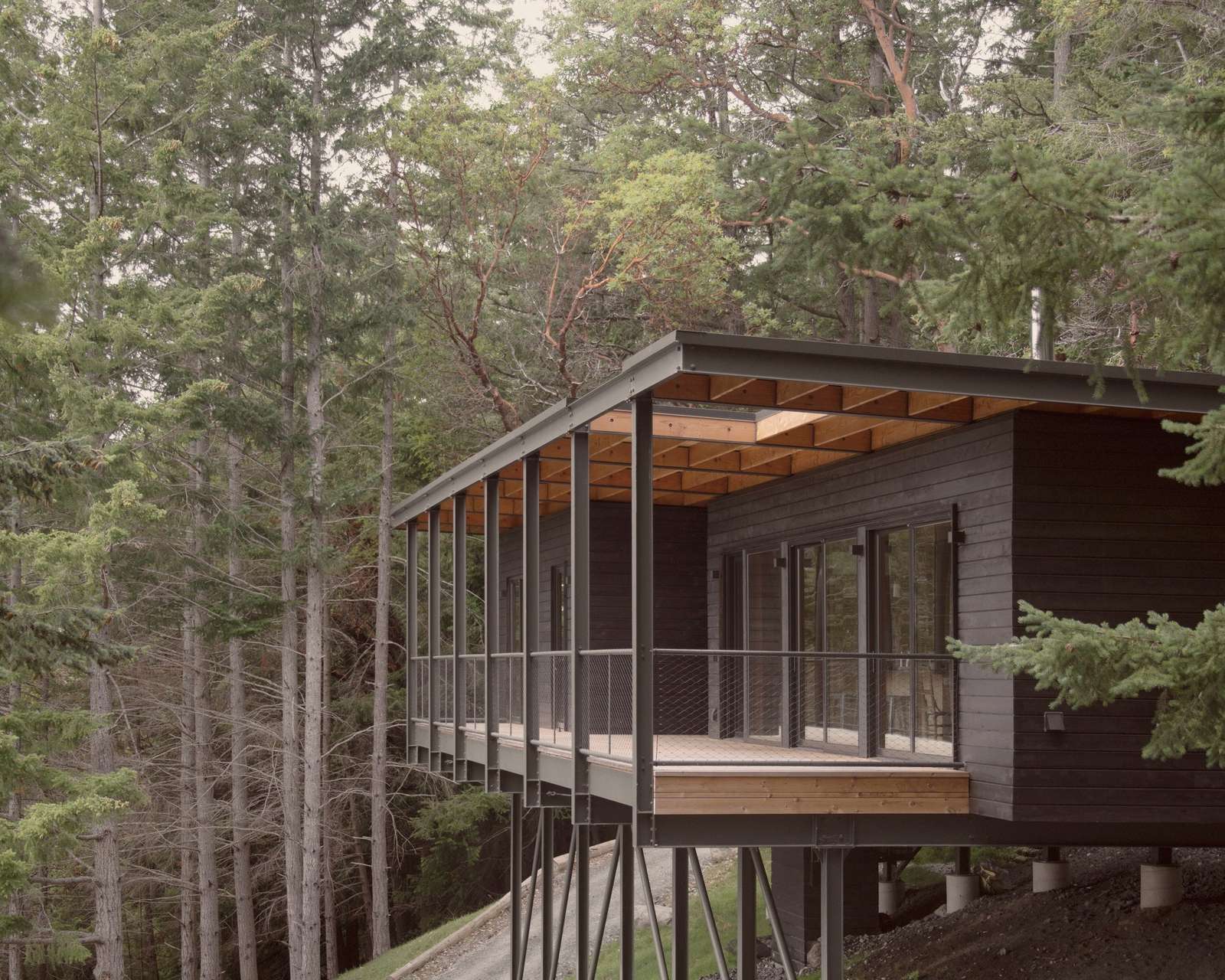
June 29, 2026 June 29, 2026 Home » Projects » Bridge Cabin Offers a Structural Approach to Building on Steep Terrain The structural positioning and adaptability of the project re-employ the principles of metabolis architecture by separating the bearing structure and the modular living units, allowing for the architectural mass to be developed or reorganized without affecting the infrastructure. The project is presented as a prototype to explore building on remote and steep terrain, where living spaces are suspended within an independent steel frame that minimizes direct intervention on the natural site. The structural system relies on an overhead structure designed for a long lifespan of around 200 years, while the internal units can be modified or replaced according to future user requirements.
The spatial experience is shaped by the user gradually transitioning from ground level to suspended spaces among the trees, opening visual vistas toward the San Juan Islands to the south and providing the site with a different perceptual dimension. Raising the architectural mass allows for the continuity of natural movement beneath the building, enhancing natural ventilation and benefiting from southern solar exposure. This approach fosters a direct relationship between the user and the surrounding natural elements, making the natural landscape an essential part of the daily living experience.
The project addresses the steep slope through a structural suspension system that reduces the need for traditional excavation work, as the mass rises above the site via a regularly spaced external steel frame. The verticality of the structural elements aligns with the rhythm of the surrounding tree trunks, minimizing the visual presence of the building within the forest and enhancing its integration with the natural environment. This elevation allows air and light to pass beneath the architectural mass, maintaining the natural characteristics of the site within an approach tied to contemporary environmentally-sensitive urban concepts.
The design relies on reducing enclosed and conditioned spaces, measuring around 868 square feet, by transferring parts of daily movement to external spaces. This distribution contributes to lowering energy demand, while enhancing the user's connection to the natural site. On the southern facade, a deep roof overhang provides protection from direct sunlight and ensures usable outdoor spaces year-round, making it a functional extension of the internal spaces.
The passive environmental strategies are complemented by a photovoltaic solar power system of 3.6 kW, designed to efficiently meet current occupancy requirements. Future expansion possibilities have been considered by equipping the structure for adding greater production capacity as needed, allowing the building performance to evolve with changing usage patterns without making substantial modifications to its structure or architectural language, a trend present in many contemporary architectural projects.
The project revives the ideas of metabolis architecture through a long-lasting structural framework that separates the permanent structure from replaceable living units. Rather than treating sustainability as a package of added technologies, it presents adaptability as the primary environmental strategy. By suspending the mass above a steep forest slope, it reduces intervention on the site and capitalizes on natural ventilation and solar energy, presenting architecture as an evolving framework capable of change rather than a completed static body.
However, this proposal may overestimate the value of future flexibility. Assuming that replaceable units will ensure the continuity of the building overlooks the operational costs and logistical challenges associated with maintaining specialized structures in remote locations. While structural elevation mitigates the impact of construction on the ground, it shifts some of the complexity to subsequent maintenance cycles, revealing the ongoing tension between ambitions for adaptable design and requirements for long-term building performance, along with the importance of choosing building materials capable of supporting this type of extended structural systems.