
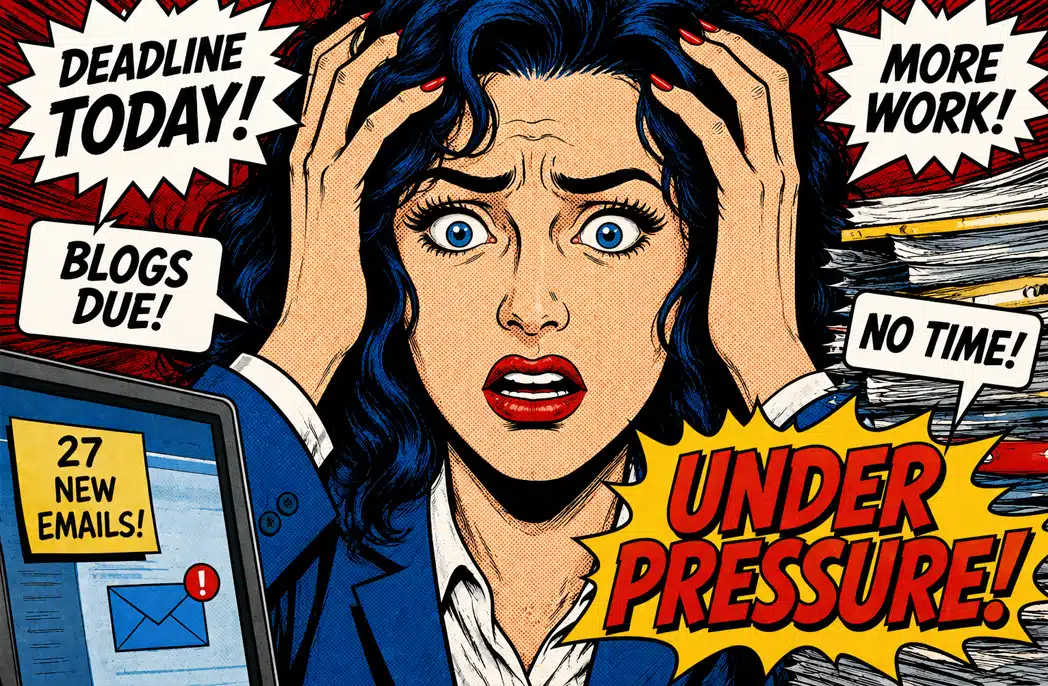
The internet is becoming a pressure cooker. Between 2022 and 2024, the number of AI-generated web pages increased 80-fold . That explosive growth appears to have moderated, with the proportion of online articles, blogs and listicles that are primarily AI-generated hovering around 50 percent for more than a year.
Even so, with half of online content now machine-generated, the internet is becoming a machine that consumes and reproduces itself. What began as a repository of human knowledge risks morphing into an engine that endlessly recycles, remixes and repackages existing ideas, expressing them through increasingly familiar structures, metaphors, transitions and turns of phrase – basically, a bastardisation of itself.
The AI-generated plateau may also be temporary. According to HubSpot’s ‘ 2026 State of Marketing Report ’, around 94 percent of marketers plan to use AI in their content creation this year, and 83 percent say they are expected to produce more content than ever before as a result.
That expectation generates pressure from three directions simultaneously. There is:
The contradiction is obvious. Organisations demand originality and differentiation while creating the very conditions that make those qualities more difficult to produce.
Every time a manager or client directs a content creator to achieve volume outputs or meet unrealistic timelines, they increase the likelihood that the result will be low-quality ‘content pollution’: thin, generic, recycled, error-riddled, plagiarised or little more than ‘AI slop’.
Consider how familiar these instructions sound:
‘We need three blogs a week.’
‘We need to rank for these keywords.’
‘Give me something like [COMPETITOR].’
None of those instructions asks for high-quality content, originality or insight. Some actively discourage it.
Most discussions frame what follows as an ethical failure of content creators. Yet, through their demands, expectations and briefs, clients and managers are often complicit.
In this environment, AI doesn’t just enable shortcuts – it almost invites them.
When a brief says, ‘Give me something like [COMPETITOR]’, the instruction is to imitate – to ‘clone and cloak’ a competitor’s content.
When under pressure to achieve volume targets, or when a brief says, ‘We need to rank for these keywords’, the temptation is to prompt an LLM (large language model) to regurgitate existing material, further flooding the market with homogeneous content.
When a brief sets an unrealistic deadline, governance falls to the wayside. Fact-checking gets skipped. Reviews are compressed. AI outputs go unchallenged.
We blame the creator for content degradation while ignoring the systems that reward and demand derivative content.
B2B marketers should be periodically reminded of content marketing’s core purpose: to create content that a carefully defined audience finds timely, relevant and valuable – and, in doing so, to move that audience through the buyer’s journey: from awareness to consideration, trial, repeat purchase and ultimately advocacy.
If a piece of content is not doing at least one of those things, it’s ineffective – regardless of whether it was created by a human or generated by AI.
This is where the volume pressure and the effectiveness pressure collide. Managers and clients demanding more content, faster, while simultaneously expecting it to perform, are making contradictory demands. E...