
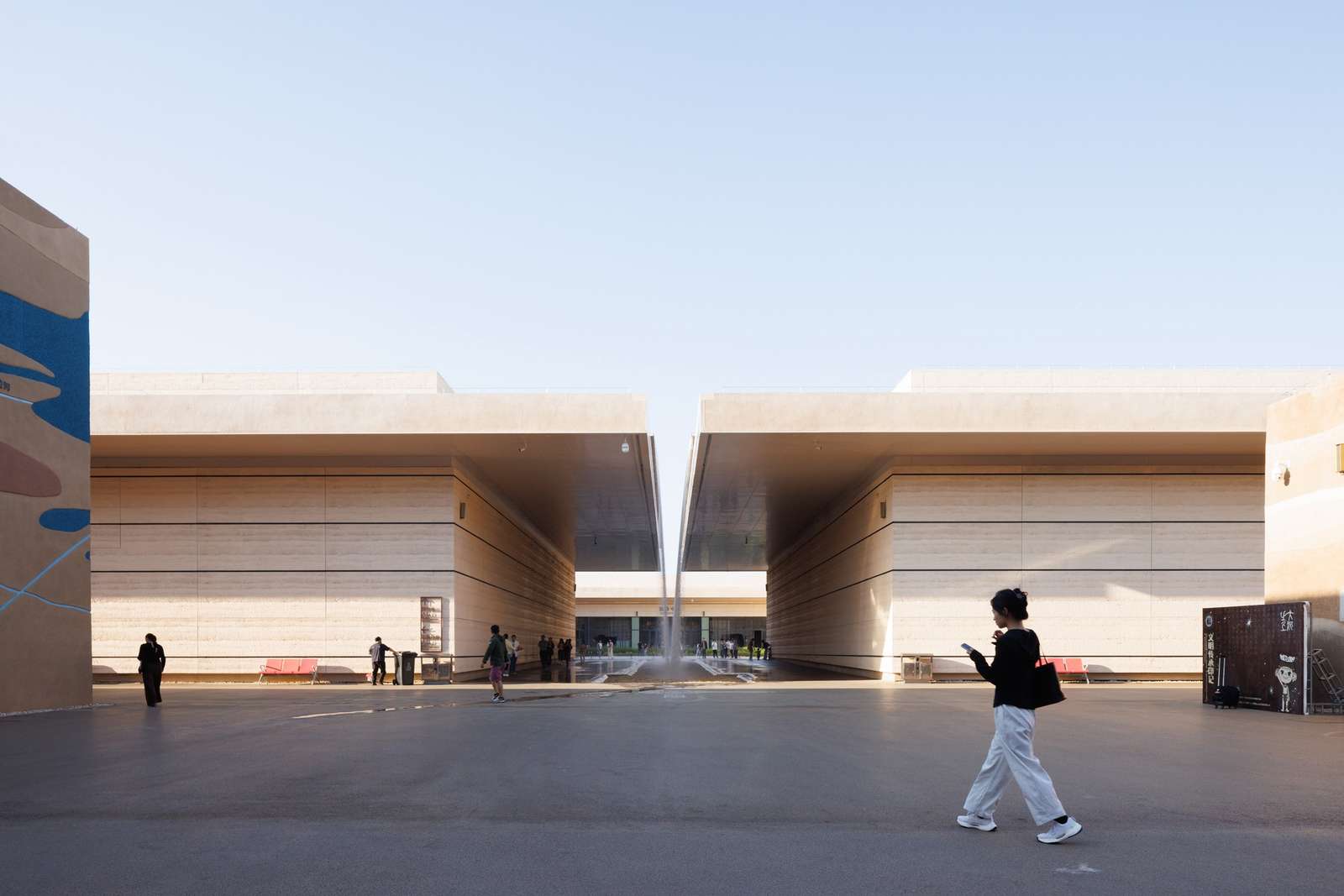
On June 30, 2026, the architectural museum design relies on ground immersion as an entry to the architectural experience. The retreat of the mass and its merging into the ground surpasses the traditional building concept based on mass, adopting a strategy of immersion in the historical site by hiding a large part of the building underground. This approach harmonizes with the surrounding terrain and reduces the visual impact of the built mass.
This treatment directly responds to the sensitivity of the soil and deep archaeological deposits, necessitating a reduction of structural interventions above ground level. With this configuration, excavation becomes part of the design language, reshaping the earth to achieve a balance between site preservation and its architectural use. This approach also improves the environmental performance of the site by enhancing rainwater drainage and supporting the restoration of the surrounding natural cover.
The user experience begins with a gradual transition from the open surface to the sunken spaces, where a downward path leads visitors to deeper levels that visually and emotionally connect with the layers of the historical site.
Concrete masses interact with the movement of the sun to produce variable light contrasts throughout the day, enhancing the sense of depth and drama inside the internal spaces. Sunken courtyards allow for natural air flow, supporting user comfort. Raw materials provide a direct tactile sensation linking the architectural experience to the nature of archaeological excavation, transforming movement within the building from a transitional function to a comprehensive perceptual experience.
The project is based on integrating passive environmental strategies with site data to create a stable indoor environment without complete reliance on mechanical conditioning systems. The use of sunken courtyards, green roofs, and adjacent wet areas contributes to improving the local climate and reducing thermal fluctuations.
The blocks and facade details have been directed in response to simulating wind movement and thermal performance, helping reduce wind speed at pedestrian level and enhancing natural ventilation within the spaces. This system functionally minimizes condensation and humidity issues, while providing a well-thought-out drainage system to protect against water accumulation.
The design relies on reducing the visible mass by embedding the building within the site's terrain and achieving a precise balance in excavation and soil reshaping works. The sunken space has been designed in accordance with unsuitable soil treatment, reducing the need for additional backfilling and limiting overall structural impact.
The green roof integrates with the surrounding natural landscape to create a visual extension of the natural environment, re-establishing the site’s connection to its original nature. This approach aids in restoring local ecosystems, including vegetation and wildlife, while enhancing natural lighting thoughtfully within the site.
The building's outer shell is based on a façade system that reinterprets the texture of rammed earth in a contemporary manner, creating a direct relationship between architecture and the geological context of the site.
The façade modules have been developed in relatively large dimensions (4.2 m x 2.1 m), aimed at reducing visual gaps and enhancing thermal performance and sealing, while accelerating on-site execution processes. This system has contributed to enhancing the clarity and cohesiveness of the architectural mass, achieving continuous interaction between light and shadow on the rough surfaces, enriching the user’s visual experience. The success of this system also depends on advanced properties in building materials.
The experience within the museum reaches its peak as the user transitions between immersive exhibition halls that isolate the visitor from the contemporary context and connect them with deeper temporal layers of history.
The experience extends beyond the displayed content to the perception of the space itself; where air flows underneath architectural elements, and lighting interacts with surfaces and voids to create a comprehensive sensory environment. The return of natural elements to the site further enhances this scene, intertwining visitor movement with the presence of wildlife, making the building a medium between humanity, nature, and history simultaneously.
The project redefines the museum as an artifact integrated into the ground, where the architectural mass is immersed...