
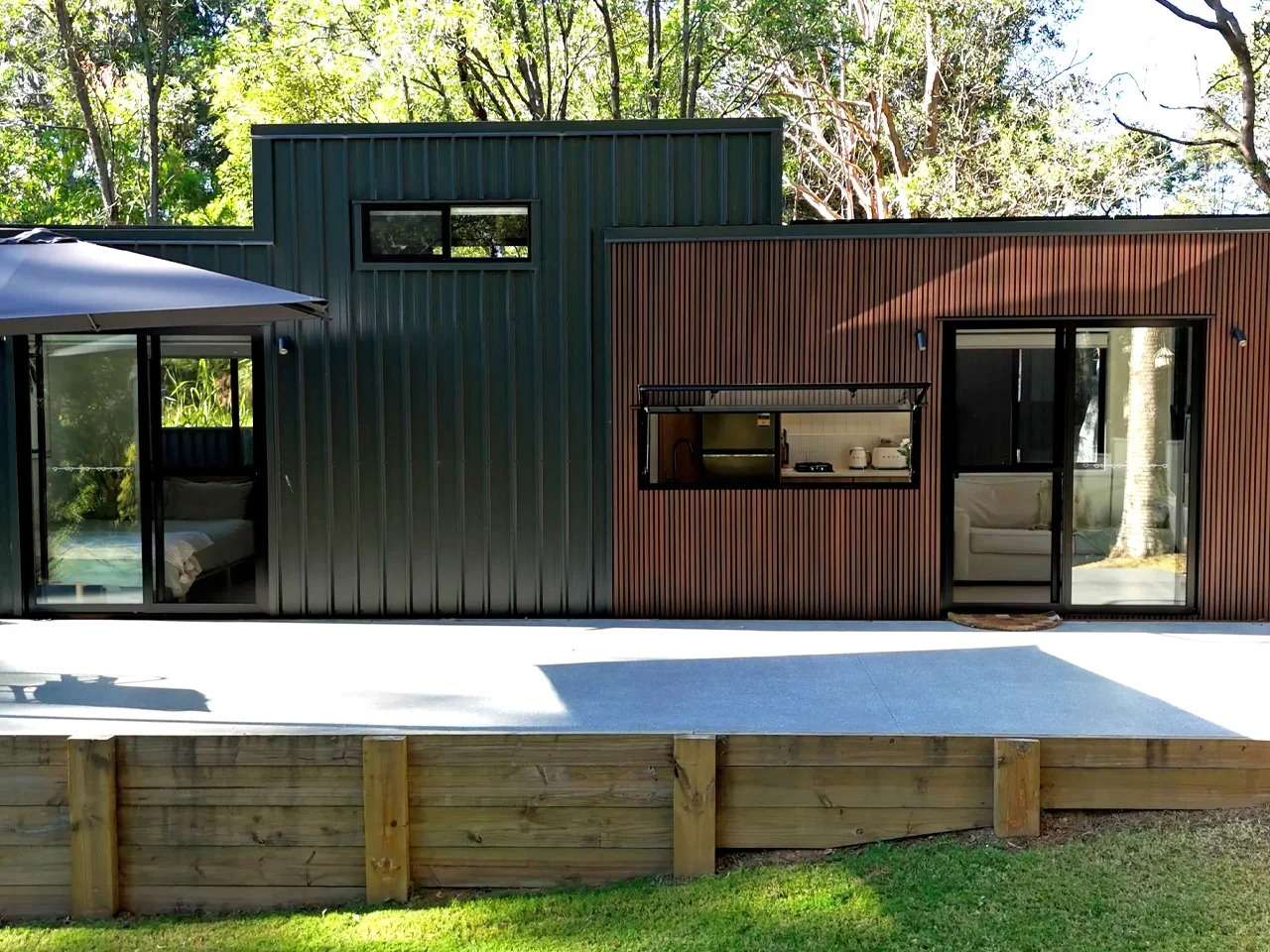
July 2, 2026 July 2, 2026 Home » Projects » The Burly 9.6 Project Balances Architectural Customization and Mobility Home Efficiency The disassembly of the mass and the scenographic effect of the building's external composition transcend the idea of traditional temporary shelter, as it creates a dynamic angular and sloped roof line that breaks the usual horizontal character of mobile homes. The NewTechWood cladding gives the façades an additional layer of material and visual depth, transforming the mass from a ready-made structural solution into a more architecturally connected element to its environment.
The overall configuration is based on a direct response to the environment, as the sharp roof edges regulate the movement of light and shadow throughout the day, resulting in a perception-changing façade depending on time and natural conditions.
The internal experience begins from the moment of entry through the double glass doors that reduce the visual separation between the inside and outside. This passage opens directly onto the living space, where the panoramic windows enhance the presence of the external landscape and integrate it into the daily perception of the space, instead of treating it as a fixed background.
The natural light entering from multiple directions helps reduce the sense of physical boundaries of the space, resulting in a more open and cognitively flexible environment. Everyday operational elements, such as the ceiling fan and the rotating TV stand, support this flexible character by maintaining an adaptable function without visual clutter.
The kitchen takes on a linear configuration linking different parts of the home and acting as a main circulation path, enhancing functional efficiency and ease of movement. The Japanesque style effect is evident in the balance between light oak wood and white walls in VJ pattern, with the addition of black metallic elements as visual control features that reduce surface uniformity.
The stone countertops enhance the sense of material texture, while the exterior-facing serving window visually and environmentally connects the kitchen to the surroundings, allowing light and air in and making the workspace more interactive with the outside.
The bathroom redefines small space by treating it as an integrated area and not an isolated function. The double sink over the white stone countertop enhances the sense of spaciousness, while the backlit mirror adds a visual depth dimension that doubles the perception of space.
The material contrast between the black faucets and glass shower acts as a visual organizing element defining relationships within the space. The window also plays a crucial role in bringing in natural light and renewing the air, reducing the feeling of enclosure and enhancing daily usability.
The distribution of the bedrooms is based on functional separation and varying levels of circulation within the mass. The master bedroom is located at the far end of the building, providing it with a higher degree of privacy, with a direct connection to the external environment through a separate entrance. This layout allows for a balance between isolation and connection to the environment, supported by natural air flow.
The loft room above the kitchen offers a different experience based on spatial disconnection and access via a removable ladder, enhancing the sense of privacy within a compact volume without losing connection to the common space.
The project presents a model of a mobile home relying on integrated energy solutions, where solar panels are integrated into the roof to provide an independent energy source supporting daily operations.
The project's significance lies in being the result of a tailored design process that allows for adjustments to the distribution of mass and spaces according to user needs, creating a more direct relationship between design and daily behavior. Rather than treating the home as a standard product, it becomes a flexible system that redefines quality living within small spaces.
The Burly 9.6 Project redefines mobile living as a compressed architectural structure functioning as a mini-ecosystem, where the outer shell becomes an environmental filter for light and heat. The sloped roof and NewTechWood cladding reflect a material logic linking movement and function, while the interior spaces integrate seamlessly in a continuous sequence incorporating kitchen, living, and loft within high efficiency linked to the logic of building materials.
Despite the liberating nature of the model, Burly 9.6 reveals a gap between aesthetics and the operational execution of mobile living. Its structure relies on lightweight materials and integrated energy systems, but it remains constrained by regulatory frameworks and policies.