
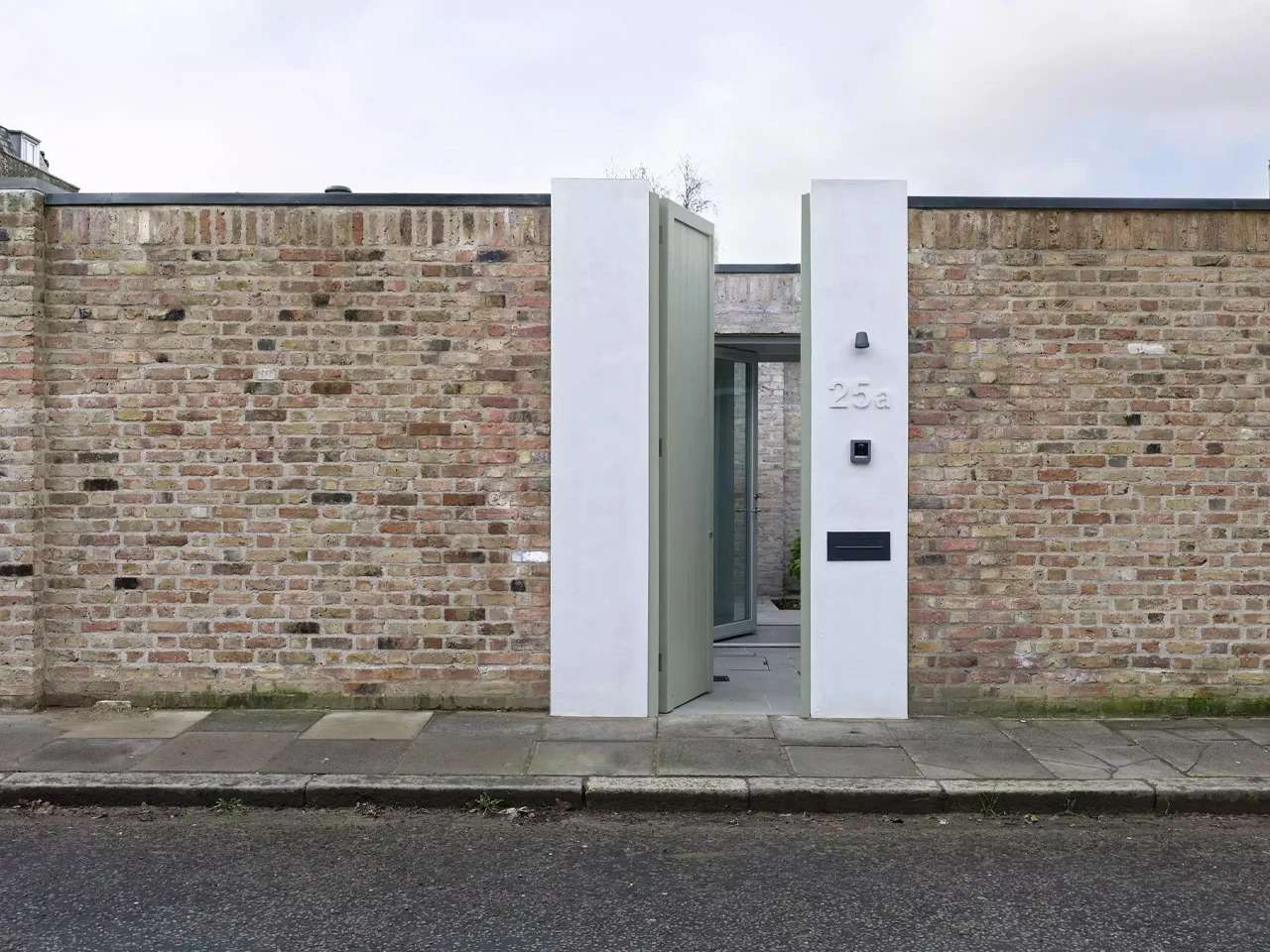
July 2, 2026 July 2, 2026 Home » Projects » “Walled Courtyard House” Project Uses Skylights as a Substitute for Open Facades The massing and dialogue of light and shadow transform the reclaimed brick wall from merely an external fence that harmonizes with the historical character of the Clever Square into an architectural shell that defines the site boundaries and directs the experience inward. By dispensing with street-facing windows, the project relies on skylights and lime plastered walls to create the interior environment. These light surfaces enhance the natural light reflection and distribution within the spaces, providing a renewed visual diversity to the internal scene and alleviating the feeling of boundaries of the closed area in the context of buildings.
The building experience begins upon crossing the wooden gate, where the user transitions from the atmosphere of the surrounding street to a more tranquil and private interior world. The architectural program is distributed across a single floor, considering ease of movement and access, while the sequential sight lines between different spaces lead towards the inner courtyard and natural light sources. This horizontal organization, supported by skylight illumination, enhances the sense of openness and continuity of space despite the limited site area within the architectural project trends.
The planted courtyard organizes the heart of the architectural plan, serving as the linking element between different parts of the residence. The floor-to-ceiling sliding glass doors allow visual connections between the bedrooms, living areas, and kitchen, reinforcing the interconnection between different functions. Moreover, hidden doors integrated within the walls minimize visual barriers when opened, transforming movement within the house into a connected experience where views and spaces seamlessly transition within the interior design.
The interior spaces rely on a calm material palette combining white walls, grey porcelain floors, and exposed wooden elements. The wooden ceiling beams stand out as part of the structural expression of the building, while skylights play a crucial role in introducing and directing natural light throughout the spaces throughout the day. This integrates with the ceiling planted with sedum plants and the environmental strategies embedded in the project, offering a model of visually restrained architecture that responds to the demands of ecological performance while maintaining its harmony with the historical context surrounding the architectural research studies.
The project redefines the surrounding wall from being a visual boundary to a spatial filter directing the residential experience towards a central inner courtyard. The design relies on eliminating street-facing openings in favor of skylights and lime-coated walls to redistribute light within a single horizontal floor. The movement transforms into a continuously visual sequence between the rooms and the internal garden, within a regulated lighting logic that reshapes spatial perception in the design context.
However, this internal closure may exaggerate the idea of spatial purity, ignoring that complete isolation from the street in densely urban environments may create social detachment and an environmental burden on thermal performance. Additionally, relying on skylight openings imposes thermal fluctuations and ongoing maintenance that contradicts the claim of luminous control. Ultimately, this model appears closer to a budget-directed residential scenography than a flexible response to the complexities of contemporary cities within urban contexts and architectural news.