
Science Mars Meets Uranus Before Dawn On July 4 In Closest Pairing Until 2053 By Jamie Carter ,
Forbes contributors publish independent expert analyses and insights. An award-winning reporter writing about stargazing and the night sky. Follow Author Jul 03, 2026, 12:30am EDT Topline A rare dawn conjunction on Saturday, July 4, brings fourth planet Mars and seventh planet Uranus unusually close together in the east-northeastern sky, offering skywatchers a chance to find one of the solar system’s most elusive naked-eye planets. Here’s how to find Uranus on U.S. Independence Day.
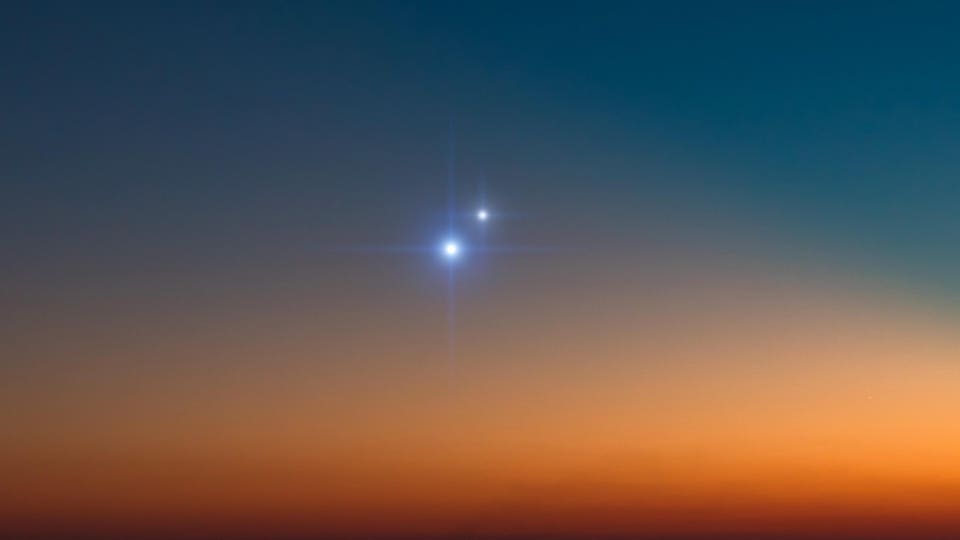
A rare dawn conjunction on Saturday, July 4, brings fourth planet Mars and seventh planet Uranus unusually close together in the east-northeastern sky. getty Key Facts On Saturday, July 4, Mars will pass just below Uranus, making it possible to find the typically very faint seventh planet using the brighter red planet.
Be out looking low about 1 hour 45 minutes before sunrise, according to Sky & Telescope . Uranus will be just above Mars, as seen from North America.
Mars will shine at magnitude 1.3, while Uranus will glow much more faintly at magnitude 5.8, within the constellation Taurus. Under dark skies, it will be possible to find Uranus with the naked eye after first locating it beside Mars, though a pair of binoculars will make it easier. Uranus will also appear in an image taken with a smartphone.
This very close conjunction will be visible low in the northeast sky, with the two planets just below the famous Pleiades open cluster.
According to the College of Southern Idaho , it’s the closest pairing of Mars and Uranus until 2053.
On Saturday, July 4, Mars will pass just below Uranus, making it possible to find the typically very faint seventh planet using the brighter red planet. Be out looking low to the northeast about an hour and 45 minutes before sunrise. Stellarium How close will Mars and Uranus be? At the start of morning twilight, Mars and Uranus will be separated by just over 6 arcminutes (about 0.1 of a degree). That’s about a quarter of the diameter of the full moon. A degree can be measured by holding up your little finger to the sky. The close pass of two planets is technically called an appulse, according to In-The-Sky . Orangey-red Mars will be the brighter of the two, shining just below Uranus, which will appear blue-green. Relatively close Mars and distant Uranus will appear to be roughy the same size in the sky. If you look through binoculars or a telescope, you may also see a distant star between them called HD 284146.
The entire appulse is, of course, an optical illusion. In reality, Mars will be 195 million miles (314 million kilometers) from Earth, and Uranus 1,881 million miles (3,028 million kilometers), with HD 284146 a whopping 1,240 light-years away. Nevertheless, they will all briefly appear to align very closely. The photons of light entering your eyes from Mars will have taken 17.5 minutes to reach your eyes. For Uranus, they will have traveled for almost three hours.
July’s best stargazing window begins on Tuesday, July 7, when the last-quarter moon rises around midnight and leaves the evening sky dark through Thursday, July 16 — ideal timing for a camping trip under the stars. Other highlights include Venus shining about a degree from Regulus after sunset on Wednesday, July 8, and a 13%-lit waning crescent moon appearing close to Mars and Aldebaran before dawn on Saturday, July 11, with the Pleiades nearby. Later in t…