
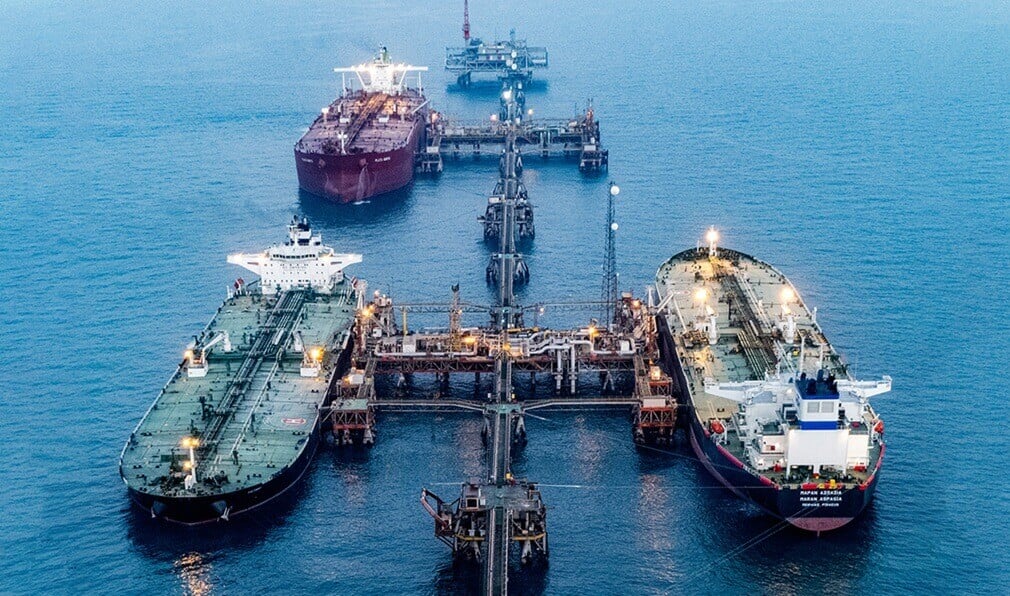
Oil tankers Tataki and Maran Aspasia fill at Al-Basrah Oil Terminal off Iraq’s Faw peninsula, Aug. 5, 2025. Photo: AFP
Baghdad (IraqiNews.com) – Over eight million barrels of Iraqi crude oil are still trapped aboard ships, but over 100 million barrels of crude oil and petroleum products that had accumulated in the Gulf have begun to slowly flow back to international markets, offering a temporary relief from supply constraints, Shafaq News said on Thursday, citing a report issued by S&P Global Commodity Insights.
Iraq, along with Oman, has been identified as one of the Middle East's top countries to reactivate oil output, while key refineries in Saudi Arabia, Bahrain, and Kuwait would take months to restore operations, according to the report.
The total amount of crude oil in the Arabian Gulf reached around 90.5 million barrels, with the remainder divided among other petroleum products. More than 90 million barrels of crude oil were aboard vessels ready to be transported.
According to estimates, Iraq has around 8.3 million barrels of oil stuck on tankers, following only Iran with 31.7 million barrels, Saudi Arabia with 18.7 million barrels, and the UAE with 17 million barrels. Kuwait recorded 8.1 million barrels, Qatar had 4 million, and Oman had 2.2 million barrels.
Most Gulf oil exports are bound for East Asian markets. This demonstrates that the resumption of these supplies may have an impact on the global supply-demand balance, affecting oil prices and producing nations' income.
International banks anticipate that exports will return to pre-war levels in July, but there is still concern that the effects of such quantities will be temporary until actual production in the region improves.