
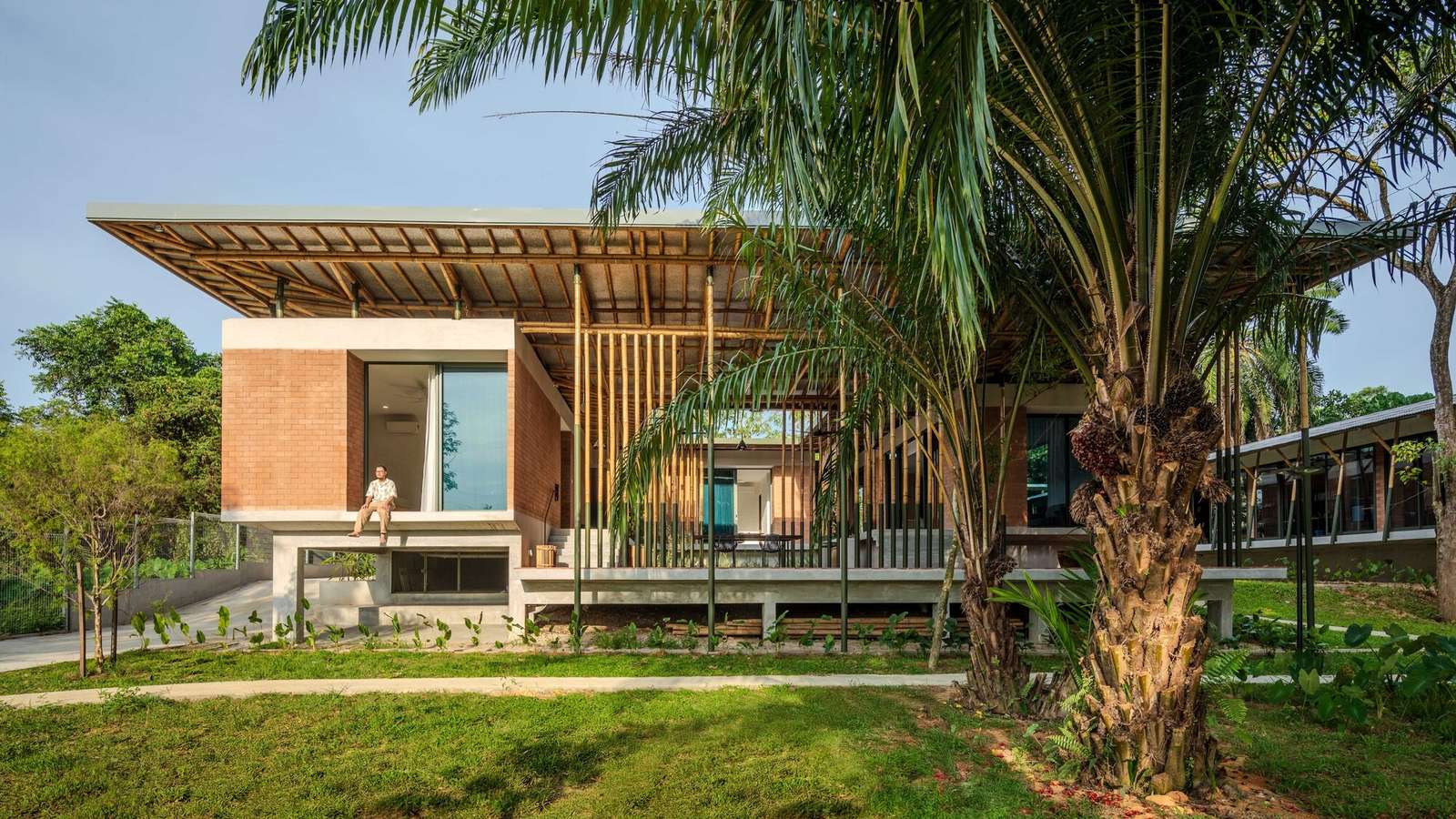
July 3, 2026 July 3, 2026 Home » Architecture » The Anjung Project Reinterprets the Relationship Between Mass Form and Spatial Structure and Climate Adaptation The dismantling of mass and its relationship with spatial structure is manifested in the architectural formation of the Anjung Project through an experimental approach that reconsiders the relationship between architectural mass and space. The project appears as two clear functional structures: a retreat house and a work studio, positioned in direct response to the topographic site characteristics and the surrounding natural movement scenario.
The site placement decision is tied to the low elevation of the site and the high groundwater level and the likelihood of seasonal flooding, leading to the placement of the house on the higher eastern edge of the land near the main access path. This orientation not only addresses environmental site challenges but also reinterprets the experience of entry so that the transition from outside to inside transforms into a gradual path revealing the backyard through a calculated visual and sensory gradient.
The spatial experience is based on a direct interaction between the user and the existing natural elements at the site. The project maintains the original vegetation, including oil palm trees, local trees, and bamboo groves, as a structural part of the local architecture and not merely a natural backdrop.
This plant system produces dynamically changing shadows that intersect with the architectural surfaces throughout the day, constantly reshaping the perception of material and space. Additionally, the movement of air within the bamboo groves and the opening of the internal spaces towards the garden enhances a sensory feeling connected to moisture, shade, and movement, integrating the building into a living ecosystem and transforming it into a medium of interaction between humans and the surrounding climate.
The project reinterprets the concept of transitional space in local architecture known as 'Anjung' as an intermediary structure that transcends being an attached space. This element turns into an organizational hub linking the inside and outside of both the house and the studio.
The design relies on expanding the scope of semi-external spaces through shaded surfaces and structural projections of the roof, leading to the dismantling of the strict borders between inside and outside. This results in a living pattern based on spatial gradient rather than binary separation, where daily movement overlaps with the natural environment in a continuous spatial experience allowing air flow and constant visual communication with the surroundings.
The project explores climatic design strategies based on using locally sourced materials with low carbon impact while maintaining the quality of spatial experience. Natural bamboo stems are used to form the roof structure, giving the space an organic character that interacts with light and shadow movement.
This system integrates with walls made of compressed earth blocks (CEBs) that provide clear thermal and visual mass, while recycled food packaging materials are used in roofing elements to enhance the environmental aspect of the project. This overlap between materials creates a balanced structural system that combines lightness and mass, and between climatic performance and material expression.
The house design adopts an organization based on the geometric square, with functions distributed around the central courtyard representing the climatic and visual nucleus of the building. It is accessed via a transitional terrace that enhances the gradient of privacy between the outside and the inside.
On the western side, a low terrace extends by 1.5 meters according to the site’s topography, transforming into an open social space directly connected to the garden and reasserting the relationship with the ground. The internal spaces rely on a unidirectional organization with wide openings towards the courtyard and the garden, enhancing natural lighting and cross ventilation.
The roof is formed by single-pitched bamboo rafters directed towards the courtyard to drain rainwater into specified collection tanks, while the building’s terraces are supported by rhythmically distributed bamboo columns that evoke the density of the surrounding vegetation and achieve a blend between structural framework and nature.
The studio adopts a linear organization divided into a work mass and another for meetings and workshops, connected by a shaded northern corridor resulting from the low roof projections.
The bamboo structure is left fully exposed, highlighting the logic of structural composition and turning structural details into part of the experience…