
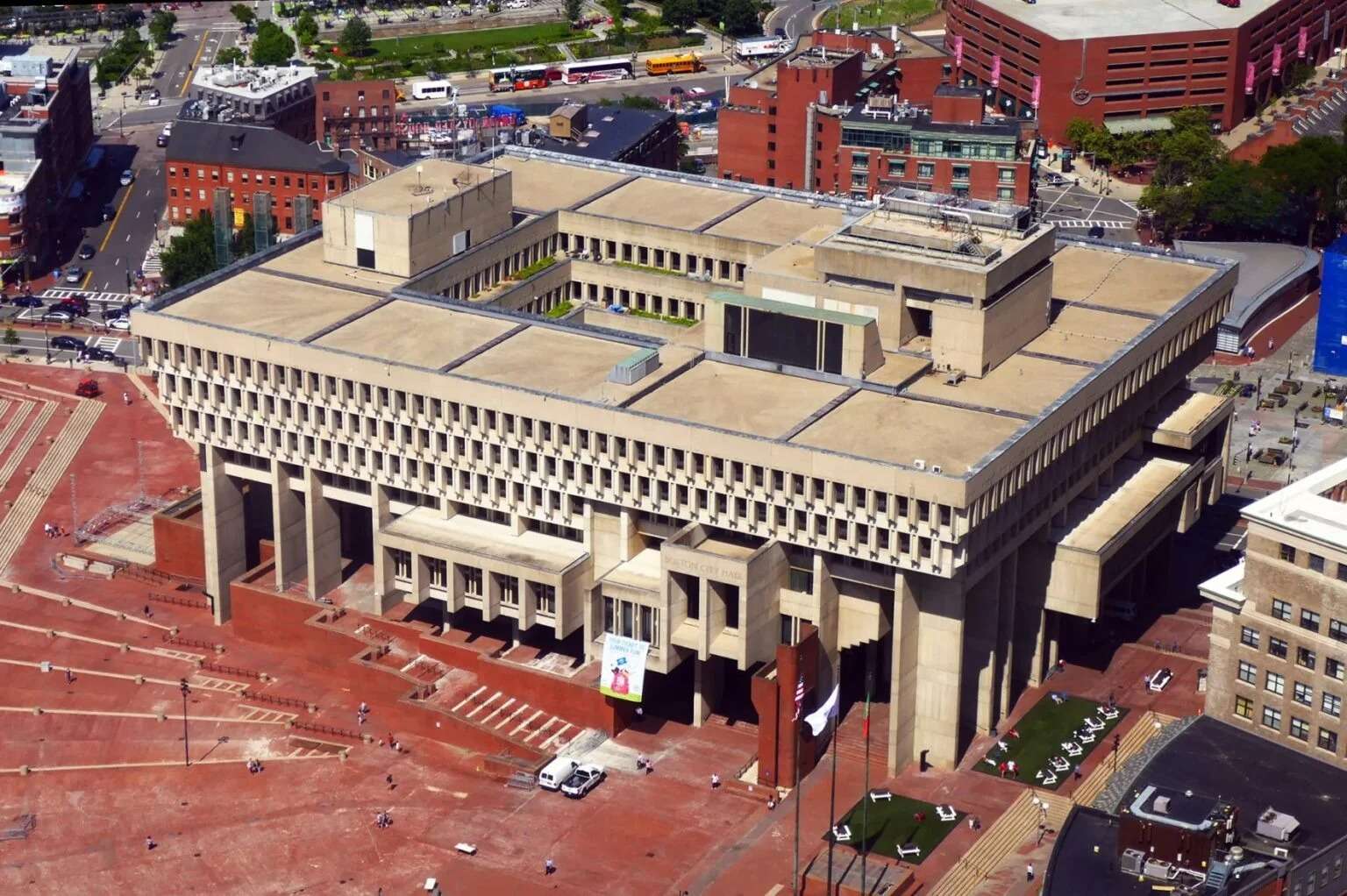
July 3, 2026 July 3, 2026 Home » Buildings » The Boston City Hall Building and Reframing the Relationship between Power and Public Space The silent hierarchy and the dismantling of mass present the mass of the City Hall building as a structural system that reinterprets the traditional model of municipal buildings, where the exterior facade reflects the structure of the internal program with three levels. The lower level consists of exposed concrete and brick to establish a functional base that accommodates direct public services, while the deep cantilevers and recessed openings in the middle highlight the spaces associated with the higher representative and administrative functions of the council and mayor. At the top, administrative offices are arranged in a repetitive rhythm of concrete frames, giving the façade a clear class reading of the functional structure without the need for direct explanatory signals.
The roughness of the concrete and the mass configurations control the formation of light and shadow on the exterior surface, giving the building a variable character that changes with the movement of the sun throughout the day. The urban experience begins at City Hall Plaza, which extends as an open space that visually and at a level merges with the building's floor, reducing the traditional separation between the exterior civil space and the institutional interior. Inside this transition, a clear contrast is generated between the expansiveness of the exterior plaza and the compression of mass at entry points, creating an experience that blends the institutional character of the place with a sense of proximity to the public space.
The structural organization of the building reflects its division into three main functional areas that are directly translated onto the facade. Public services occupy the ground level within a base of brick open to the public, while representative functions are manifested on the middle level through prominent concrete frames that distinguish the council chamber and mayor's office. The upper floors host administrative offices within a more regular facade with a repeated rhythm of openings, making the facade a direct reading of the building's functional sequence.
City Hall Plaza plays a mediating role between the city and the building, as the extension of the paving continues inward to reach the public reception hall, creating a physical and visual continuity between the urban space and the administrative area. The lower levels transform into an internal civic space organized by corridors, ramps, and stairs, guiding the experience of transition between different access levels. The hall takes on a dynamic character due to the interplay of solid materials with movement and light paths, enhancing the sense of spaciousness and connection to the urban surroundings.
The fifth floor contains the symbolic center of the building, where the functions of the mayor and city council are externally translated through prominent concrete frames that define their presence within the mass. This configuration results in a direct visual relationship between these functions and the public square below. In contrast, the upper floors appear as a more regular administrative layer, while the size of the building gradually projects outward as it rises, enhancing the sense of mass and deepening the contrast between the protruding masses and recessed openings.
The materials used define the identity of the building and its visual and spatial experience, as the rough concrete, brick, and glass with their metal frames give it a direct character that reflects the severity of architectural expression. The concrete surfaces reveal traces of molds and construction, grounding a sense of belonging to the brutalist approach and transforming the facade into a surface that interacts with light and shadow, emphasizing the construction process as part of the architectural expression itself.
The internal organization relies on the same structural logic as the facade, emphasizing construction materials and functional clarity. The public spaces are made of brick, concrete, and stone tiles, designed to facilitate movement and transit within the building. In contrast, the upper floors depend on flexible office divisions using glass partitions. The council chamber stands out as a central space that enhances the relationship between the public and officials through direct visual organization of seats around the working platform, reflecting the principles of functional design for public spaces.
The building received widespread critical acclaim upon completion as a prominent model of brutalist civic architecture, noted for its functional clarity and expressive strength. In contrast, it sparked public controversy due to its heavy massing character that aroused...