
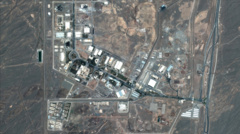
BBC News, Arabic Go to content Main Watch Listen Main Sections News Economy Health and Science Culture and Arts World Cup 2026 Investigations News Economy Health and Science Culture and Arts World Cup 2026 Investigations Satellite images reveal for the first time the extent of damage to Iranian nuclear and military facilities. Image source, Reuters
For the first time, the extent of damage to some military and nuclear sites in Iran has been revealed, following the release of over a quarter million high-resolution satellite images that were previously subject to publishing restrictions.
Planet Labs, one of the leading satellite image providers, has made access to images of around 800 sites in Iran available again, after previously imposing restrictions in response to a request from the U.S. government.
The BBC’s verification unit analyzed satellite images taken of two key sites, Isfahan and Bushehr, since the imposition of restrictions on March 9.
According to military intelligence firm Janes, the images show a range of targets that have been bombed, including ammunition storage areas, ballistic missile infrastructure, nuclear sites, surface-to-air missile systems, and naval bases.
Video footage previously documented these sites being hit by American and Israeli strikes, but the newly released images provide a more detailed view of the targets hit and the extent of damage done.
Satellite images show that several sites around the coastal city of Bushehr have either been damaged or entirely destroyed since March 9.
According to Janes, there are clear damages to military buildings and government facilities, including aircraft hangars, ammunition storage areas, docks, maritime berths, and missile launch sites, with the damaged sites belonging to the Iranian government and the Islamic Revolutionary Guard Corps.
The images show collapsed roofs of many buildings, while some appear to have been completely leveled, with other images revealing destroyed aircraft and sunken ships.
There are also craters from explosions on several aircraft runways, including runways at Bushehr International Airport, which have been partially repaired since.
In some areas identified on electronic maps, such as "OpenStreetMap," as military zones, nearly all buildings were destroyed.
Jeremy Binnie, a defense and Middle East specialist at Janes, stated that the scope of damage "aligns with what the United States and Israel have reported regarding the execution of a wide-ranging strike campaign, which targeted not only deployed forces but also the infrastructure supporting them."
He added that construction and maintenance workshops at one of the military naval bases have also been damaged.
Images taken of Isfahan province, which contains two nuclear facilities in the cities of Isfahan and Natanz, showcase the extent of damage to military infrastructure.
The images show clear damages in buildings within military bases in the area, and according to Janes, a building identified by the firm as an ammunition storage area belonging to an airbase suffered damages at the eighth air base in Shahrikhari, which is considered strategically important.
The images show that more than 60 facilities suffered significant damage or were completely destroyed at a military base south of the city of Isfahan.
Strikes also hit around 12 other facilities at a military base located to the south of the province, near the town of Baharestan.
The decision to restrict access to the images has sparked controversy, limiting journalists’ and humanitarian organizations’ abilities to assess the impacts of the American-Israeli war on Iran, including the extent of damage to military targets and civilian infrastructure.
Restrictions on Planet’s images remain in place across much of the Middle East, including Iraq, Lebanon, Israel, and Gaza.
The company, based in California, stated that "delays remain in other parts of the region, and we will continue to manage distribution to those areas, in line with ongoing concerns regarding national security and individual safety."
In the absence of Planet services, its clients from news organizations such as the BBC and The New York Times have turned to solutions outside the United States.
00:30 Video ,…