
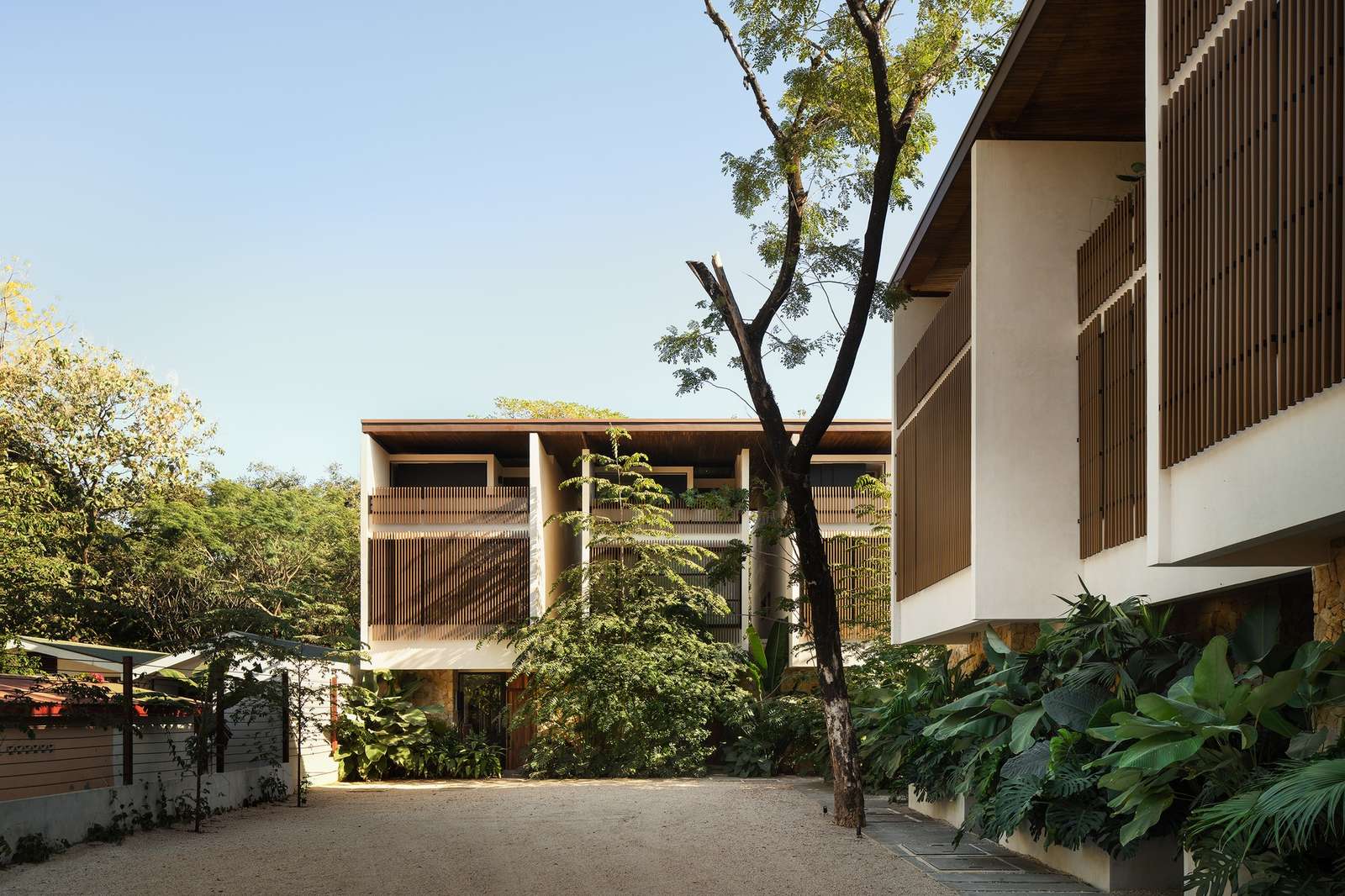
July 4, 2026 July 4, 2026 Home » Projects » El Molino Project Integrates Natural Ventilation within the Site's Urban Organization The debate between space and mass: the formulation of the integrated urban fabric goes beyond the design proposal for the “El Molino” project to redefine the concept of the traditional residential complex as a spatial system seeking to balance building density and environmental openness. The site's organization through two elongated architectural volumes creates a visual and kinetic dialogue; these masses do not act as solid barriers but as tools to direct the spatial flow and draw the surrounding nature inwards. The experience of passage and movement is generated through a series of interstitial courtyards and external circulation paths that transform daily mobility from a mere mechanical function into a conscious human experience affected by changing shadows and the continuous movement of air resulting from the careful orientation of the masses.
The relationship between private spaces and the natural landscape is defined by an architectural language based on gradation and transparency. This is clearly evident in the treatment of the facades, where wooden screens and architectural setbacks play a dual role; they give users control over privacy levels while simultaneously acting as dynamic filters for bright coastal light. The sun's path intersects with these wooden elements, creating a shifting scenography of light and shadow within the residential units, generating a calm and orderly visual environment that psychologically aligns with the majestic presence of the adjacent natural reserve, establishing an outdoor living pattern without compromising thermal comfort.
The vertical organization of the project relies on a sharp functional separation but is scenographically integrated through a continuous spatial sequence; while the lower floors settle as a social base integrating living rooms and kitchens with private beach pools, the upper floors ascend towards nature to host the bedrooms. The user experiences the moment of entry and passage through a continuous movement channeled by external corridors and recessed terraces and shaded transitional spaces. This design stimulates the psychological and physical response to the place, transforming movement into a conscious experience that is mentally and sensorially connected to the external natural landscape and the surrounding vegetation canopy, emphasizing the flexibility of the architectural space.
The materials in this architectural formation shift from mere dry cladding to tools for vital interaction with the dense tropical environment; local stone, warm wood cladding, and exposed structural surfaces collaborate with deep eaves to create a balanced visual language. Wooden slats act as filters that regulate privacy and exposure to sunlight, generating a continuously changing rhythm of shadows on the facades throughout the day. This tectonic treatment is inseparable from environmental analysis; the separation between architectural volumes allows natural ventilation to flow freely across all levels, reducing heat gain and establishing a comfortable physical environment that relies on passive design solutions rather than mechanical systems.
The El Molino project redefines mass housing as a balance system between solid and space, through two linear masses that organize air and visual flows and redefine movement as a climatic reading. The courtyards and shaded paths become an intermediate structure that links the interior with the exterior, within an architectural framework that treats housing as a climate-responsive structure rather than a static container, redistributing density as a flexible urban fabrication tool while redefining the relationship between mass and space.
However, this proposition exaggerates the independence of passive climatic performance, assuming that transparency and external shading are sufficient to control the internal environment without operational constraints. Yet, the humidity of the climate, wood decay, and the need for mechanical support systems reveal the limits of this ideal model. The discourse here shifts towards an aesthetic distinction closer to producing market value in luxury housing design projects rather than being an innovation with generalizable potential and clear applicative limits.